
The Honest Timeline, What Makes Them Worse, and How to Heal Faster
| Quick Answer
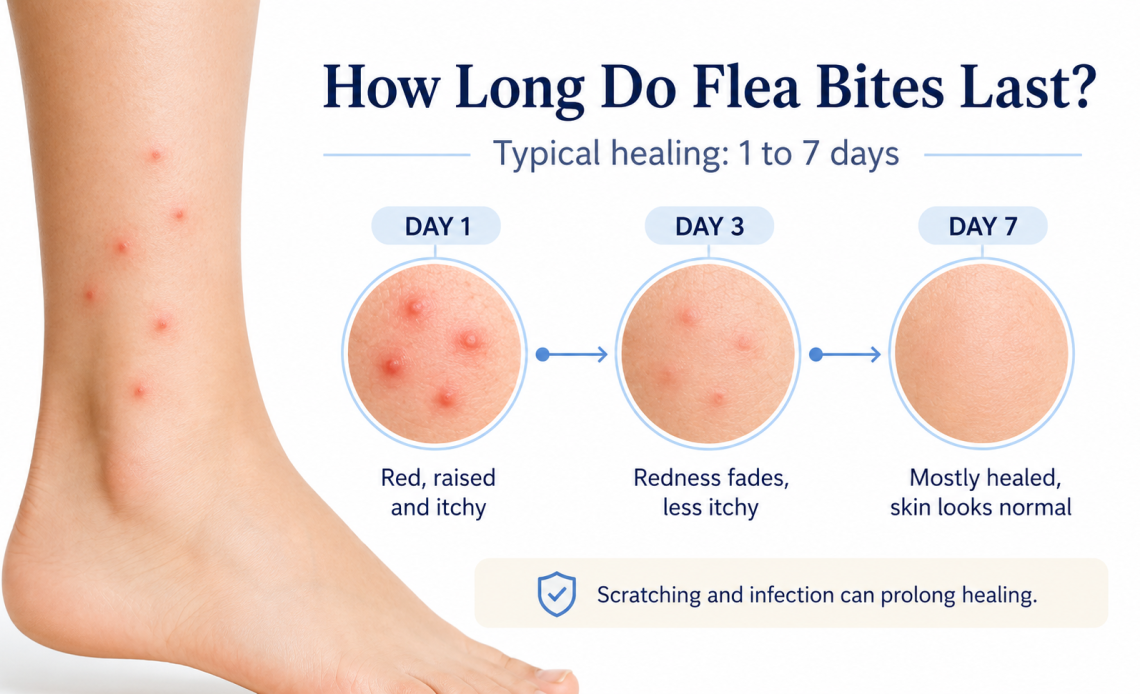
Flea bites on humans typically last between one and seven days. Mild bites with no scratching can heal in as little as one to two days. If you scratch them, have sensitive skin, or develop an allergic reaction, they can linger for one to two weeks — and infected bites can take four to six weeks to fully resolve. The single biggest factor that extends healing time is scratching. |
Flea Bites at a Glance — Everything You Need in One Table
| Factor | Details |
| What They Are | Small red bumps caused by flea saliva injected under the skin to prevent blood clotting |
| Typical Duration | One to seven days for most people; up to two weeks if scratched or allergic |
| Infected Bite | Four to six weeks to fully heal; may require antibiotics |
| Where They Appear | Ankles, lower legs, waist, armpits, elbows, knees — anywhere clothes fit tightly or skin folds |
| What They Look Like | Small, dark red bumps with a tiny red dot at the centre; appear in clusters or lines |
| Main Symptom | Intense itching — begins within hours and peaks around 24 hours after the bite |
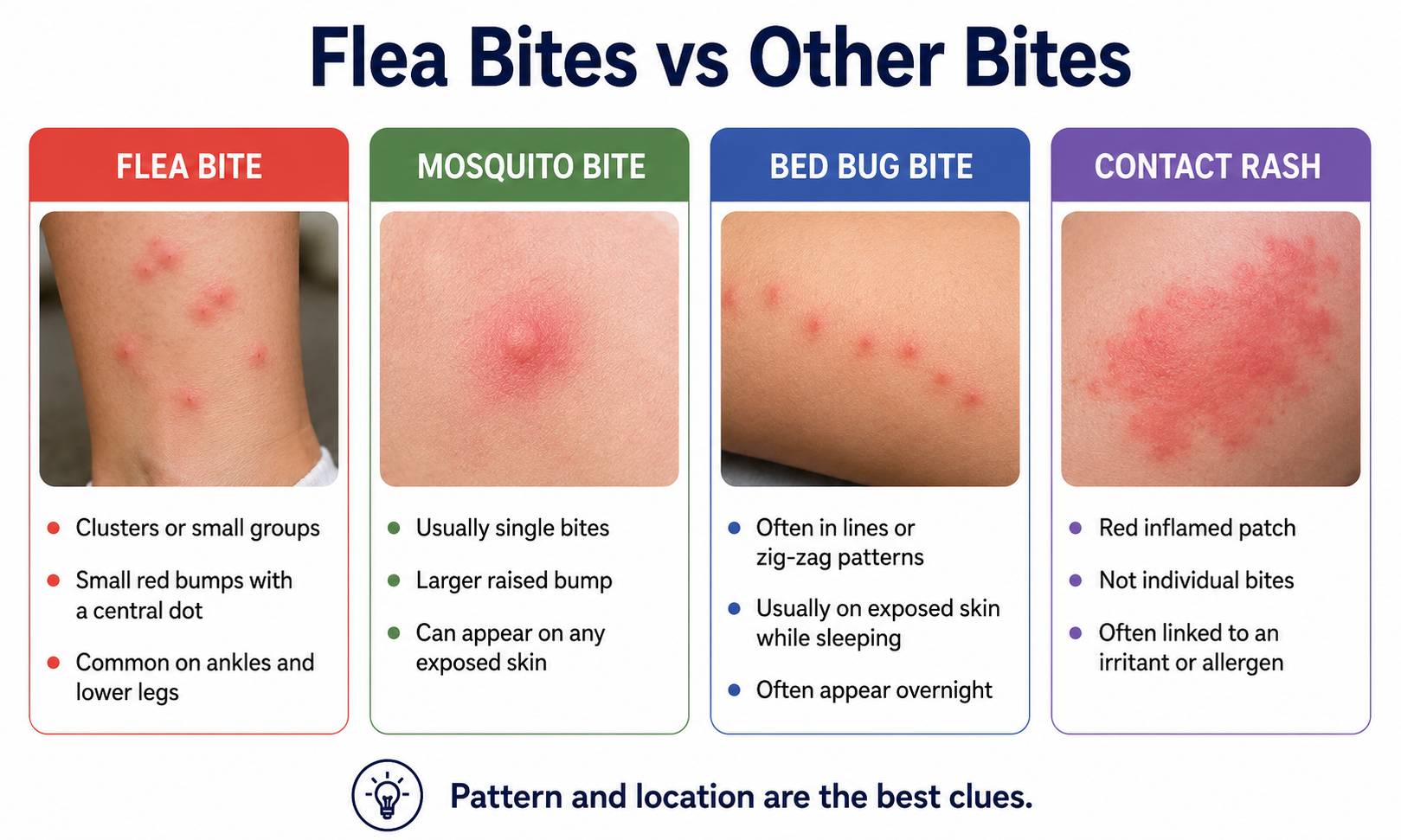
| Healing Stages | Wheal (minutes) → Papule / raised bump (12–24 hrs) → Fading (day 2–3) → Gone (day 5–7) |
| What Slows Healing | Scratching, sensitive skin, allergic reaction, ongoing flea exposure, infection |
| What Speeds Healing | Keeping clean, antihistamines, hydrocortisone cream, cold compress, no scratching |
| Unusual Cases | In rare cases, some people experience bites lasting months or over a year — sometimes misdiagnosed as skin conditions |
| In Dark Skin Tones | Flea bites can leave dark marks (post-inflammatory hyperpigmentation) that linger after the bite has healed |
| When to See a Doctor | Signs of infection, severe allergic reaction, fever, difficulty breathing, symptoms lasting over two weeks |
| Biggest Mistake | Scratching — breaks the skin, causes infection, and can extend healing from days to weeks |
Still Itching Three Days Later? You Are Not Imagining It.
You noticed the bites on your ankles yesterday morning. Or maybe you woke up with a cluster of red bumps and have been scratching ever since. Either way, the question is the same: how long is this going to last, and is there anything you can actually do to make it stop faster?
Flea bites are one of those things that feel more dramatic than they are. The itch is intense, the bumps look alarming, and the frustration of not being able to scratch is genuinely difficult. But for most people, they clear up within a week, often faster if you know what to do and what not to do.
So, how long do flea bites last? This guide breaks down the honest timeline, the stages a bite goes through, every factor that affects how long it sticks around, and the practical steps that actually speed up healing, not generic advice, but specific things that work.
Why Do Flea Bites Itch So Much in the First Place?
When a flea bites you, it injects saliva into your skin. That saliva contains an anticoagulant — a substance that prevents your blood from clotting so the flea can feed more efficiently. Your immune system detects the foreign protein in that saliva and triggers a histamine response.
Histamine is what causes the swelling, redness, and most critically — the itch. The more sensitive your immune system is to flea saliva, the stronger and longer-lasting that response will be. Some people barely react. Others develop intensely itchy welts that last days. A small group has what is called papular urticaria — a hypersensitivity reaction that can cause ongoing raised bumps for weeks with continued exposure.
The key point: the bite itself is not doing the damage. Your own immune response is. That is why people with the same number of bites can have completely different experiences — it is not about how many fleas bit you, it is about how your body reacts to the saliva.
What Are the Stages of a Flea Bite — And How Long Does Each Last?
A flea bite does not arrive fully formed and then disappear all at once. It moves through distinct stages, and knowing which stage you are in tells you whether things are progressing normally or getting worse.
| Stage | When It Happens | What You See / Feel | Normal Duration |
| Wheal | Immediately after the bite — within minutes | A raised, slightly itchy bump. Not intensely uncomfortable. The area around it may redden. Easy to miss if you are not looking. | Fades within a few hours — usually completely gone within 12 hours |
| Papule | 12 to 24 hours after the bite | A hard, raised, dark red bump replaces the wheal. This is where the intense itching lives. It can be swollen and may have a tiny dark dot at the centre. | Peaks at 24 hours. Begins fading on day two. Often barely visible by day three if you have not scratched it. |
| Resolution | Day two onwards | The bump flattens and fades. Itching decreases. Skin colour gradually returns to normal. | Typically complete within five to seven days for most people |
| Post-inflammatory mark | After the bump resolves — more visible in darker skin tones | A flat dark spot where the bump was. Not raised. Not itchy. Just discoloured. | Can take weeks to months to fully fade — not the bite itself, just residual pigmentation |
| Infected bite (if scratched) | Can develop at any point if the skin is broken | Increasing redness, swelling, warmth, pus, or the bite getting worse instead of better. | Four to six weeks with treatment; longer without |
What Makes Flea Bites Last Longer Than They Should?
Two people can be bitten by the same flea at the same time and have completely different healing timelines. These are the variables that actually determine how long yours sticks around.
| Factor | How It Affects Duration | What You Can Do |
| Scratching | The single biggest delay. Breaks skin, introduces bacteria, causes infection. Can turn a three-day bite into a three-week problem. | Treat the itch directly with antihistamines or hydrocortisone cream — address the root cause, not the symptom |
| Allergic sensitivity | People with sensitive immune systems react more intensely and for longer. Some develop papular urticaria — a hypersensitivity where bumps reappear or persist for weeks. | Oral antihistamines reduce the allergic response, not just the itch. Cetirizine or loratadine work well. |
| Skin type | Sensitive or reactive skin prolongs the inflammatory response. Darker skin tones may experience post-bite hyperpigmentation lasting weeks. | Keep the area moisturised and avoid irritants during healing |
| Ongoing flea exposure | This is the most underestimated factor. If fleas are still in your home, you are being re-bitten constantly. Bites appear to linger when you are actually getting new ones on top of old ones. | Treat the infestation simultaneously — treating your skin without treating the environment is pointless |
| Infection | Extends healing from days to four to six weeks. Usually caused by bacteria entering through scratched or broken skin. | Keep clean, apply antiseptic, see a doctor if pus or spreading redness develops |
| Location on the body | Bites in skin folds or high-friction areas (ankles, waistband) tend to linger longer because of ongoing irritation from movement and clothing. | Keep clothing loose around affected areas during healing |
Is That Actually a Flea Bite — Or Something Else?
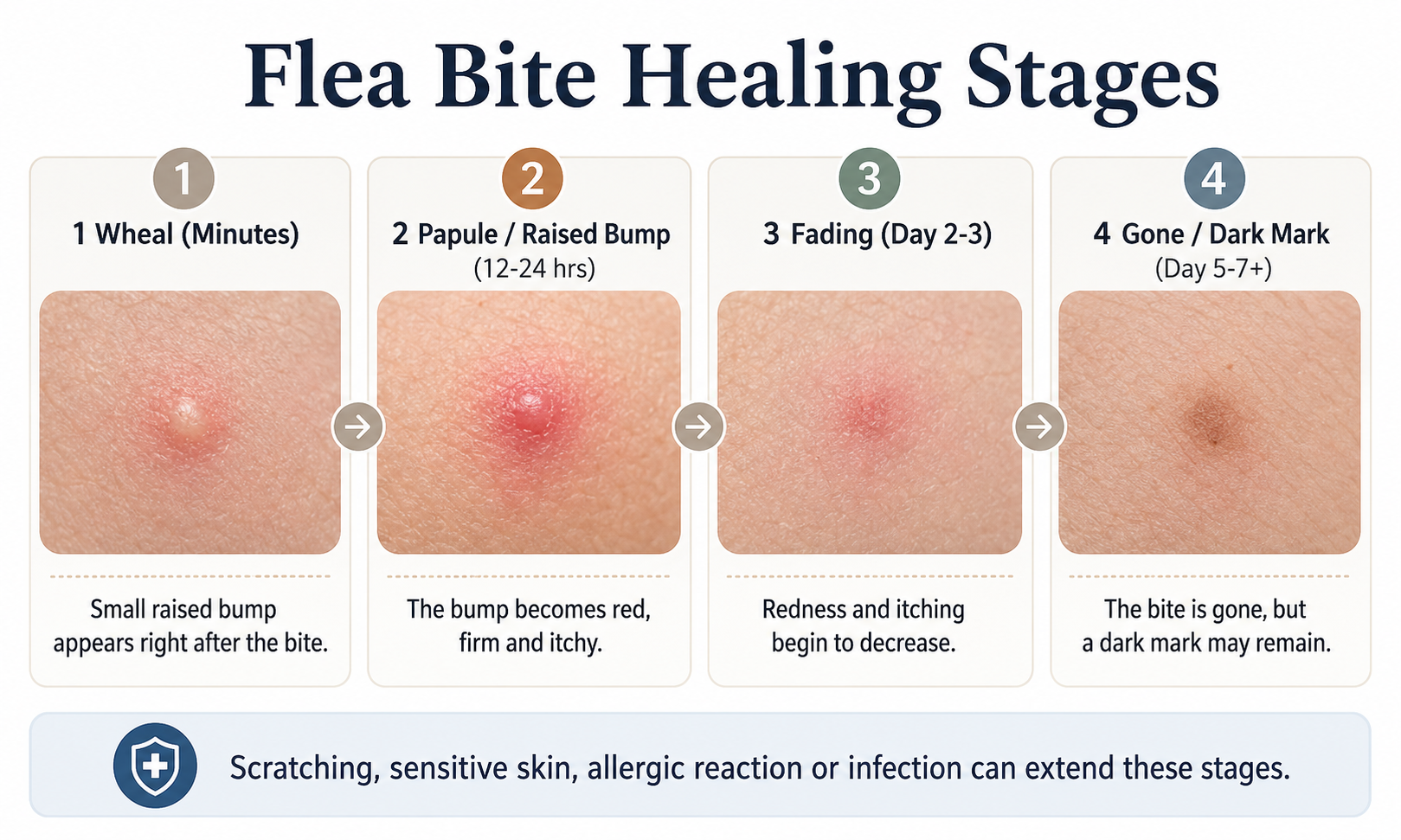
Flea bites are often confused with mosquito bites, bed bug bites, and skin conditions like eczema or hives. The pattern and location are your best clues.
| Bite Type | Pattern | Typical Location | Key Difference |
| Flea Bite | Clusters or random groups, small dark red bumps with a central dot | Ankles, lower legs, waist, skin folds | Very itchy; appear in clusters; pets usually involved |
| Mosquito Bite | Single bites, spread out, larger bumps | Any exposed skin | Appear immediately; no central dot; larger individual welt |
| Bed Bug Bite | Lines or zig-zag patterns | Exposed skin while sleeping — arms, neck, face | Appear in lines; happen overnight; no pets required |
| Mite Bite | Random scatter, tiny red spots | Anywhere on body | Associated with dusty environments; no jumping insects |
| Contact Dermatitis | Spreading rash, not individual bumps | Where skin contacted the irritant | Not in clusters; no central dot; linked to a product or plant |
How Do You Make Flea Bites Heal Faster? — What Actually Works
You cannot reverse a bite once it has happened, but you can significantly shorten how long it bothers you by managing the immune response correctly. Here is what works, in order of impact.
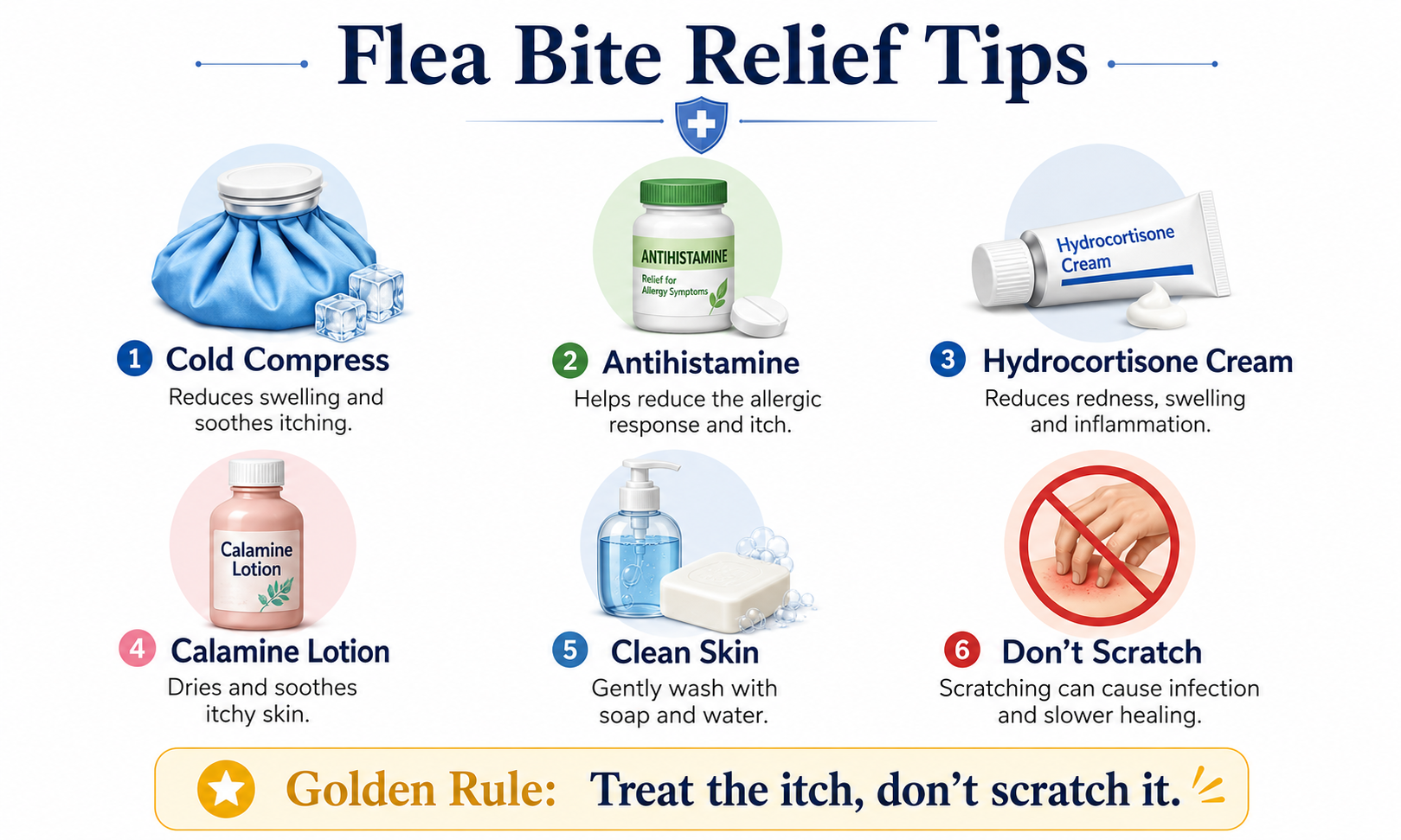
- Take an oral antihistamine immediately. Antihistamines like cetirizine (Zyrtec), loratadine (Claritin), or diphenhydramine (Benadryl) reduce the histamine response that is causing the swelling and itch. Taking one early — not waiting until the itch is unbearable — reduces the peak intensity and shortens the overall duration. Diphenhydramine also causes drowsiness, which is helpful if the itching is keeping you awake.
- Apply a cold compress first, then topical treatment. Cold reduces blood flow to the area, which reduces histamine release and brings down swelling. Use ice wrapped in cloth (not directly on skin) for ten to fifteen minutes. Follow with one percent hydrocortisone cream or calamine lotion directly on the bite to reduce inflammation and itch at the skin level.
- Wash the area with soap and water — do not rub. Clean the bite gently as soon as you notice it. This reduces bacterial load on the skin surface and lowers the risk of infection if you scratch later. Pat dry rather than rubbing, which re-irritates the area.
- Do not scratch. Seriously. This sounds obvious but almost everyone does it anyway. Scratching re-triggers the wheal response — the bite comes back more raised and more itchy. It also breaks the skin, which introduces bacteria and is the most common cause of flea bite infections. If the urge is overwhelming, press firmly on the bite without scratching — pressure provides some relief without breaking skin.
- Address the flea infestation at the same time. If fleas are still in your environment, you will keep getting new bites. Many people think their bites are not healing when they are actually being re-bitten every night. Treat your pet with vet-recommended flea treatment. Vacuum carpets, rugs, and upholstered furniture. Wash all bedding in hot water. Repeat treatment every five to ten days for at least two cycles to break the flea life cycle.
- Use aloe vera gel for overnight calming. Aloe vera has anti-inflammatory properties and is one of the better evidence-adjacent home remedies for itchy bites. It does not replace antihistamines for severe reactions, but applied overnight it can reduce morning redness and calm the skin between applications of topical cream.
What Do People Keep Getting Wrong About Flea Bites?
- “It will heal faster if I scratch it.” The opposite is true. Scratching re-triggers the inflammatory response, can bring back the raised wheal, and breaks the skin surface — introducing bacteria and causing the infection that extends healing from a few days to several weeks. The itch feels satisfying to scratch in the moment and dramatically worse shortly after.
- “My bites are taking weeks to heal — they must be infected.” Not necessarily. The most likely explanation for bites that seem to linger is ongoing re-infestation. If fleas are still present in your home, you are getting new bites on top of healing old ones. It looks like one long healing process, but it is actually multiple waves of new bites. Address the environment first.
- “Flea bites only happen on legs and ankles.” Fleas jump from the ground, which is why ankles and lower legs are the most common sites. But they can bite anywhere on the body — particularly in areas where clothing fits tightly (waistband, socks, bra straps) because the fabric keeps them close to the skin. Clusters in body folds or under tight clothing are still flea bites.
- “If I have no pets, I cannot have fleas.” Fleas can come from wildlife outside, from a previous tenant’s infestation in a new home, or from a pet you recently visited. They can survive in carpets and soft furnishings for months without a host. No pets does not mean no fleas.
- “Biting insects only leave one bite at a time.” Fleas typically bite multiple times in one session. The clustered pattern of three or more bites close together is sometimes called breakfast, lunch, and dinner — because the flea feeds, moves slightly, feeds again. The cluster pattern is one of the key identifiers of a flea bite rather than a mosquito bite.
Which Treatment Works Best — A Side-by-Side Look
| Treatment | Best For | Pros | Cons |
| Oral Antihistamine | Moderate to strong reactions; multiple bites; sensitivity | Addresses the immune response directly; reduces overall inflammation; available OTC; works within an hour | Some (diphenhydramine) cause drowsiness; not suitable for everyone; does not treat the bite topically |
| Hydrocortisone Cream (1%) | Localised itch and swelling on individual bites | Directly reduces skin inflammation; fast-acting topically; widely available | Short-term use only; not suitable for broken or infected skin; should not be used on the face without medical advice |
| Calamine Lotion | Mild reactions; children; those wanting a gentle option | Cooling and soothing; safe for all ages; no side effects at typical use | Less potent than hydrocortisone; needs frequent reapplication; drying to skin |
| Cold Compress | Immediate relief; reducing acute swelling | Immediate and free; no side effects; can be combined with any other treatment | Temporary relief only; does not address the underlying histamine response |
| Aloe Vera Gel | Mild reactions; overnight calming; preference for natural options | Anti-inflammatory; soothing; widely available; can be used freely | Less powerful than medicated options for strong reactions |
| Prescription Steroid Cream | Severe or persistent allergic reactions not responding to OTC options | Stronger anti-inflammatory effect than OTC options; faster resolution of severe bites | Requires a doctor’s visit; not for long-term use; potential side effects with overuse |
| When to Seek Medical Attention
See a doctor or seek urgent care if you notice: spreading redness or red streaks around a bite (signs of infection), pus or the bite getting worse after two or three days, fever, headache, or body aches after being bitten, severe swelling in the face or throat, difficulty breathing, or dizziness (signs of anaphylaxis — call emergency services immediately). Flea bites can in rare circumstances transmit diseases including typhus, so systemic symptoms are not something to dismiss. |
Still Confused? Here Are the Answers to What People Keep Searching
Can flea bites last for months? Yes, in rare cases. Some people with hypersensitivity develop papular urticaria — a condition where the immune system reacts severely to insect bites, causing bumps that reappear or persist for months. These are sometimes mistaken for skin conditions or even lesions. If bites appear to last longer than two to three weeks without any improvement, see a dermatologist.
Why do flea bites itch more at night? Your body temperature rises slightly in bed and blood flow increases to the skin surface, which intensifies the histamine response and the itch. The quiet and reduced distraction at night also means you notice the itch more acutely. Taking an antihistamine before bed (diphenhydramine in particular causes drowsiness) helps with both the itch and the sleep disruption.
Do flea bites leave scars? Scars can result from infected flea bites, particularly if they were picked at or developed into open wounds. Bites that healed without infection rarely leave permanent scars. In darker skin tones, post-inflammatory hyperpigmentation (a flat dark mark) can remain for weeks to months after the bite has resolved — this is not a scar but a pigmentation response that typically fades with time.
Why does one person in the family get bitten and not others? Fleas are attracted to warmth, carbon dioxide, and vibration — but individual skin chemistry, blood type, and body heat all influence attractiveness to fleas. Some people are also significantly more reactive to flea saliva than others. It is genuinely possible for one person in a household to be bitten frequently while another in the same room barely reacts or does not appear to attract the fleas at all.
Is it safe to use hydrocortisone cream on flea bites on children? Low-strength OTC hydrocortisone (one percent) is generally considered safe for short-term use on children over two years old. For younger children or for use on the face, check with a pharmacist or doctor first. Calamine lotion is the gentler alternative for young children and is safe across most ages.
What if I keep getting bitten even after treating the house? Fleas have a life cycle that includes egg, larval, pupal, and adult stages. Most treatments kill adult fleas but not pupae. Pupae can survive in carpets and soft furnishings for months and hatch in response to warmth and vibration. This is why repeated treatment — at least twice, five to ten days apart — is necessary. Vacuuming regularly and washing bedding in hot water between treatment cycles is essential to fully disrupt the cycle.
The Part Nobody Talks About — What Actually Extends Your Healing Time
Most guides focus on treating the itch. What they miss is the environment problem — and it is the most common reason people feel like their flea bites are not healing.
If fleas are still active in your home, you are not watching one set of bites slowly get better. You are watching old bites fade while new bites appear at the same time. From your perspective, the bites look like they are persisting for weeks. In reality, the skin is healing on a normal timeline — you are just being re-bitten every night.
Flea eggs, larvae, and pupae live in soft surfaces — carpet fibres, furniture seams, pet bedding. Adult fleas make up only about five percent of the total flea population in an infested home at any given time. So even after you have treated your pet and stopped seeing adult fleas jumping, the eggs and larvae in your carpet are still developing. This is why bites seem to mysteriously continue for weeks after you have done something about it.
Most people do not realise that a flea pupa can survive dormant for several months in a cocoon, waiting for vibration, warmth, and carbon dioxide that signals a host has arrived. You can move into an empty flat that has been vacant for three months and experience a sudden flea infestation the first week because your presence triggered hatching of dormant pupae left by the previous occupant’s pet.
The Bottom Line — Here Is Exactly What to Do
Most flea bites last between three and seven days. They heal faster when you resist scratching, treat the itch with antihistamines and topical creams from day one, and deal with the flea infestation in your environment at the same time.
If your bites seem to be persisting longer than a week without improvement, the most likely explanation is that you are still being bitten — not that your skin is particularly slow to heal. Treat the environment: vacuum thoroughly, wash all bedding in hot water, and apply a vet-recommended flea treatment to your pet.
See a doctor if you notice pus, spreading redness, a bite that is getting worse rather than better, or any systemic symptoms like fever. Those are signs of infection or an allergic response that needs medical attention — and they are straightforward to treat if caught early.
The Flea Bite Healing Framework — Where Are You in the Process?
| Day | What Is Normal | Red Flag Signs | What to Do |
| Day 1 | Raised red bump, intense itch. May appear in clusters of three or more. | Severe swelling, difficulty breathing, hives spreading rapidly | Antihistamine, cold compress, hydrocortisone cream. Do not scratch. |
| Day 2–3 | Bump still present but beginning to flatten. Itch at its worst around the 24-hour mark, beginning to reduce. | Bite is getting larger, more swollen, or warmer | Continue antihistamine if needed. Keep area clean. Aloe vera gel at night. |
| Day 4–5 | Bump noticeably smaller. Itching mild or occasional. Skin returning to normal colour. | Pus, red streaks, increasing pain | Gentle moisturiser. If not improving, see a doctor. |
| Day 6–7 | Most bites resolved or barely visible. Residual mark possible in darker skin. | Still raised, swollen, or itchy at day seven | See a doctor — could be infected or hypersensitivity reaction. |
| Beyond 1 week | Flat dark mark fading slowly (normal). No itch or swelling. | Still itchy, raised, or spreading | Medical assessment — ongoing exposure, infection, or papular urticaria possible. |
Myth vs. Reality — The Short Cheat Sheet
| Myth | Reality |
| Scratching flea bites helps them heal faster | Scratching re-triggers inflammation, breaks skin, and is the most common cause of flea bite infections — it extends healing, not shortens it |
| Bites lasting weeks mean something is seriously wrong | Usually means ongoing re-infestation — you are getting new bites while old ones heal, not one bite taking unusually long |
| You only get flea bites if you have pets | Fleas can come from wildlife, previous occupants, or infested environments with no pet required |
| Flea bites only appear on ankles and legs | They appear anywhere — ankles are most common because fleas jump from the ground, but tight clothing and skin folds anywhere attract them |
| One treatment round kills all the fleas | Adult fleas are only five percent of a flea population — eggs and larvae survive and hatch. Repeat treatment every five to ten days for at least two cycles |