
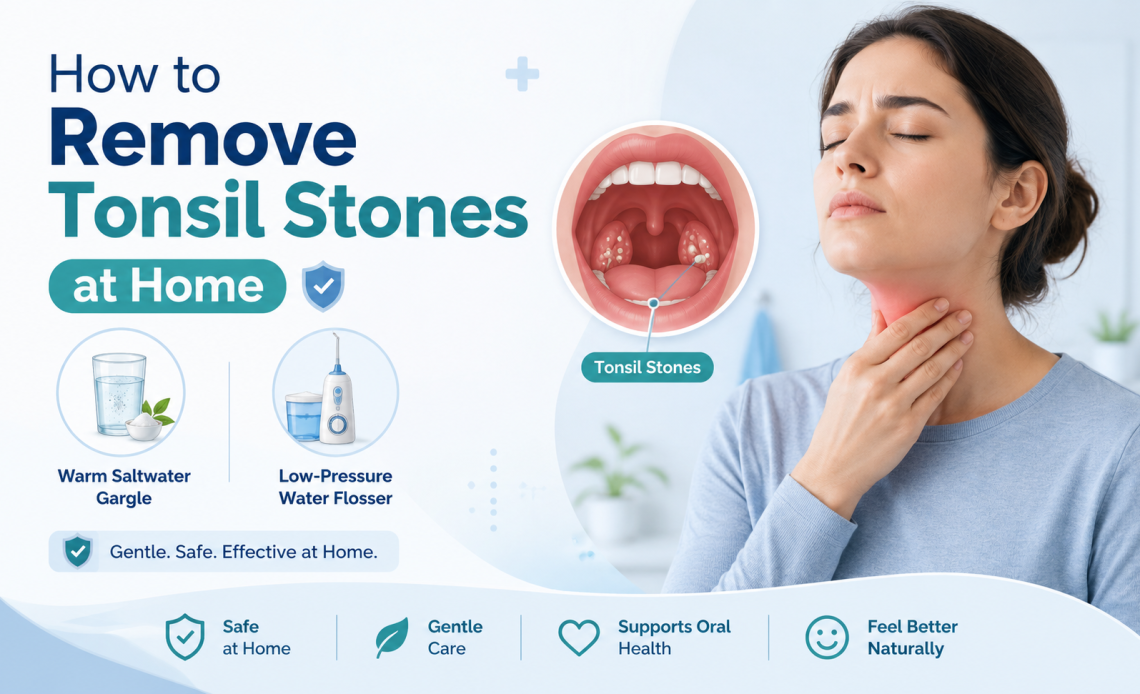
What actually works, what to avoid, and when it’s no longer a DIY job
Quick Answer
Learning how to remove tonsil stones at home usually starts with gentle methods like gargling with warm saltwater, coughing forcefully, or using a water flosser on a low setting aimed at the visible stone. Never dig at them with your fingers, a toothbrush, or anything sharp, because tonsils are delicate and easily injured. If a stone will not budge, or you have real pain or swelling, that is a sign to see a doctor or dentist instead of forcing it.
That “Something’s Stuck Back There” Feeling
You catch a whiff of bad breath that won’t go away no matter how much you brush. Or you glance in the mirror and spot a small white speck tucked into the back of your throat.
That’s almost always a tonsil stone — and the instinct to immediately go digging for it with whatever’s nearby is exactly how people end up hurting themselves.
Here’s the actual safe way to deal with it, plus what to skip.
What’s Actually Going On Back There?
Tonsil stones (tonsilloliths) form when food particles, dead cells, mucus, and bacteria get trapped in small pockets on your tonsils called crypts, then harden over time.
They’re usually harmless, but they can cause bad breath, a scratchy throat, or a feeling like something’s lodged in the back of your mouth. Larger ones can make swallowing uncomfortable.
Anyone can get them, but they’re more common in people with deeper tonsil crypts, frequent tonsil infections, or chronic dehydration — it’s not necessarily a sign of poor hygiene.
The Safe Removal Methods, Step by Step

- Saltwater gargle — dissolve 1 teaspoon of salt in a cup of warm water, gargle for 15–30 seconds, and repeat a few times. This often loosens stones on its own.
- Forceful coughing — take a deep breath and cough firmly 6 to 10 times in a row. Smaller stones sometimes dislodge this way, with no tools involved.
- Water flosser, low setting — lean over a sink, set the flosser to its lowest pressure, and aim the stream at the visible stone for about 20 seconds. Stop immediately if it hurts.
- Alcohol-free mouthwash rinse — swish twice daily to help kill bacteria around the stone. Skip alcohol-based mouthwash — it dries the throat and can make stones harder.
The One Method to Avoid (Even Though It’s Tempting)
It’s common advice online to “gently” push a tonsil stone out with a cotton swab or a clean finger. Ear, nose, and throat doctors generally advise against this.
Tonsil tissue is delicate and bleeds easily, and poking at it raises the risk of pushing debris deeper or introducing more bacteria — the opposite of what you want.
If a stone is visible but a gentle flosser stream or gargle won’t bring it out, that’s the line where it’s worth waiting it out or getting it removed professionally, rather than reaching for a tool.
When Coughing and Gargling Aren’t Enough
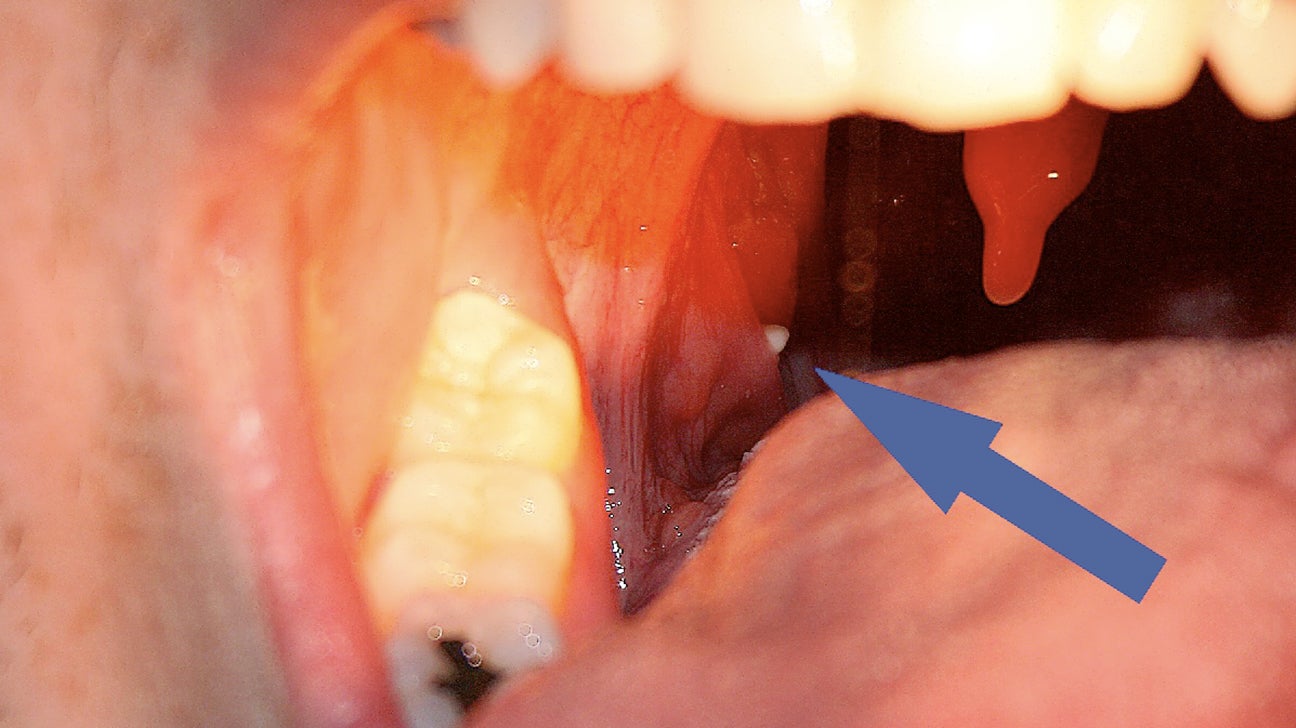
Someone notices a stone, gargles a few times over two days, and it still won’t move.
Instead of escalating to picking at it, the better move is a same-week dentist or ENT visit — they can remove it in minutes with sterile tools, with far less risk than DIY methods.
Common Mistakes People Make Trying to Remove Tonsil Stones
- Using a toothbrush or fingernail — these aren’t precise enough and often cause more irritation than removal.
- Cranking the water flosser to max pressure — this can bruise or injure tonsil tissue instead of just dislodging the stone.
- Giving up after one gargle — saltwater rinses often need to be repeated several times over a day or two to work.
- Using alcohol-based mouthwash daily — it dries out the throat, which can actually encourage new stones to form.
- Assuming it means bad hygiene — deep tonsil crypts are mostly anatomy, not a brushing problem.
Which Method Should You Try First?
| Method | Best For | Caution |
| Saltwater gargle | First attempt, any size stone | None — safest option, repeat as needed |
| Forceful coughing | Small, loose stones near the surface | Doesn’t work for everyone; stop if it irritates your throat |
| Water flosser (low setting) | Visible stones that gargling didn’t move | Use low pressure only; stop if it hurts |
| Professional removal | Stones that won’t budge, or recurring stones | Best option once home methods are exhausted |
How to Stop Them From Coming Back
- Gargle with saltwater after meals tonight — it flushes out the debris before it has time to settle into the crypts.
- Add a tongue scraper to your routine tomorrow morning — odor-causing bacteria collect on the tongue, not just the tonsils.
- Swap your mouthwash for an alcohol-free one — check the label next time you’re at the pharmacy.
- Keep a water bottle at your desk — staying hydrated keeps saliva flowing and debris from drying into stones.
- Mention recurring stones at your next dental visit — it’s worth flagging even if they don’t bother you much yet.
Can I Get Rid of Tonsil Stones Permanently on My Own?
Not always. If your tonsil crypts are naturally deep, stones can keep reforming no matter how consistent your home routine is. Frequent recurrence is a good reason to ask a dentist or ENT about longer-term options.
Do Tonsil Stones Mean I Have Bad Oral Hygiene?
Not necessarily. People with excellent hygiene still get them if they happen to have deeper tonsil crypts or a history of frequent tonsil infections.
Is It Safe to Swallow a Tonsil Stone?
Yes — if one comes loose and you swallow it, it’s harmless and will pass through your digestive system like any other small bit of debris.
How Long Do Tonsil Stones Usually Last?
Some fall out within days on their own. Others can sit for weeks if they’re lodged deeper in a crypt, which is when home methods become more worth trying.
When Should I Actually See a Doctor About This?
If you have real pain, swelling, trouble swallowing, or stones that keep coming back despite consistent home care, it’s time for a professional opinion rather than more DIY attempts.
What Most People Don’t Realize
Most people assume tonsil stones are a hygiene failure. ENT specialists say that’s largely a myth — some people simply have more pronounced tonsil crypts than others, the same way some people produce more earwax than others, without it meaning anything is wrong.
That reframe matters: it shifts the goal away from “fixing” something broken and toward simply managing a normal anatomical quirk with the right routine.
The Three-Tier Rule for Removing Tonsil Stones
A simple way to decide what to try, in order, without skipping straight to something risky:
- Tier 1 — No tools: saltwater gargles and forceful coughing. Always start here.
- Tier 2 — Gentle tools: a water flosser on the lowest setting, aimed carefully, for stones Tier 1 didn’t move.
- Tier 3 — Professional only: anything that hasn’t responded to Tiers 1 and 2 goes to a dentist or ENT — not to a sharp object at home.
Skipping straight to Tier 3-level tools at home (picks, fingernails, hard scraping) is where most avoidable injuries happen.
What Should You Do Next?
Start tonight with a warm saltwater gargle — it’s the safest first move and often enough on its own.
If a visible stone is still there after a day or two, try a water flosser on the lowest setting before considering anything more aggressive.
Avoid fingers, toothbrushes, or sharp tools entirely — if gentle methods don’t work, a quick dental or ENT visit is faster and safer than continuing to dig at it yourself.
Suggested Internal Links
Add these once the matching pages exist on your site, with descriptive anchor text:
- Link to a bad breath causes guide using anchor text like “what else causes persistent bad breath”
- Link to an oral hygiene routine guide using anchor text like “a daily routine for tongue and gum health”
- Link to a water flosser buying guide using anchor text like “choosing a water flosser with adjustable pressure”
External Sources
These back the methods and cautions used above:
- Cleveland Clinic — Tonsil Stones: Symptoms, Causes & Treatment
- Northwestern Medicine — Tonsil Stones 101
Technical & On-Page Checklist
- H1 uses the primary keyword once; H2/H3s cover steps and natural-language questions
- Entity/definition table skipped — this is a how-to query, not a definitional one
- Comparison table included for genuine decision-making value (method selection)
- Paragraphs kept to 2–3 lines; numbered steps used for the core how-to section
- One named framework included for differentiation (“Three-Tier Rule”)
- 2–3 internal link recommendations + 2 external authoritative links included
- Add at least one diagram/photo (e.g., labeled tonsil crypt illustration) with descriptive alt text before publishing