

The real drivers behind that thin, papery look — and what actually helps
Quick Answer
If you are wondering “What Causes Crepey Skin,” it happens when collagen and elastin, the proteins that keep skin firm and bouncy, break down faster than your body can replace them. The biggest driver is cumulative sun exposure, followed by natural aging, dehydration, weight fluctuation, and smoking. It is most noticeable on the arms, under the eyes, and on the neck, usually after age 40.
At a Glance
| Factor | Details |
| Topic | Crepey skin |
| Definition | Thin, finely wrinkled skin that looks and feels like crumpled crepe paper |
| Main Causes | UV exposure, natural aging, dehydration, weight fluctuation, smoking, genetics, some medications |
| Key Benefit of Knowing the Cause | Lets you target the actual driver instead of guessing with random creams |
| Risk if Ignored | Thinner skin bruises and tears more easily as it progresses |
| Best Use Case for Action | As soon as skin starts feeling papery — before laxity becomes advanced |
That Papery, Crinkled Look Isn’t Random
You notice it first on the back of your hand, or the underside of your arm — skin that suddenly looks thinner, finer, almost wrinkled like tissue paper.
It’s not the same as a wrinkle from smiling or squinting. It’s a different kind of aging, and it usually has a specific, identifiable cause behind it.
Once you know what’s actually driving it, the frustrating part — not knowing whether anything will help — gets a lot more manageable.
What Is Crepey Skin, Really?
Crepey skin describes a loss of structural support in the deeper layer of skin. Two proteins are responsible for that support: collagen, which keeps skin from sagging, and elastin, which lets it stretch and spring back into place.
When both proteins break down or thin out, skin loses its rebound. It becomes loose, finely lined, and noticeably more fragile than it used to be.
Why This Goes Beyond Appearance
Crepey skin isn’t only a cosmetic concern. As skin thins, it bruises more easily and can tear or break open from minor bumps that wouldn’t have caused damage before.
That’s part of why understanding the cause matters — it’s not just about how the skin looks, but how well it can protect you.
Who Notices It First, and Where?
It shows up most often in people over 40, though sun exposure and rapid weight changes can bring it on earlier.
The classic spots are the upper arms, under the eyes, the neck, and the chest — areas with thinner skin and heavier lifetime sun exposure.
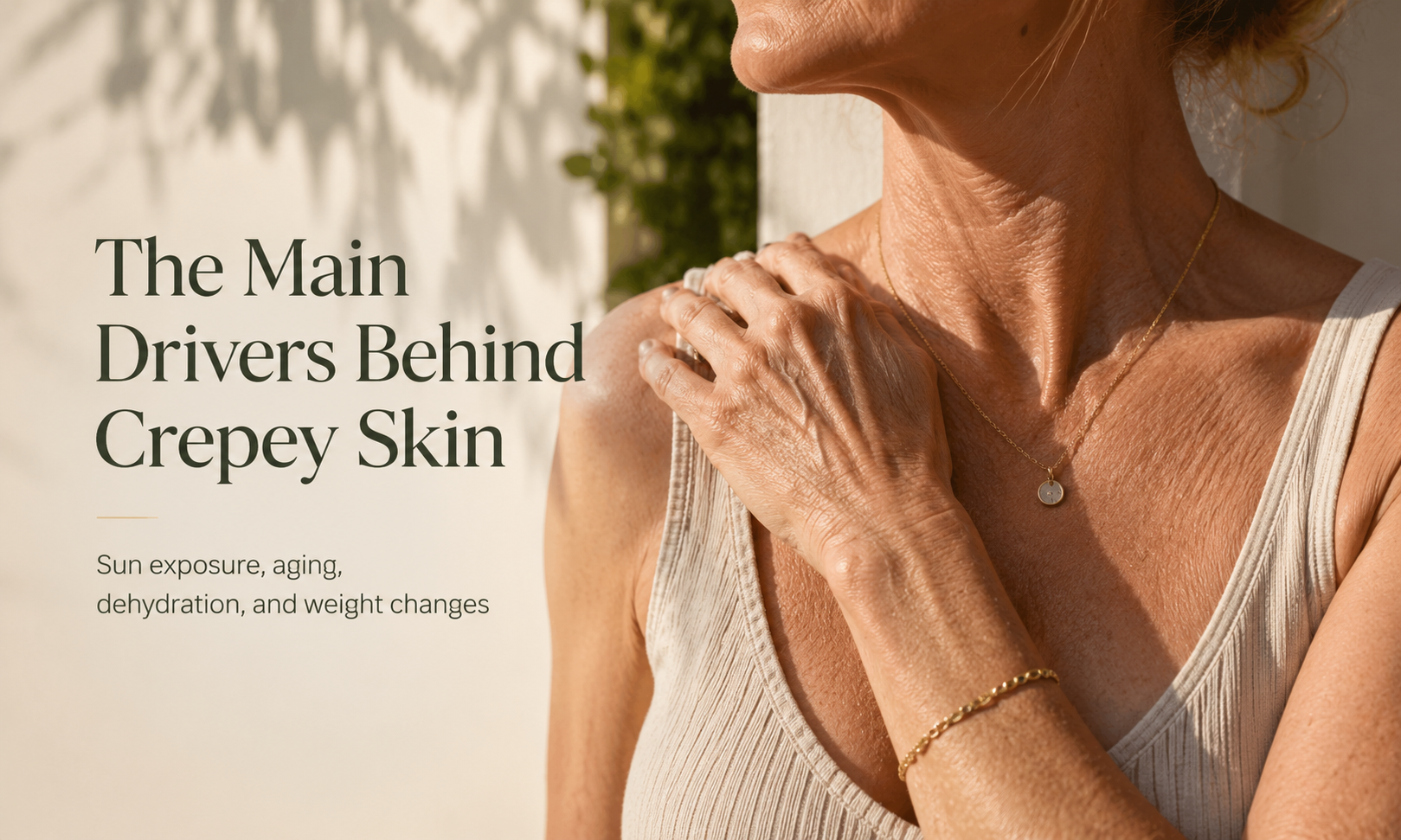
The Main Drivers Behind Crepey Skin
| Cause | What It Does to the Skin |
| UV exposure (sun and tanning beds) | Breaks down collagen and throws off the collagen-elastin balance — the single biggest driver |
| Natural aging | Collagen production slows gradually starting in your 20s |
| Dehydration / lower oil production | Skin loses the moisture barrier that helps it stay plump and supple |
| Weight loss or fluctuation | Skin that stretched to accommodate weight may not fully spring back |
| Smoking | Restricts blood flow to skin and accelerates collagen breakdown |
| Genetics & certain medications | Some people are simply predisposed; long-term steroid use can also thin skin |
How the Damage Builds Up Over Time
- UV rays penetrate the skin’s deeper layers and trigger collagen breakdown
- Elastin fibers lose their ability to fully “snap back” after stretching
- Natural collagen production slows further with each passing decade
- Reduced oil and moisture retention makes the surface look finer and more lined
- Repeated stress — sun, dehydration, weight changes — compounds faster than skin can repair
A Real Number Worth Knowing
Dermatology sources commonly cite a figure from the American Academy of Dermatology: collagen production drops by roughly 1% per year starting in your 20s.
Independent research backs up just how much that adds up — one study tracking collagen content found it peaks between ages 25 and 34, then declines by close to 25% over the following four decades.
That’s the difference between skin that bounces back instantly and skin that takes a visible moment to settle after you pinch it — a simple test dermatologists sometimes use to gauge elasticity.
Common Mistakes People Make With Crepey Skin
- Treating it like a hydration problem only — moisturizer helps the surface, but it doesn’t rebuild collagen underneath.
- Expecting full reversal — most dermatology sources agree crepey skin can be minimized, not eliminated, once it’s established.
- Skipping sunscreen on “less visible” areas — arms and chest get just as much cumulative sun damage as the face.
- Giving up on retinoids too early — most people need 8 to 10 consistent weeks before seeing any real change.
- Assuming it’s purely a weight issue — people at stable, healthy weights develop it too, mostly from sun and age.
What’s Driving Yours? A Quick Comparison
| Likely Cause | Telltale Sign | What Helps Most |
| Sun damage | Worse on arms, chest, hands — areas with heavy lifetime sun exposure | Daily SPF, retinoids, in-office resurfacing |
| Natural aging | Gradual, even thinning across the body, often after 40 | Retinoids, peptide creams, collagen-supporting treatments |
| Weight loss | Looser, more deflated-looking skin in areas that changed size | Strength training, radiofrequency or microneedling treatments |
| Dehydration | Skin feels dry and finely lined but improves somewhat with moisture | Increased water intake, barrier-repair moisturizers |
What Can You Actually Do About It?

- Apply SPF 30+ right now, today — it’s the single highest-leverage habit for slowing further damage.
- Start a retinoid at night, a few nights a week — begin low-strength to avoid excess dryness and build up gradually.
- Swap one sugary drink for water today — hydration supports the skin’s moisture barrier over time.
- Check your moisturizer for peptides or ceramides — look at the ingredient list you already have in your bathroom.
- Book a dermatologist consult if home products haven’t helped in 8–10 weeks — that’s the general window dermatologists use before recommending stronger options.
Does Drinking More Water Fix Crepey Skin?
It helps the surface look less dry and finely lined, but it won’t rebuild lost collagen or elastin on its own. Hydration is supportive, not corrective.
Can Crepey Skin Be Reversed Completely?
Generally, no. Dermatologists describe it as something that can be minimized through treatment, not fully reversed once the underlying protein structure has broken down.
Is Crepey Skin the Same as Regular Wrinkles?
Not quite. Expression wrinkles come from repeated muscle movement, while crepey skin is more about a widespread loss of collagen and elastin, often from sun damage.
Does Losing Weight Quickly Cause It?
It can contribute, especially with significant or rapid weight loss. Skin that stretched to accommodate added weight doesn’t always have the elasticity to fully contract again.
When Should I See a Dermatologist About This?
If you’ve used retinoids or peptide creams consistently for 8 to 10 weeks without improvement, or if the laxity feels advanced, that’s the point to get a professional opinion.
What Most People Don’t Realize
Most people assume crepey skin is just “what happens” with age, full stop. But dermatology clinics report a noticeable rise in patients specifically asking about it in recent years — partly because more people now recognize the term, and partly because more aggressive cosmetic treatments are being marketed for it than ever before.
The counterintuitive part: the products generating the most buzz online aren’t necessarily the ones with the strongest evidence behind them. Long-studied basics — sunscreen and retinoids — still have more research support than most trending serums.
The Two-Bucket Way to Think About Causes

Dermatologists generally sort skin-aging causes into two buckets, and it’s a genuinely useful way to think about your own case:
- Inside Job — things your body does on its own: natural aging, genetics, hormonal shifts. You can support these but not fully stop them.
- Outside Job — things done to your skin from the outside: sun exposure, smoking, dehydration, weight swings. These are the ones you have the most control over.
Most people’s crepey skin is a mix of both — but the “outside job” bucket is where targeted changes make the most visible difference, fastest.
What Should You Do Next?
If you’re just starting to notice early signs, focus on daily SPF and a consistent retinoid — the two changes with the most evidence behind them.
If skin already feels notably loose or thin, or home products haven’t worked after 8–10 weeks, book a dermatologist visit rather than trying more over-the-counter options.
Avoid chasing every new trending serum hoping for a full reversal — that expectation usually leads to disappointment and wasted money.
Suggested Internal Links
Add these once you have the matching pages live on your site, using descriptive anchor text rather than “click here”:
- Link to a retinoid skincare guide using anchor text like “a beginner’s retinol routine for aging skin”
- Link to a sunscreen/SPF guide using anchor text like “choosing a daily SPF for sun-damaged skin”
- Link to a treatments/procedures page using anchor text like “in-office options like microneedling and laser resurfacing”
External Sources
These back the stats and claims used above and are good candidates for outbound links:
- Cleveland Clinic — What’s Causing Your Crepey Skin and How Can You Fix It
- PMC / National Library of Medicine — Role of Age-Associated Alterations of the Dermal Extracellular Matrix in Skin Aging
Technical & On-Page Checklist
- H1 uses the primary keyword once; H2/H3s cover subtopics and natural-language questions
- Entity table included (definitional/causal query — appropriate here)
- Comparison table included where genuinely useful, not forced
- Paragraphs kept to 2–3 lines; no walls of text
- One named framework included for differentiation (“Inside Job vs. Outside Job”)
- 2–3 internal link recommendations + 2 external authoritative links included
- Add at least one diagram/image (e.g., collagen vs. elastin illustration) with descriptive alt text before publishing