
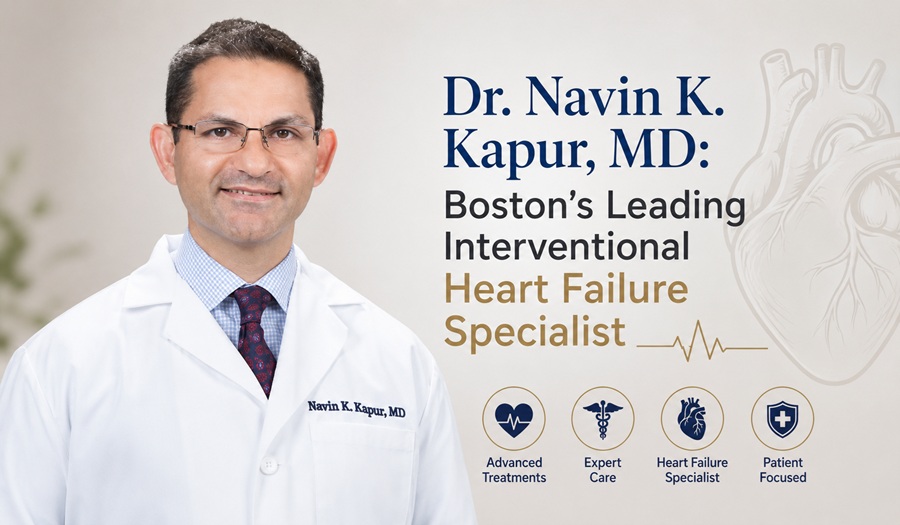
| Full Name | Navin K. Kapur, MD, FSCAI, FAHA, FACC |
| Specialty | Interventional Cardiology and Advanced Heart Failure |
| Board Certifications | Interventional Cardiology; Advanced Heart Failure and Cardiac Transplant |
| Primary Affiliation | Tufts Medical Center, Boston, MA |
| Academic Appointment | Professor, Tufts University School of Medicine |
| Medical School | Georgetown University School of Medicine |
| Residency | Internal Medicine, Beth Israel Deaconess Medical Center, Boston |
| Recognition | Boston Magazine Top Doctors (multiple years) |
| Languages | English, German |
| Accepting New Patients | Yes (at Tufts Medical Center Cardiology) |
| Office Address | 860 Washington Street, Building 6, Boston, MA 02111 |
| Phone | +1 617.636.2273 |
| Appointment Scheduling | tuftsmedicine.org/doctor/navin-kapur |
When the heart fails so severely that conventional medications and procedures cannot stabilize it, the next call often goes to a specialist in mechanical circulatory support — the field of medicine that uses devices to temporarily or permanently take over the work of a failing heart. In Boston’s cardiac community, few names carry more weight in this area than Dr. Navin K. Kapur.
Named to the Boston Magazine Top Doctors list across multiple years, Dr. Kapur has spent his career at the intersection of clinical care and cardiovascular innovation, caring for some of the most critically ill cardiac patients in New England while simultaneously advancing the science that determines how those patients are treated.
Clinical Expertise: Who Dr. Kapur Treats
Dr. Kapur’s clinical practice is built around patients whose heart failure has reached the most acute and dangerous stages. His specific areas of expertise include cardiogenic shock — a condition where the heart suddenly loses the ability to pump enough blood to sustain vital organs and which carries a mortality rate that approaches 50% without rapid, aggressive intervention. He is one of a small number of physicians in the country with dual board certification in both interventional cardiology and advanced heart failure, a combination that allows him to move fluidly between complex coronary procedures and heart failure management in the same patient.
His procedural expertise includes invasive hemodynamic assessment, complex percutaneous coronary intervention, and the placement and management of mechanical circulatory support devices including the Impella heart pump, intra-aortic balloon counterpulsation, and extracorporeal membrane oxygenation (ECMO). These devices are used in the most critically ill cardiac patients to sustain circulation while the underlying problem is being treated or while a patient awaits a heart transplant.
Patients referred to Dr. Kapur typically fall into one or more of these categories: cardiogenic shock after a heart attack, advanced heart failure no longer responding to standard therapy, complex coronary artery disease requiring high-risk intervention, or right heart failure complicating a primary left ventricular problem.
Research and Scientific Contributions
Dr. Kapur’s research career is unusually prolific even by the standards of academic cardiology. He is the founder of the Cardiogenic Shock Working Group, a multicenter clinical registry that has brought together interventional cardiologists and heart failure specialists across dozens of major hospitals to generate real-world data on how cardiogenic shock patients are managed and how outcomes can be improved. This registry has produced numerous landmark publications that have shifted clinical practice.
He served as principal investigator for several multicenter clinical trials in mechanical circulatory support, including the STEMI-Door-to-Unload Trial, which tested the concept of mechanically unloading the left ventricle immediately after a heart attack to reduce heart muscle damage. This hypothesis — that actively resting the heart at the time of injury activates protective biological programs that preserve function — is one of the most important emerging ideas in interventional cardiology, and Dr. Kapur’s laboratory was the first to identify the molecular mechanisms supporting it.
Beyond clinical trials, his laboratory has produced foundational research into the molecular biology of cardiac remodeling. His work was the first to identify a functional role for endoglin, a co-receptor in the TGF-beta signaling pathway, in the cardiac remodeling that follows heart failure — research that opens potential drug targets for preventing the irreversible structural changes that make chronic heart failure progressively worse.
He is also the inventor of multiple patents including the pulmonary artery pulsatility index, a clinical measurement tool now widely used to identify and grade right heart failure — a complication that significantly affects treatment decisions and outcomes in heart failure patients.
Why His Approach Stands Out
What distinguishes Dr. Kapur’s approach from many heart failure specialists is the depth of his integration between clinical care and real-time research. His clinical decisions in individual patients are informed by data from the registry he built, and his laboratory work is directly shaped by the clinical problems he encounters managing cardiogenic shock patients.
He founded the Robert Kung Combined Interventional Heart Failure Fellowship Program at Tufts Medical Center, which trains a new generation of cardiologists in the combined skill set that advanced heart failure management now requires — one that bridges the procedural world of interventional cardiology with the physiological complexity of heart failure medicine. This is a rare dual-training pathway that reflects how specialized the care of critically ill cardiac patients has become.
Patient reviews on Healthgrades and Medical News Today consistently note his combination of technical skill and genuine communication — an unusual pairing in the high-stakes environment of cardiogenic shock care. One reviewer described him as explaining everything patiently before surgery, being empathetic, and taking time to address the concerns of family members as well as the patient.
Recognition and Professional Standing
Dr. Kapur holds fellowships in the Society for Cardiovascular Angiography and Interventions (FSCAI), the American Heart Association (FAHA), and the American College of Cardiology (FACC) — the three principal professional organizations in cardiovascular medicine. He is an elected member of the American Society for Clinical Investigation, a prestigious honor society for physician-scientists that recognizes outstanding contributions to medical research, and was appointed to its membership based on his research productivity and impact.
He has served on national committees for the American Heart Association, the American College of Cardiology, the Heart Failure Society of America, and the Society for Cardiac Angiography and Interventions, shaping clinical practice guidelines that affect how cardiogenic shock and heart failure are managed at hospitals across the country.
How to See Dr. Kapur
Dr. Kapur practices interventional cardiology and heart failure medicine at Tufts Medical Center in Boston’s South End neighborhood, where the cardiology department is located at 860 Washington Street, Building 6.
He is currently accepting new patients, and telehealth appointments are available in addition to in-person visits. The practice accepts Medicare, Medicaid, and a broad range of private insurance plans including Aetna, Blue Cross Blue Shield, First Health, Tufts Health Plan, Humana, and United Healthcare. Patients should verify their specific plan coverage directly with the office before scheduling.
To schedule an appointment:
The most direct route is through the Tufts Medicine online booking system at tuftsmedicine.org/doctor/navin-kapur, where appointment availability and telehealth options are listed. Patients who prefer to call can reach the Tufts Medical Center cardiology scheduling line at 617-636-8068. New patient appointments for specialist cardiology consultations typically require a referral from a primary care physician, though the scheduling team can advise on whether a self-referral is appropriate depending on the clinical situation.
For patients dealing with an acute cardiac emergency, the Tufts Medical Center emergency department is located at 800 Washington Street, Boston, MA 02111, and is staffed around the clock with direct access to the cardiac catheterization laboratory for emergency procedures.
| Contact Method | Details |
|---|---|
| Online Scheduling | tuftsmedicine.org/doctor/navin-kapur |
| Phone | 617-636-8068 |
| Office Address | 860 Washington Street, Building 6, Boston, MA 02111 |
| Emergency | 800 Washington Street, Boston, MA 02111 |
| Telehealth | Available — book through the online portal |
| Insurance | Medicare, Medicaid, Aetna, BCBS, Tufts Health, United, Humana, First Health |
What Patients Should Know Before Their Appointment
Patients referred to Dr. Kapur are typically dealing with serious, complex cardiac situations. A few practical notes:
Bring a complete list of current medications, including doses, as hemodynamic and heart failure assessments depend on understanding current therapy. Bring records of any previous echocardiograms, cardiac catheterization reports, or imaging results — Tufts Medical Center can often receive electronic records in advance. If you have had previous cardiac procedures at another institution, a surgical or procedural report is helpful context.
For patients whose primary concern is a heart failure diagnosis or complex coronary anatomy, arriving with a recent echocardiogram from your referring cardiologist significantly accelerates the evaluation. For patients in more acute situations, direct emergency referral to Tufts Medical Center’s cardiac catheterization laboratory is available through referring physicians.
Dr. Navin K. Kapur is recognized on Boston Magazine’s Top Doctors list, produced in collaboration with Castle Connolly Medical Ltd. based on peer nomination and review of qualifications, appointments, outcomes, and professional reputation. Boston Health Journal profiles physicians from this list to help Greater Boston residents identify and connect with the region’s most distinguished specialists.
