
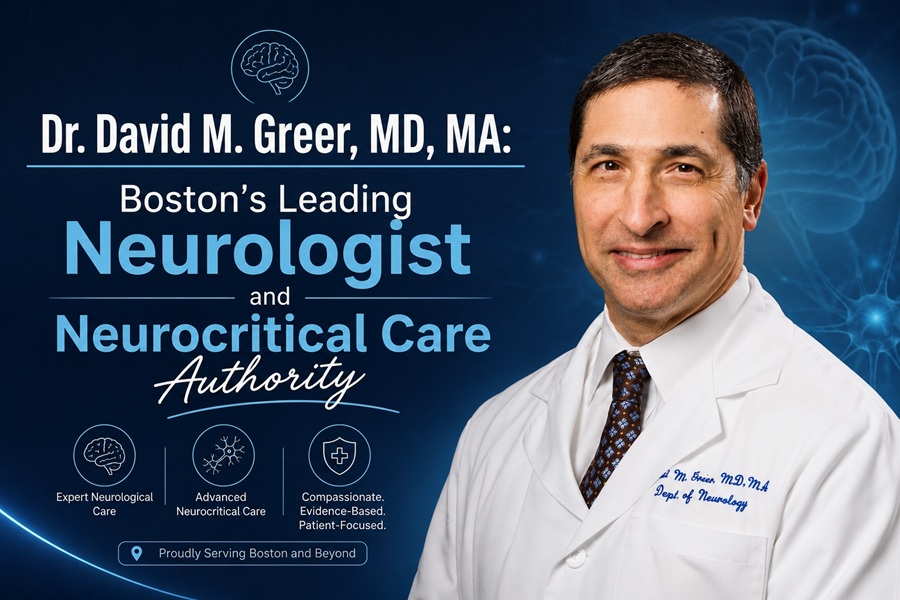
| Full Name | David M. Greer, MD, MA, FCCM, FAHA, FNCS, FAAN, FANA |
| Specialty | Neurology, Vascular Neurology, Neurocritical Care |
| Board Certifications | Neurology; Vascular Neurology; Neurocritical Care |
| Title | Richard B. Slifka Chief of Neurology, Boston Medical Center |
| Academic Appointment | Professor and Chair of Neurology, Boston University Chobanian & Avedisian School of Medicine |
| Primary Hospital | Boston Medical Center, Boston, MA |
| Undergraduate | Williams College (BA, English Literature) |
| Medical School | University of Florida College of Medicine (MD, MA English Literature) |
| Residency | Neurology, Massachusetts General Hospital / Harvard Medical School |
| Fellowship | Vascular Neurology and Neurocritical Care, Massachusetts General Hospital |
| Recognition | Boston Magazine Top Doctors 2026; AAN A.B. Baker Lifetime Achievement Award 2022; Best Doctors in America since 2007 |
| Office Address | Boston Medical Center, 1 Boston Medical Center Place, Boston, MA 02118 |
| Phone | 617.638.8456 |
| Appointment Scheduling | bmc.org or call 617.638.8456 |
When a patient suffers a catastrophic brain injury, slips into a coma after cardiac arrest, or experiences a major stroke, the questions that follow are among the most consequential in all of medicine. Will the patient recover consciousness? How much function can be regained? And in the most difficult cases, how is brain death determined with the precision and certainty that such a determination demands? Few physicians in the world have done more to answer those questions rigorously than Dr. David M. Greer.
Named to the Boston Magazine Top Doctors 2026 list, Dr. Greer is the Richard B. Slifka Chief of Neurology at Boston Medical Center and Chair of the Department of Neurology at Boston University Chobanian & Avedisian School of Medicine. He is a globally recognized authority in neurocritical care, stroke, and the determination of brain death, and he has shaped the national and international standards that govern how some of medicine’s most serious neurological situations are managed.
A Career Built at the Frontier of Brain Injury
Dr. Greer has been a neurointensivist since 2001, specializing in the care of patients with the most severe and life-threatening neurological conditions. His clinical and academic focus sits at the intersection of three fields: vascular neurology, which addresses stroke and cerebrovascular disease; neurocritical care, the intensive care management of patients with brain and spinal cord injuries; and the science of neuroprognostication, which is the discipline of predicting recovery in patients with severe brain injury.
He trained at Massachusetts General Hospital through Harvard Medical School, completing a neurology residency followed by specialized fellowship training in vascular neurology and neurocritical care. He served as Vice Chair of Neurology at Yale University from 2010 to 2017, where he directed the stroke service and co-directed the Neurovascular Center at Yale New Haven Hospital, before being recruited to Boston University and Boston Medical Center in 2017 to lead the Department of Neurology.
Clinical Expertise: Who Dr. Greer Treats
Dr. Greer’s clinical practice is concentrated on patients with serious and complex neurological conditions, particularly those requiring intensive care management. His specific areas of expertise include acute ischemic and hemorrhagic stroke, coma and disorders of consciousness, recovery prediction after cardiac arrest, and the management of patients with severe traumatic brain injury and other neurological emergencies.
His areas of clinical focus include the use of targeted temperature management in acute brain injury, a technique in which a patient’s body temperature is carefully controlled to protect the brain following cardiac arrest or stroke. He has also worked extensively on the prevention of fever in patients with acute vascular brain injury, recognizing that elevated temperature worsens outcomes in patients with brain injury.
He is also described as an expert in spinal disorders and vascular neurology, reflecting the breadth of his clinical practice across the neurological conditions most likely to require urgent, high-stakes decision-making.
Defining the National Standard for Brain Death Determination
Perhaps no single area of Dr. Greer’s work has had a more significant impact on the practice of medicine than his contributions to the standardization of brain death determination.
The determination of brain death, also called death by neurologic criteria, is one of the most consequential and sensitive judgments in all of clinical medicine. For decades, the criteria and procedures used to make this determination varied considerably between hospitals and even between physicians within the same institution, creating the potential for inconsistency in situations where certainty is essential.
Dr. Greer has spent much of his career working to eliminate that variability. He was the senior author on the 2010 American Academy of Neurology Practice Parameter Update on Brain Death Determination, which became the reference standard for the field. He went on to play a central role in developing the comprehensive 2023 Brain Death/Death by Neurologic Criteria Guidelines, a landmark consensus document that brought together the American Academy of Neurology, the American Academy of Pediatrics, the Child Neurology Society, and the Society of Critical Care Medicine to establish unified national standards for adults and children alike.
His ongoing advocacy work includes pressing for state-level legal acknowledgment of the 2023 guidelines as the accepted medical standard, addressing the gap that can exist between medical consensus and legal frameworks in different states. This work has profound implications for patients, families, organ donation systems, and the integrity of one of medicine’s most serious determinations.
Research Contributions
Dr. Greer is an extraordinarily prolific academic, having authored more than 400 peer-reviewed manuscripts, reviews, book chapters, guidelines, and books over the course of his career. His research interests center on predicting recovery from coma after cardiac arrest, the determination of brain death, and multiple stroke-related topics including acute stroke treatment, temperature modulation, and stroke prevention.
A significant thread of his research addresses neuroprognostication after cardiac arrest, using a combination of neuroimaging, electrophysiology, biomarkers, and clinical examination to predict which patients are likely to recover meaningful neurological function. This work matters enormously to families and clinicians facing decisions in the intensive care unit, where accurate prediction of outcome shapes the most difficult choices in medicine.
His recent published research includes work on integrating brain imaging and quantitative pupillometry to predict neurological deterioration after large strokes, the relationship between connectome disruptions and consciousness disorders after hypoxic-ischemic injury, and continued refinement of the standards and practices surrounding brain death determination. He serves as a peer reviewer for the most prestigious journals in medicine, including the New England Journal of Medicine, Annals of Internal Medicine, Brain, Neurology, and Stroke.
He is the editor-in-chief of Seminars in Neurology, a position he has held since 2013, and was the inaugural editor-in-chief of Neurocritical Care on Call, shaping how the field communicates and disseminates knowledge.
Leadership and Recognition
Dr. Greer’s standing in his field is reflected in the leadership roles he holds across the major professional organizations in neurology and critical care. He serves as Chair of the American Academy of Neurology Academic Neurology Committee and as a senior leader in the Neurocritical Care Society, where he has served as Vice President and President. He is a Fellow of the Society of Critical Care Medicine, the American Academy of Neurology, the American Heart Association, the American Neurological Association, and the Neurocritical Care Society, holding the highest level of recognition in each.
In 2022, he received the A.B. Baker Lifetime Achievement Award for Neurological Education from the American Academy of Neurology, one of the most prestigious honors in the field, recognizing a sustained career of excellence in training and educating neurologists. He has been named one of the Best Doctors in America consistently since 2007. He describes himself as a lifelong mentor, having trained countless students, residents, fellows, and faculty over the course of his career.
His unusual academic background includes degrees in English Literature at both the undergraduate level from Williams College and the master’s level, reflecting an intellectual range uncommon in clinical medicine.
Boston Medical Center Neurology
Dr. Greer leads the Department of Neurology at Boston Medical Center, the largest safety-net hospital in New England and the primary teaching affiliate of Boston University Chobanian & Avedisian School of Medicine. Under his leadership since 2017, the department provides comprehensive neurological care across stroke, epilepsy, movement disorders, multiple sclerosis, neuromuscular disease, headache, and neurocritical care.
Boston Medical Center’s mission as a safety-net hospital means it provides care to all patients regardless of their ability to pay, serving one of the most diverse patient populations in the region. The neurology department combines this commitment to accessible care with the academic rigor of a major university medical center, offering patients access to clinical trials, subspecialty expertise, and the most current evidence-based treatments.
How to See Dr. Greer
As Chair of Neurology and a neurocritical care specialist, Dr. Greer’s clinical practice is concentrated on complex and severe neurological conditions, many of which arrive through hospital admission and emergency referral rather than routine outpatient scheduling. Patients and referring physicians can access the Boston Medical Center Department of Neurology for evaluation and to determine the most appropriate pathway to care.
| Contact Method | Details |
|---|---|
| Phone | 617-638-8456 |
| Department of Neurology | Boston Medical Center, 1 Boston Medical Center Place, Boston, MA 02118 |
| Online Information | bmc.org |
| Physician Referrals | 617-638-8456 |
| Emergency | Boston Medical Center Emergency Department, 1 Boston Medical Center Place |
| Insurance | Medicare, Medicaid/MassHealth, and most major insurers (verify with office) |
For patients experiencing an acute neurological emergency such as signs of stroke — sudden facial drooping, arm weakness, or speech difficulty — call 911 immediately rather than attempting to schedule an appointment. Boston Medical Center operates a comprehensive stroke center with around-the-clock neurological emergency care.
Preparing for Your Appointment
For patients referred to Boston Medical Center neurology for evaluation, bringing a complete record of prior neurological imaging including CT or MRI scans, a detailed history of symptoms with their timeline, a complete medication list, and records of any prior neurological evaluations significantly improves the productivity of the initial consultation. For patients with a history of stroke or cardiac arrest, prior hospital discharge summaries and imaging are particularly valuable.
Dr. David M. Greer is recognized on the Boston Magazine Top Doctors 2026 list, produced in collaboration with Castle Connolly Medical Ltd. based on peer nomination and review of qualifications, appointments, outcomes, and professional reputation. Boston Health Journal profiles physicians from this list to help Greater Boston residents connect with the region’s most distinguished specialists.