
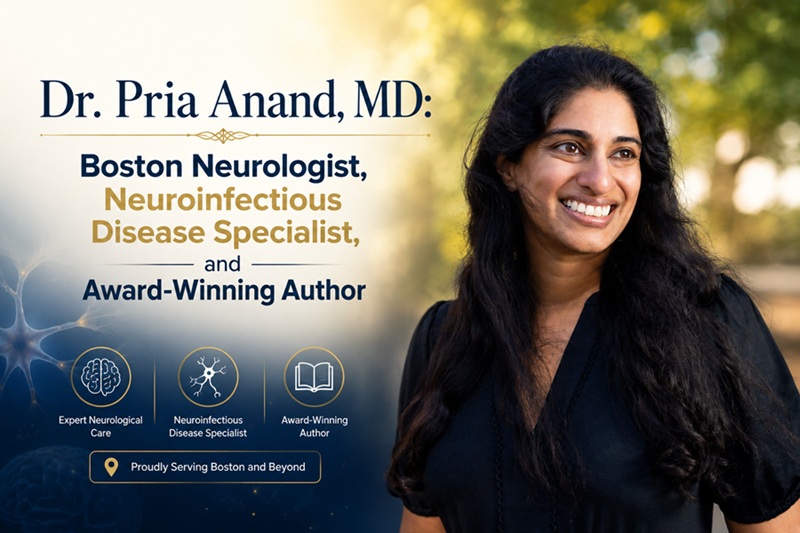
| Full Name | Pria Anand, MD |
| Specialty | Neurology, Neuroinfectious Diseases, Hospital Neurology |
| Board Certification | Neurology |
| Titles | Chief, Division of Hospital Neurology; Director, Adult Neurology Residency Program, Boston Medical Center |
| Academic Appointment | Assistant Professor of Neurology, Boston University Chobanian & Avedisian School of Medicine |
| Primary Hospital | Boston Medical Center, Boston, MA |
| Undergraduate | Yale University (BA, Cognitive Science) |
| Medical School | Stanford University School of Medicine (MD, concentration in biomedical ethics and medical humanities) |
| Residency | Neurology, Johns Hopkins University School of Medicine |
| Fellowship | Advanced General Neurology (neuroinfectious diseases, neuroimmunology), Massachusetts General Hospital |
| Recognition | Boston Magazine Top Doctors 2026; 2026 PEN America E.O. Wilson Literary Science Writing Award |
| Notable Work | Author of The Mind Electric (Simon & Schuster, 2025) |
| Office Address | Boston Medical Center, 1 Boston Medical Center Place, Boston, MA 02118 |
| Phone | 617-638-8456 |
| Appointment Scheduling | bmc.org or call 617-638-8456 |
It is rare to find a physician who is simultaneously a leading subspecialist, the director of a major residency program, and a nationally celebrated author whose debut book has been compared to the work of Oliver Sacks. Dr. Pria Anand is all three. A neurologist at Boston Medical Center specializing in neuroinfectious diseases, she has built a career that bridges the clinical precision of hospital neurology with a profound commitment to storytelling and the humanity of patient care.
Named to the Boston Magazine Top Doctors 2026 list, Dr. Anand serves as Chief of the Division of Hospital Neurology and Director of the Adult Neurology Residency Program at Boston Medical Center, while holding a faculty appointment as Assistant Professor of Neurology at Boston University Chobanian & Avedisian School of Medicine. In 2026, her debut book won one of the most prestigious science writing awards in the United States, marking her as a distinctive voice in both medicine and literature.
An Unusual Path Through Medicine
Dr. Anand’s educational journey reflects a longstanding interest in the intersection of science, ethics, and the human experience. She earned her undergraduate degree in cognitive science at Yale University, a field that studies the mind from the combined perspectives of psychology, neuroscience, philosophy, and linguistics. She went on to earn her medical degree from Stanford University School of Medicine, where she pursued a concentration in biomedical ethics and medical humanities, an academic focus that distinguishes her approach to clinical practice.
She completed her neurology residency at Johns Hopkins University, one of the most rigorous neurology training programs in the country, where she was recognized with the Thomas J. Preziosi Award for Clinical Excellence in Neurology and the Frank L. Coulson, Jr. Award for Clinical Excellence — the latter awarded for what the program described as a level of mastery in interpersonal skills, humanism, diagnostic acumen, knowledge, and a scholarly approach to clinical practice. She then completed an Advanced General Neurology fellowship at Massachusetts General Hospital, focusing on neuroinfectious diseases, neuroimmunology, and the neurological manifestations of systemic diseases.
Clinical Expertise: Neuroinfectious Diseases and Hospital Neurology
Dr. Anand’s clinical practice at Boston Medical Center centers on hospitalized patients with acute neurological disorders and on patients with neurological complications of infectious diseases. This is a specialized and complex area of neurology that requires expertise in both the nervous system and the infectious processes that can affect it.
Her areas of particular clinical focus include the neurological complications of HIV, neurocysticercosis (a parasitic infection of the brain caused by tapeworm larvae), meningitis, encephalitis, HTLV-associated myelopathy, and progressive multifocal leukoencephalopathy. These conditions sit at the intersection of neurology and infectious disease, and they frequently affect underserved and immunocompromised patients — populations that Boston Medical Center, as the largest safety-net hospital in New England, is specifically dedicated to serving.
Treatment records also indicate she frequently cares for patients with migraine and other headache disorders, autonomic disorders, and nerve root and plexus disorders, reflecting the broad scope of an academic hospital neurologist.
As Chief of the Division of Hospital Neurology, she leads the team responsible for the neurological care of hospitalized patients across Boston Medical Center, managing acute strokes, seizures, infections, and other neurological emergencies that arise in the inpatient setting.
A Commitment to Neurologic Health Equity
A defining theme of Dr. Anand’s academic work is neurologic health equity — the effort to ensure that high-quality neurological care reaches the patients who have historically been underserved by the healthcare system. Her research and scholarship have addressed healthcare disparities directly, including studies on disparities in telehealth use during the COVID-19 pandemic, the role of social work in outpatient neurology at a safety-net hospital, and the profile of preventable errors in hospital-based neurology.
This focus is closely aligned with the mission of Boston Medical Center, which provides care to all patients regardless of their ability to pay and serves one of the most diverse patient populations in the region. Her work examines not only how neurological diseases are treated but who has access to that treatment and how the system can be made more equitable.
She has also contributed to medical education research, including the MANET Project, an innovative program that uses museum art to train neurology residents in observation and clinical reasoning skills — reflecting her enduring interest in the connections between the humanities and clinical medicine.
Director of the Neurology Residency Program
As Director of the Adult Neurology Residency Program at Boston Medical Center, Dr. Anand is responsible for training the next generation of neurologists. Residency program directors shape the clinical and academic development of physicians during the most formative years of their specialty training, and the role reflects significant trust in both her clinical expertise and her commitment to education.
Her recognition with the A.B. Baker Award for teaching from the American Academy of Neurology — the same lineage of teaching honors held by the most respected neurological educators in the country — underscores her standing as an educator. She is widely regarded as a mentor who brings the same humanism to teaching that she brings to patient care.
The Mind Electric: A Literary Achievement
Beyond her clinical and academic work, Dr. Anand is a celebrated author. Her debut book, The Mind Electric: A Neurologist on the Strangeness and Wonder of Our Brains, was published by Simon & Schuster in the United States and Little, Brown in the United Kingdom in June 2025.
The book blends case study, history, fable, and memoir to explore the complexity and wonder of the human brain in health and in extremity. Drawing on her work at Boston Medical Center, her childhood years in India, and experiences in the Caribbean and West Africa, the book examines the paradox at the heart of neurology — that even the most peculiar neurological symptoms can reveal something universal about being human.
The Mind Electric won the 2026 PEN America E.O. Wilson Literary Science Writing Award, a $10,000 prize that recognizes outstanding writing that makes the physical and biological sciences accessible to a general audience. It was named a Best Book of 2025 by Publishers Weekly, Barnes & Noble, The Observer, The Globe and Mail, and Book Riot, among others. Critics have compared her writing to that of Oliver Sacks, the legendary neurologist and author whose case-based narratives defined the genre of popular neurology writing.
Her shorter work has appeared in the New York Review of Books, the Boston Globe, the Washington Post, the New York Times, the Los Angeles Review of Books, Time, the New Yorker, and Ploughshares. This sustained body of public writing reflects a physician deeply committed to communicating the realities of medicine and neurology to the broader public.
Research and Publications
Dr. Anand maintains an active research and publication record concentrated in neuroinfectious diseases, neuroimmunology, and neurologic health equity. She has contributed to consensus recommendations for the management of neurosarcoidosis, research on stroke associated with sarcoidosis, studies of the neurological complications of COVID-19, and numerous case-based contributions to the neurological literature.
During the COVID-19 pandemic, she was part of the Boston Medical Center neurology team that rapidly developed and disseminated protocols for managing neurology inpatients with COVID-19, coauthoring work alongside colleagues including Dr. David Greer and other members of the BMC and BU neurology faculty. This work helped hospitals across the country respond to the novel neurological challenges the pandemic presented.
Boston Medical Center Neurology
Dr. Anand practices within the Department of Neurology at Boston Medical Center, an academic medical center and the primary teaching hospital of Boston University Chobanian & Avedisian School of Medicine. As the largest safety-net hospital in New England, BMC combines comprehensive neurological care with a commitment to serving all patients regardless of ability to pay.
The neurology department offers care across the full range of neurological conditions including stroke, epilepsy, movement disorders, multiple sclerosis, neuromuscular disease, headache, and the neuroinfectious and neuroimmunological conditions in which Dr. Anand specializes.
How to See Dr. Anand
Dr. Anand cares primarily for hospitalized patients at Boston Medical Center as Chief of the Division of Hospital Neurology, though she also sees patients with neuroinfectious and neuroimmunological conditions. Patients and referring physicians can contact the Boston Medical Center Department of Neurology to determine the most appropriate pathway to care.
| Contact Method | Details |
|---|---|
| Phone | 617-638-8456 |
| Department of Neurology | Boston Medical Center, 1 Boston Medical Center Place, Boston, MA 02118 |
| Online Information | bmc.org |
| Physician Referrals | 617-638-8456 |
| Emergency | Boston Medical Center Emergency Department, 1 Boston Medical Center Place |
| Insurance | Medicare, Medicaid/MassHealth, and most major insurers (verify with office) |
For patients experiencing an acute neurological emergency such as signs of stroke, sudden severe headache, or new confusion, call 911 immediately rather than scheduling an appointment.
Preparing for Your Appointment
For patients referred for evaluation of a complex neurological or neuroinfectious condition, bringing complete records of prior infectious disease workups, neurological imaging including MRI and CT scans, lumbar puncture results if performed, and a detailed timeline of symptoms is especially helpful given the complexity of the conditions Dr. Anand treats. For patients with HIV or other immunocompromising conditions, records of immune status and prior treatments support an accurate and efficient evaluation.
Dr. Pria Anand is recognized on the Boston Magazine Top Doctors 2026 list, produced in collaboration with Castle Connolly Medical Ltd. based on peer nomination and review of qualifications, appointments, outcomes, and professional reputation. Boston Health Journal profiles physicians from this list to help Greater Boston residents connect with the region’s most distinguished specialists.
