
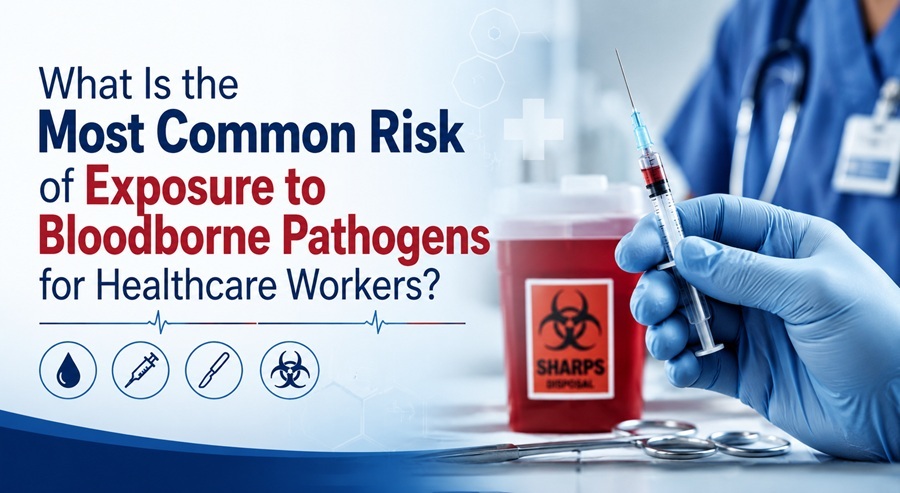
Every day, healthcare workers handle needles, scalpels, IV lines, and dozens of other sharp instruments — often in fast-paced, high-stakes environments where the margin for error is thin. The single greatest occupational risk those workers face for exposure to bloodborne pathogens is a needlestick or sharps injury: the accidental puncture of the skin by a contaminated needle or other sharp medical device.
It is not a rare event. An estimated 400,000 sharps injuries occur in United States hospitals alone every year. The real number is likely significantly higher, because research consistently shows that more than half of all needlestick and sharps injuries go unreported. Healthcare workers who sustain them often downplay the incident, feel embarrassed, worry about the paperwork, or simply do not have time to follow the reporting process during a busy shift.
That silence has real consequences. Understanding exactly how these exposures happen, what pathogens they carry, which healthcare workers are most affected, and what actually works to prevent them is not just an occupational health concern — it is a patient safety issue and a public health priority.
What Are Bloodborne Pathogens?
Bloodborne pathogens are infectious microorganisms that live in human blood and certain body fluids and are capable of causing serious disease in another person when they enter the bloodstream. The three pathogens of greatest clinical concern in healthcare settings are Hepatitis B virus (HBV), Hepatitis C virus (HCV), and Human Immunodeficiency Virus (HIV). At least 20 other pathogens have been documented as transmissible through needlestick and sharps injuries, but these three account for the vast majority of occupational infection risk.
Each pathogen carries its own transmission profile and clinical consequence:
| Pathogen | Transmission Risk After Needlestick | Primary Consequence |
|---|---|---|
| Hepatitis B (HBV) | Up to 30% (unvaccinated) | Chronic liver disease, cirrhosis, liver cancer |
| Hepatitis C (HCV) | Approximately 1.8% | Chronic hepatitis, cirrhosis, liver cancer |
| HIV | Approximately 0.3% | Progressive immune system failure, AIDS |
The numbers in that table tell an important story. HBV is dramatically more infectious per exposure than HIV, which is why the hepatitis B vaccine — which provides near-complete protection — is considered a foundational occupational health intervention for anyone working in a healthcare setting. HCV sits in the middle: less infectious than HBV per exposure, but with no vaccine available, every exposure carries real risk.
Needlestick and Sharps Injuries: Why They Are the Dominant Risk
A needlestick injury occurs when a needle that has been in contact with another person’s blood, tissue, or body fluid penetrates the skin. Sharps injuries are the broader category — any penetrating wound from a needle, scalpel, lancet, IV stylet, broken glass vial, or other sharp object that could carry contaminated material.
These injuries are the primary route of bloodborne pathogen transmission in healthcare for a straightforward anatomical reason: they breach the skin barrier entirely and introduce contaminated material directly into the recipient’s blood or tissue. This is a fundamentally more efficient transmission route than mucosal exposure, where contaminated fluid contacts mucous membranes like the eyes, nose, or mouth — a route that does cause infection but at lower rates.
The injuries happen constantly and for predictable reasons. Healthcare settings are high-pressure environments where workers handle sharps under conditions that are not always ideal — rushing to meet competing demands, working in cramped spaces, wearing gloves that reduce dexterity, performing procedures on uncooperative or moving patients. Even highly experienced clinicians with years of flawless technique can sustain a needlestick during an unexpected patient movement or a momentary lapse in concentration.
Specific situations that generate the most sharps injuries include recapping needles after use, administering injections and IV medications, drawing blood, suturing wounds, handling surgical instruments, and disposing of used sharps. A full one-third of all sharps injuries in hospital settings occur during the disposal process — at the very moment when the clinical procedure has ended and the worker’s guard may be down.
Which Healthcare Workers Face the Highest Risk
Not all healthcare workers carry equal exposure risk, and understanding the distribution matters for designing effective prevention strategies.
Nurses sustain the greatest absolute number of needlestick injuries of any single occupational group in healthcare. This makes statistical sense — nurses administer the overwhelming majority of injections, IV medications, and blood draws in hospital and outpatient settings, meaning their cumulative exposure to sharps is far higher than most other roles. They are the largest healthcare workforce, and they handle needles with the highest frequency.
Surgeons and surgical technicians face significant risk during operative procedures. The density of sharps use in an operating room — suture needles, scalpels, retractors, bone saws, and other instruments passing between hands under time pressure — creates a high-exposure environment. Suturing in particular generates a substantial proportion of surgical sharps injuries, which is one reason blunt-tipped suture needles have become increasingly common in surgical settings.
Phlebotomists by definition spend their entire working day drawing blood, putting them in repeated daily contact with the primary exposure scenario.
Emergency department staff work with patients whose infection status is often unknown and whose cooperation cannot be guaranteed, combining two major risk factors simultaneously.
Housekeeping and environmental services staff are exposed to improperly discarded sharps — needles left in bed linens, dropped on the floor, or placed in regular trash rather than sharps containers. These workers sustain a meaningful proportion of total hospital sharps injuries despite having no direct patient care role, which is why proper sharps disposal is not just a clinical issue but a facility-wide safety issue.
Laboratory workers handling blood specimens face exposure risk particularly during specimen processing, when tubes can break or leak.
The Second Route of Exposure: Mucocutaneous Contact
After needlestick and sharps injuries, the second most common exposure route is mucocutaneous contact — when blood or other potentially infectious body fluids splash or spray onto mucous membranes, most commonly the eyes, nose, or mouth, or contact broken or non-intact skin.
This type of exposure happens during procedures that generate splashing — arterial line insertion, suctioning, intubation, surgical irrigation, wound debridement, and similar tasks. It also occurs when a worker rubs their eyes or touches their face with contaminated gloves, or when a patient coughs or vomits unexpectedly during a procedure.
Mucocutaneous exposure is generally considered a lower transmission risk than percutaneous sharps injury for HIV and HCV, but it is not negligible — particularly for HBV, which is highly infectious and can survive on surfaces for up to seven days at room temperature. The standard precaution against mucocutaneous exposure is face and eye protection: surgical masks, face shields, and safety goggles appropriate to the procedure being performed.
OSHA’s Bloodborne Pathogens Standard: The Legal Framework
The federal regulatory response to bloodborne pathogen exposure in healthcare is OSHA’s Bloodborne Pathogens Standard, codified at 29 CFR 1910.1030. Originally established in 1991 and significantly strengthened by the Needlestick Safety and Prevention Act in 2001, the standard creates mandatory employer obligations that govern how healthcare facilities must protect their workers.
Under the standard, covered employers must maintain an Exposure Control Plan — a written document that identifies job classifications where employees face occupational exposure, describes the specific tasks that create that exposure, and details the methods the employer uses to control it. The plan must be updated annually and whenever new tasks or procedures are introduced.
The standard mandates a hierarchy of controls for bloodborne pathogen exposure that runs from elimination and engineering controls at the top — the most effective interventions — down to personal protective equipment at the bottom, which reduces but does not eliminate exposure.
Engineering controls are the highest-priority intervention under this framework. The most important are safety-engineered sharps devices — needles, scalpels, and IV catheters designed with built-in protective mechanisms that reduce needlestick risk. These include retractable syringes, sheathed needles, and needleless IV systems. The CDC estimates that 62 to 88 percent of sharps injuries are preventable with the use of safer medical devices.
Sharps disposal containers — puncture-resistant, closable, leak-proof, and clearly labeled — are required throughout facilities wherever sharps are used, positioned to allow immediate disposal at the point of use rather than requiring workers to carry contaminated sharps across a room.
Work practice controls include protocols like never recapping needles by hand, activating safety features immediately after use rather than after reaching a disposal container, and following two-handed passing techniques for sharps in the operating room.
The Three Bloodborne Pathogens in Detail
Hepatitis B Virus
HBV is the most efficiently transmitted bloodborne pathogen in occupational settings. Without vaccination, a healthcare worker exposed to HBV-positive blood through a needlestick faces a transmission risk of up to 30%, depending on the infected patient’s viral load. HBV can survive outside the body on environmental surfaces for up to seven days, making it a risk from contaminated surfaces as well as direct sharps contact.
The hepatitis B vaccine is highly effective — providing greater than 90% protection — and is recommended for all healthcare workers before they begin working in settings with potential exposure. The vaccine series consists of three doses over six months. Post-vaccination serologic testing confirms immune response, and workers who do not achieve adequate antibody levels after the primary series may need booster doses or additional evaluation.
If an unvaccinated or non-immune healthcare worker sustains a needlestick from a source patient known or suspected to be HBV-positive, hepatitis B immunoglobulin (HBIG) administered within 24 hours combined with the vaccine series significantly reduces infection risk.
Hepatitis C Virus
HCV is less infectious per needlestick than HBV, with a transmission rate of approximately 1.8% after a hollow-bore needlestick from an HCV-positive source. Unlike HBV, there is no vaccine against hepatitis C, which makes exposure prevention the only prophylactic tool available.
The clinical trajectory of occupational HCV infection has changed dramatically since the development of direct-acting antiviral medications. Hepatitis C is now curable in over 95% of cases with an 8 to 12 week course of treatment. This does not diminish the importance of exposure prevention, but it does mean that a healthcare worker who seroconverts after an occupational HCV exposure has a strong treatment option available rather than facing a lifelong chronic infection.
HCV is the leading cause of cirrhosis and liver transplantation in the United States, making prevention and early treatment both clinically urgent.
Human Immunodeficiency Virus
HIV has the lowest per-exposure transmission risk of the three — approximately 0.3% after a needlestick from an HIV-positive source with detectable viral load. For source patients on effective antiretroviral therapy with undetectable viral loads, the transmission risk is even lower.
The critical post-exposure intervention for HIV is Post-Exposure Prophylaxis, known as PEP — a 28-day course of antiretroviral medications that, when started within 72 hours of exposure, significantly reduces the risk of HIV transmission. Time is the defining variable: PEP must begin as soon as possible after exposure and should be initiated within two hours when feasible. Every hour of delay reduces its effectiveness. PEP started after 72 hours is not recommended because it is unlikely to be effective.
Any healthcare worker who sustains a potential HIV exposure must report it immediately, regardless of the time of day, and receive urgent evaluation for PEP eligibility.
What to Do Immediately After a Sharps Injury or Blood Exposure
The first minutes after a bloodborne pathogen exposure are clinically important. Here is the correct immediate response:
For a needlestick or cut: Wash the affected area immediately and thoroughly with soap and water. Do not squeeze the wound to express blood — this does not reduce transmission risk and may increase local tissue injury.
For a splash to the eyes, nose, or mouth: Flush the affected area with large amounts of clean water or saline for several minutes. Eye wash stations exist in clinical areas for this purpose.
Report immediately. Do not wait to see how you feel. Every facility covered by the OSHA Bloodborne Pathogens Standard has a post-exposure response protocol. Report to your occupational health department, supervisor, or designated emergency contact immediately. The source patient’s blood should be tested for HBV, HCV, and HIV with their consent, and the exposed worker should be evaluated for PEP and other post-exposure interventions.
Prompt reporting is also the only way to document the exposure in the event the worker develops infection and needs to establish the occupational connection for workers’ compensation or disability purposes.
Prevention: The Hierarchy That Actually Works
The most effective bloodborne pathogen prevention programs in healthcare combine multiple layers of protection rather than relying on any single intervention.
The single most impactful institutional change has been the widespread adoption of safety-engineered sharps devices. Studies documenting their implementation in hospital systems have shown reductions in sharps injuries of 60% or more. The OSHA standard requires employers to evaluate and implement these devices when they are commercially available and clinically appropriate.
Hepatitis B vaccination of all healthcare workers before potential exposure remains the most complete protection against the most efficiently transmitted bloodborne pathogen. There is no rational reason for any healthcare worker to remain unvaccinated against HBV.
Needleless IV systems have substantially reduced one of the most common sharp exposure scenarios — the IV access and medication delivery process — in facilities that have fully adopted them.
Immediate disposal of sharps into puncture-resistant containers at the point of use removes the disposal process as a source of injury. Overfilled sharps containers that are not replaced promptly are a consistent source of preventable injuries and represent a failure of basic facilities management.
Training and culture matter. A healthcare environment where workers feel comfortable reporting exposures, where near-misses are analyzed rather than dismissed, and where safety protocols are designed with frontline worker input rather than imposed from administration produces better outcomes than one with policies on paper that nobody follows. The CDC’s NIOSH division provides current guidelines and resources on bloodborne pathogen exposure prevention at cdc.gov/niosh, which serves as the primary federal reference for occupational exposure standards in healthcare.
Frequently Asked Questions
Is HIV the biggest risk from a needlestick?
No. Despite its public profile, HIV is actually the least likely of the three primary bloodborne pathogens to transmit per needlestick, at approximately 0.3%. Hepatitis B, with a transmission risk up to 30% in unvaccinated workers, is the most efficiently transmitted. The difference is stark enough that HBV vaccination is considered the single most important occupational protection a healthcare worker can have against bloodborne pathogen exposure.
Does wearing gloves prevent needlestick injuries?
Gloves significantly reduce the volume of blood introduced into a wound by acting as a wipe — studies suggest gloves can reduce blood transfer by up to 50%. However, gloves do not prevent the puncture itself. A needle passes through a glove and into the skin beneath it. The protection gloves provide is meaningful for mucocutaneous exposure prevention, but they are not a substitute for safety-engineered devices for sharps injury prevention.
What if I do not know the source patient’s infection status?
The source patient should be tested with their consent. If they are unavailable or refuse testing, the exposed worker and the occupational health team make a risk assessment based on the type of exposure, the clinical setting, and the likelihood of infection in the patient population. PEP decisions for HIV are made on this basis when the source’s status cannot be determined.
Are non-clinical staff at risk?
Yes. Environmental services, laundry, and housekeeping staff sustain a meaningful proportion of sharps injuries from improperly discarded needles. The OSHA standard covers any employee with reasonably anticipated occupational exposure to blood or other potentially infectious materials — not just clinical staff.
Can bloodborne pathogens be transmitted through casual contact?
No. HBV, HCV, and HIV are not transmitted through casual contact — touching, hugging, sharing food, or breathing the same air. Transmission requires the introduction of infected blood or specific body fluids into another person’s bloodstream or mucous membranes. This distinction is important for reducing stigma around infected patients and ensuring they receive equitable care.