
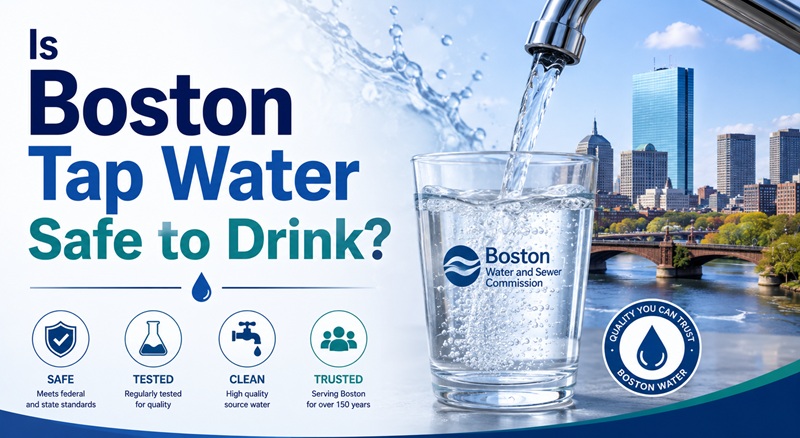
Yes. Boston tap water is safe to drink and is widely considered among the best-tasting and cleanest municipal water supplies in the United States. The Massachusetts Water Resources Authority conducts more than 1,600 water quality tests per month, testing for over 120 potential contaminants, and has consistently met or exceeded every state and federal drinking water standard. The system has received the MassDEP Outstanding Performance Award for water quality multiple times.
That said, safe at the system level does not automatically mean safe at every tap in the city. The single most important variable affecting water quality for individual Boston households is not the reservoir or the treatment plant — it is the pipes the water flows through between the street and your glass. In certain older buildings, particularly in Brighton, East Boston, Allston, Dorchester, Mattapan, and Roxbury, lead service lines and aging plumbing remain a real and specific concern.
Here is everything you need to know about where Boston’s water comes from, how it is treated, what is in it, where the risks actually are, and what to do if you are in a higher-risk situation.
Where Boston’s Water Comes From
Boston’s drinking water originates in two large, carefully protected reservoirs in central Massachusetts: the Quabbin Reservoir, located about 65 miles west of the city, and the Wachusett Reservoir, about 35 miles west. Together with the Ware River as a supplemental source, these reservoirs hold a combined capacity of approximately 477 billion gallons — enough to supply the region for over six years without any additional rainfall.
The Quabbin, completed in 1939, is the largest man-made water supply reservoir in the United States and remains the primary source for metropolitan Boston. It was created by flooding four towns in western Massachusetts — Enfield, Greenwich, Dana, and Prescott — displacing roughly 2,500 people whose homes and farms now lie beneath the water. That history gives the Quabbin a certain weight that Boston residents sometimes do not think about when they turn on their taps.
What makes these reservoirs exceptional as a water source is not just their size but their protection. Over 85 percent of the combined watershed area is covered in forest and wetlands, and more than 62 percent of the watershed land is permanently protected from development. The Department of Conservation and Recreation patrols the watersheds and restricts access to keep the source water as clean as possible before it ever reaches a treatment plant. This means that unlike many urban water systems that draw from rivers running through developed areas, Boston’s source water starts exceptionally clean.
The MWRA supplies water to Boston and 55 other communities, averaging about 200 million gallons per day across the system.
How Boston’s Water Is Treated
From the reservoirs, water travels through aqueducts and a 17.6-mile rock tunnel to the John J. Carroll Water Treatment Plant in Marlborough and the William A. Brutsch Water Treatment Facility, where it undergoes several treatment steps before reaching Boston homes.
Treatment at the Carroll Plant includes ozone disinfection, which is highly effective against bacteria, viruses, and Cryptosporidium; ultraviolet light treatment for an additional layer of pathogen inactivation; pH adjustment using sodium bicarbonate; the addition of chloramines — a more stable and longer-lasting disinfectant than plain chlorine — for residual protection throughout the distribution system; and fluoride addition at the level recommended by the CDC for dental health.
The Brutsch facility, which handles water from the Wachusett Reservoir, uses ozone and UV as primary disinfectants and chloramines for residual disinfection.
The use of UV treatment is significant. UV light is one of the most effective tools available against Cryptosporidium, the parasite that caused the largest waterborne disease outbreak in US history in Milwaukee in 1993. Boston added UV treatment in the early 2000s as part of a major infrastructure upgrade, and it has performed without incident since.
After treatment, water is stored in covered tanks at the Norumbega Reservoir and Loring Road storage tanks in Weston before being delivered to Boston’s distribution system through 29 metered connections managed by the Boston Water and Sewer Commission.
What Is in Boston’s Tap Water
Chloramines
The most detectable thing in Boston’s tap water for most people is the disinfectant. Boston uses chloramines — a combination of chlorine and ammonia — rather than plain chlorine for residual disinfection. Chloramines are commonly detectable as a slight chemical smell or taste, particularly right out of the tap. They are not harmful at the levels used, and leaving water in an open container for a few minutes or refrigerating it allows the chloramines to dissipate if the taste bothers you.
The MWRA carefully monitors and adjusts chloramine levels to stay within EPA limits while maintaining enough residual disinfectant to protect water through the distribution system.
Disinfection Byproducts
When disinfectants like chlorine or chloramines react with naturally occurring organic matter in source water, they form chemical compounds called disinfection byproducts. The main categories are trihalomethanes (TTHMs) and haloacetic acids (HAA5). Both are regulated by the EPA, and Boston’s water meets all federal legal limits for these compounds.
The Environmental Working Group, a nonprofit advocacy organization, argues that EPA limits on disinfection byproducts are too permissive given evolving research on long-term health effects at lower concentrations. Their guidelines are significantly stricter than the EPA’s legal standards, and Boston’s water does exceed EWG thresholds for some of these compounds. This is worth understanding clearly: exceeding EWG guidelines does not mean the water is illegal or immediately dangerous — it means there is a scientific debate about what the appropriate limits should be. The EPA’s legal standards are based on a balance between risk reduction and technical feasibility. People with concerns, particularly pregnant women and those with compromised immune systems, may want to use a filter that reduces disinfection byproducts.
Seasonal Taste and Odor
Boston residents who have lived here for more than a year have almost certainly noticed that the tap water tastes different in spring and fall than it does in summer and winter. The water takes on an earthy, musty, or occasionally fishy quality during these transitional seasons. This is entirely harmless — it is caused by algae that grow naturally in the Quabbin and Wachusett Reservoirs during certain temperature and light conditions. Some algae produce geosmin and other naturally occurring compounds that the human nose can detect at extremely low concentrations. The MWRA monitors algae levels and can treat the reservoirs when concentrations become problematic, but in mild cases the taste simply passes as the season changes. Running the tap for a moment or refrigerating water typically reduces the taste.
PFAS: Good News for Boston
Per- and polyfluoroalkyl substances, known as PFAS or “forever chemicals,” have contaminated drinking water systems across the United States, including several communities in Massachusetts. They are associated with a range of health concerns and have become a major focus of water quality regulation.
Boston’s water has an unusually strong story here. Testing of water from the Quabbin and Wachusett Reservoirs has consistently shown PFAS levels so low they cannot be reliably quantified — the sum of the six regulated PFAS compounds has been recorded as zero in multiple testing rounds. The protection of the watershed from industrial and agricultural activity that generates PFAS contamination means Boston’s source water is essentially free of these compounds. This is a genuine advantage Boston’s water system has over many systems drawing from more developed watersheds.
Fluoride
Boston’s water contains fluoride added at approximately 0.7 mg/L, the level recommended by the CDC for dental health. Fluoridated water is credited with significant reductions in tooth decay, particularly in children, and has been a standard public health practice in Massachusetts for decades.
Softness
Boston has notably soft water compared to many parts of the country. Soft water is low in dissolved calcium and magnesium, which means it does not leave limescale deposits on fixtures or create the chalky taste associated with hard water. This is one reason Boston tap water frequently scores well in taste comparisons.
The Lead Question: Where the Real Risk Lives
The most important nuance in any honest answer to whether Boston tap water is safe is lead — specifically, the potential for lead to enter water not from the treatment system but from old pipes within and connecting to individual buildings.
The MWRA and Boston Water and Sewer Commission deliver water that is essentially lead-free from a treatment standpoint. The addition of orthophosphate to the water as a corrosion control measure has reduced lead levels across the system by approximately 90 percent since 1996 by coating the interior of pipes and preventing leaching. The system’s 90th percentile lead level in 2024 testing was just 7 parts per billion — less than half the EPA’s action level of 15 parts per billion.
However, those system-wide figures do not tell you what is happening in your specific building. Lead can enter water through two routes: lead service lines, which are the pipes connecting the street water main to a building, and interior plumbing containing lead solder or lead-containing fixtures in buildings constructed before lead was banned in plumbing materials in 1986.
Boston currently has an estimated 3,000 to 5,000 properties with lead service lines remaining. These are concentrated in specific neighborhoods — Brighton, East Boston, and Allston have the highest density, accounting for over 50 percent of all recorded lead service lines in the city. Dorchester, Mattapan, and Roxbury are secondary risk areas due to older housing stock.
The Boston Water and Sewer Commission operates a free lead service line replacement program, fully funded through 2026, which replaces lead service lines on both the city-owned and property-owner portions of the line at no cost to property owners. Hundreds of lines were replaced in 2023 and 2024, but several thousand remain, and at the current pace it will take many years to complete the program.
If you live in an older building — particularly one built before 1986, and especially in the neighborhoods listed above — this is the water quality issue most relevant to you. Lead has no safe level of exposure for young children. It causes neurological damage, reduced IQ, and learning difficulties, and the effects are irreversible. Pregnant women and infants are also particularly vulnerable.
How to check if your building has a lead service line: You can scratch the service line near your water meter with a key. Lead pipes appear dull gray and are relatively soft. Copper pipes will show a copper color and are harder. The Boston Water and Sewer Commission also maintains records of known lead service lines and can assist with identification.
What You Can Do: Practical Steps by Situation
If you live in a newer building or a neighborhood with low lead service line density: Your tap water is safe to drink as delivered. If the chloramine taste bothers you, a basic activated carbon pitcher filter will improve it significantly.
If you live in an older building in Brighton, East Boston, Allston, or other higher-risk neighborhoods: Contact the Boston Water and Sewer Commission to check whether your service line is recorded as lead, and consider getting your water tested. Free testing kits are available through the BWSC. While you wait for assessment or replacement, run your tap for one to two minutes first thing in the morning and after the water has sat unused for several hours before using it for drinking or cooking — this flushes any water that has been sitting in contact with lead pipes overnight. Do not use the first-flush water for formula preparation, drinking, or cooking.
If you have a child under 6, are pregnant, or are immunocompromised: Consider installing an NSF-certified water filter regardless of your neighborhood. Look specifically for filters certified to NSF/ANSI Standard 53 for lead reduction, or a reverse osmosis system, which removes lead along with most other contaminants. Pitcher filters like those from Brita address chloramine taste but do not remove lead unless specifically certified to do so.
If you are concerned about disinfection byproducts: An activated carbon filter certified to NSF Standard 53 or 58 reduces these compounds effectively.
Note: Boiling water does not remove lead or disinfection byproducts — in fact, it concentrates them as water volume reduces.
Boston Water vs. Bottled Water
A common response to water quality concerns is to switch to bottled water. The data does not support this as a significant health improvement for most Boston residents, and it comes with real environmental and financial costs.
Bottled water in the United States is regulated by the FDA rather than the EPA, and the FDA’s standards are, in several areas, less stringent than EPA standards for public water systems. Public water systems like the MWRA are required to test and report results continuously and make annual Consumer Confidence Reports publicly available. Bottled water companies are not subject to the same public disclosure requirements.
Many bottled water brands source their product from municipal tap water that has been processed through reverse osmosis or carbon filtration — often tap water from different cities. Some independent testing has found bottled water to contain microplastics, disinfection byproducts, and other contaminants at levels comparable to or higher than tap water.
For the specific concern of lead, a certified home filter on your Boston tap water is a more reliable and verifiable solution than switching to bottled water, whose source and treatment history may not be transparent.
How to Stay Informed About Boston Water Quality
The MWRA publishes an annual Consumer Confidence Report covering all regulated contaminants and testing results, available at mwra.com. The Boston Water and Sewer Commission publishes its own annual Drinking Water Quality Report at bwsc.org and posts updates about any boil water advisories or service line replacement program news. For ongoing monitoring of water quality and service alerts relevant to your address, the BWSC’s website is the authoritative local source.
Boil water advisories are rare for Boston but do occur occasionally after pipe breaks or other system events. The BWSC posts these notices promptly and lifts them once the system is confirmed clear. During an advisory, use only boiled or bottled water for drinking, cooking, brushing teeth, and making ice.
Frequently Asked Questions
Is Boston tap water safe for babies and formula preparation?
For most buildings, yes — with the caveat that if you live in an older building or a neighborhood with higher lead pipe density, you should run the tap first, use a lead-certified filter, or use bottled water for formula until you have confirmed your service line material. The risk from lead is highest for infants and young children.
Why does my tap water sometimes smell like a swimming pool?
That is chloramines — the disinfectant used to keep the water safe through the distribution system. It is not harmful. Letting the water sit in an open glass for a minute or refrigerating it reduces the smell.
Why does my water taste earthy or musty in spring and fall?
This is from naturally occurring algae compounds in the source reservoirs. It is harmless. It is one of the most consistent seasonal features of Boston water and passes as temperatures change.
Can I drink Boston tap water if I am visiting?
Yes. The water is safe for healthy adults visiting the city. If you are sensitive to chloramine taste, a glass of filtered or refrigerated tap water will taste noticeably better.
Is Boston water hard or soft?
Boston has soft water, which is low in dissolved minerals. This is one reason it tastes clean and does not leave deposits on fixtures. It is also why some people find it slightly better for coffee and tea than water in hard-water regions.
