
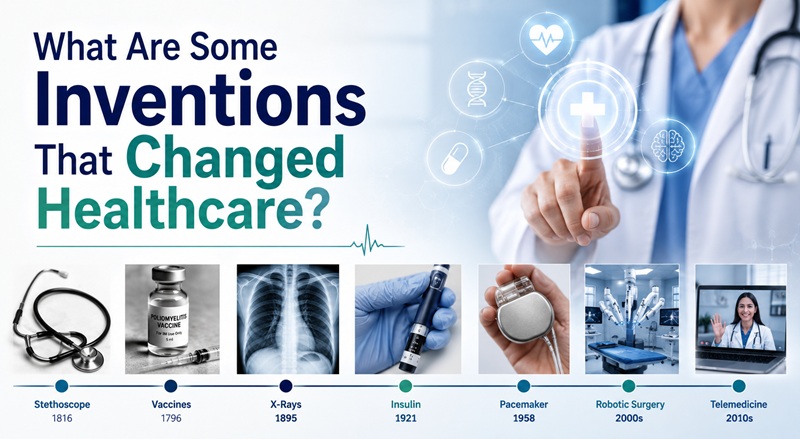
Global life expectancy in 1800 was roughly 28 years. By 2019 it had reached 72.6 years. That near-tripling of human lifespan over two centuries is not primarily the result of better diet, cleaner water, or improved shelter — though all of those helped. It is largely the story of a series of medical inventions and discoveries that remade what was survivable, treatable, and preventable.
Some of those inventions were the product of deliberate genius. Others were accidents that a prepared mind recognized for what they were. A few were so fundamental that it is genuinely difficult to imagine modern medicine existing at all without them. Here are the inventions that changed healthcare most profoundly — and why each one matters.
The Germ Theory of Disease: The Idea That Made Everything Else Possible
Before any physical invention could transform healthcare, a conceptual one had to come first. For most of human history, disease was attributed to bad air (miasma), divine punishment, or imbalances in bodily humors. The idea that invisible living organisms could invade the body and cause illness was not just unknown — it was actively rejected by the medical establishment.
That changed in the second half of the 19th century through the work of Louis Pasteur and Robert Koch, who demonstrated conclusively that specific microorganisms cause specific diseases. Pasteur’s experiments dismantled the theory of spontaneous generation. Koch identified the bacterial causes of tuberculosis, cholera, and anthrax, and developed the postulates that are still used to establish causation between a pathogen and a disease.
Germ theory is listed first here not because it was a physical invention but because without it, nothing else on this list makes complete sense. Antiseptic surgery, antibiotics, vaccines, sterilization protocols, hand hygiene — every one of these interventions is an application of germ theory. The entire edifice of modern infection control rests on it.
Anesthesia: The Invention That Made Surgery Humane
Before the middle of the 19th century, surgery was an exercise in controlled brutality. Patients were conscious throughout. Operations had to be completed as fast as possible — the best surgeons competed to amputate a limb in under a minute not out of vanity but out of necessity, because the longer the procedure lasted, the more likely the patient was to die from shock. Complex, careful surgery — the kind that saves lives today — was essentially impossible.
That changed in October 1846, when William T.G. Morton, a dentist working in Boston, publicly demonstrated the use of ether as a surgical anesthetic at Massachusetts General Hospital. A patient had a neck tumor removed while unconscious and reported feeling no pain. The watching surgeons were reported to have declared afterward: “Gentlemen, this is no humbug.”
Within months, ether anesthesia had spread to hospitals across Europe and America. The procedure changed surgery from a race against time and consciousness into a deliberate, careful clinical process. It opened the possibility of operating on the chest, abdomen, and brain — cavities that simply could not be approached in a conscious patient. Modern anesthesia, refined through subsequent generations of pharmacological development, is one of the most consequential medical innovations in history.
The fact that this demonstration happened at Massachusetts General Hospital in Boston gives it particular resonance for a Boston health publication. The original surgical theater where Morton demonstrated ether anesthesia still stands at MGH and is preserved as the Ether Dome.
Germ Theory in Practice: Antiseptic Surgery and Hand Hygiene
The knowledge that germs cause infection was only useful if it led to action. Two figures made it actionable in clinical settings.
Ignaz Semmelweis, a Hungarian physician working in Vienna in the 1840s, noticed that the mortality rate from childbed fever on the ward staffed by medical students who came directly from performing autopsies was far higher than on the ward staffed by midwives who did not. He concluded that doctors were transferring something deadly from corpses to patients on their unwashed hands. He introduced mandatory handwashing with chlorinated lime solution, and mortality rates fell dramatically. The medical establishment largely rejected his findings, and he died in an asylum — but he was right.
Joseph Lister took the principle further. Drawing on Pasteur’s germ theory, he introduced antiseptic surgical techniques in the 1860s, spraying carbolic acid over wounds, instruments, and surgical fields. Surgical mortality from infection dropped significantly. He recognized that the problem was not the operation itself but the microorganisms introduced during it — and that killing those microorganisms before they could colonize a wound changed the outcome entirely.
Together, Semmelweis and Lister laid the groundwork for sterile surgical technique and hospital infection control — disciplines that remain central to patient safety and that prevent millions of infections annually in modern healthcare settings.
The X-Ray: Seeing Inside the Body Without Opening It
On November 8, 1895, German physicist Wilhelm Röntgen was experimenting with cathode ray tubes when he noticed that a fluorescent screen across the room was glowing even though the tube was shielded. Something was passing through the shielding — something he could not see and did not immediately understand. He called it X-radiation, the X standing for unknown.
Within weeks he had produced the first medical X-ray image, a photograph of his wife’s hand showing the bones and her wedding ring in clear outline. She reportedly looked at the image and said, “I have seen my own death.”
What Röntgen had actually done was give medicine its first window into the living body without surgery. Before X-rays, diagnosing a broken bone required physical examination and inference. Detecting tuberculosis in the lungs, a foreign object in the airway, or a tumor in the chest required waiting until symptoms became severe. X-ray imaging changed the fundamental relationship between the clinician and the patient’s body — from working with external signs to seeing directly inside.
The X-ray spawned an entire lineage of medical imaging technologies: fluoroscopy, CT scanning, PET scanning, mammography, and bone densitometry. The core principle of using radiation to visualize internal anatomy, introduced in a physics laboratory in 1895, remains one of the most useful diagnostic tools in clinical medicine.
Penicillin: The Accidental Discovery That Redrew the Map of Human Mortality
At the start of the 20th century, infectious diseases were the leading cause of death. In the United States in 1900, infections accounted for roughly one-third of all mortality, with pneumonia, tuberculosis, and diarrheal diseases among the top killers. A minor cut, an insect bite, or the process of childbirth could lead to a fatal bacterial infection with no effective treatment available. In wartime, more soldiers routinely died from infected wounds than from combat itself.
In 1928, Alexander Fleming returned to his laboratory at St. Mary’s Hospital in London after a vacation and noticed that a mold had contaminated one of his Staphylococcus culture plates. Around the mold, the bacteria had died. The mold was Penicillium chrysogenum. The substance it produced was penicillin.
Fleming published his findings but was unable to purify penicillin in sufficient quantities to make it clinically useful. That step came over a decade later, when Howard Florey and Ernst Chain at Oxford developed methods to produce purified penicillin in meaningful amounts. The US and UK governments funded mass production during World War II, and by 1943 enough penicillin existed to treat Allied soldiers. The results were transformative: wound infection death rates fell dramatically.
The widespread use of penicillin in the postwar years raised life expectancy, reduced surgical mortality, and shifted the leading causes of death from infectious diseases to chronic illnesses like heart disease and cancer. It made chemotherapy and organ transplantation viable by providing infection control during immunosuppression. It created an entire pharmaceutical industry built around antibiotic research.
Penicillin’s legacy is complicated by the antibiotic resistance crisis it helped create — decades of overuse and misuse have produced strains of bacteria resistant to many existing antibiotics, a problem now recognized as one of the greatest threats to global health. But the original discovery remains arguably the most lives-saved-per-discovery in medical history.
Vaccines: Prevention at Population Scale
The concept of vaccination predates germ theory itself. Edward Jenner observed in the 1790s that milkmaids who contracted cowpox — a mild disease — seemed to be protected against smallpox, one of the most lethal diseases in human history. In 1796 he inoculated a young boy with cowpox material and then deliberately exposed him to smallpox. The boy did not develop the disease. Jenner had just demonstrated vaccination.
It took nearly a century for Pasteur to provide the scientific mechanism — understanding that a weakened or killed pathogen could train the immune system to recognize and fight the real one — and for vaccine development to accelerate. Vaccines against rabies, diphtheria, typhoid, and other diseases followed through the late 19th and early 20th centuries.
The 20th century brought vaccines that transformed child mortality. Polio, which paralyzed hundreds of thousands of children annually in the mid-20th century, was effectively eliminated from the Western hemisphere through vaccination campaigns. Measles killed roughly 2.6 million people per year before the vaccine was introduced in 1963 — that number has dropped by more than 99%. Smallpox, once the greatest infectious killer in human history, was certified as globally eradicated in 1980 — the only human disease ever to have been entirely eliminated.
Vaccines have improved child life expectancy and mortality rates by approximately 50% over the past 30 years alone. The mRNA vaccine technology demonstrated at scale during the COVID-19 pandemic opened new possibilities for vaccine development against diseases that resisted traditional approaches, from influenza to HIV to cancer.
Insulin: Transforming a Death Sentence Into a Manageable Condition
Before 1921, a diagnosis of Type 1 diabetes was essentially a death sentence. The disease — characterized by the pancreas’s inability to produce insulin, the hormone that allows cells to absorb glucose from the blood — led to starvation at the cellular level regardless of how much a patient ate. Diabetic ketoacidosis, the fatal consequence of unmanaged blood sugar, typically killed patients within months of diagnosis.
In 1921, Canadian researchers Frederick Banting and Charles Best isolated insulin from dog pancreases at the University of Toronto. In January 1922, they administered purified insulin to Leonard Thompson, a 14-year-old boy dying of diabetes in a Toronto hospital. He recovered. Within a year, insulin was being produced commercially, and patients who would have died were surviving.
The discovery of insulin transformed diabetes from an acute terminal illness into a chronic manageable condition. Today, more than 37 million Americans live with diabetes, and the vast majority — properly managed — lead full lives. The subsequent century of insulin research has produced rapid-acting formulations, long-acting basal insulins, insulin pumps, and continuous glucose monitoring systems that give patients unprecedented control over their condition.
Medical Imaging Beyond X-Rays: CT, MRI, and Ultrasound
The X-ray was only the beginning of medical imaging. Three subsequent technologies deepened what physicians could see and understand about the body’s interior in ways that X-rays alone could not provide.
Computed Tomography, the CT scan, was developed in the early 1970s by Godfrey Hounsfield and Allan Cormack, who shared the Nobel Prize for it in 1979. Where an X-ray produces a flat two-dimensional projection of the body, CT uses multiple X-ray measurements taken from different angles and computer processing to reconstruct three-dimensional cross-sectional images. The ability to visualize the brain, detect internal bleeding, identify tumors, and assess organ injury without surgery transformed emergency medicine, neurology, oncology, and trauma care.
Magnetic Resonance Imaging, MRI, uses strong magnetic fields and radio waves rather than radiation to generate detailed images of soft tissue — brain structures, spinal cord, joints, and organs — with a precision X-rays and CT cannot match for certain applications. Raymond Damadian’s foundational work on using nuclear magnetic resonance to distinguish between normal and cancerous tissue, combined with subsequent refinements by Paul Lauterbur and Peter Mansfield, led to the clinical MRI machines that are now standard in hospitals worldwide.
Ultrasound imaging, which uses high-frequency sound waves to create real-time images of internal structures, gave medicine a portable, radiation-free, real-time window into the body particularly valuable for obstetrics, cardiology, and guided procedures. The ability to visualize a developing fetus safely, in real time, transformed prenatal care.
The Stethoscope: Amplifying What the Body Communicates
Before 1816, physicians listened to the heart and lungs by pressing their ear directly to the patient’s chest. It worked — imperfectly — until French physician René Laënnec encountered a patient whose body habitus made direct auscultation ineffective. He rolled sheets of paper into a cylinder and placed it between his ear and her chest. The sound was clearer than any he had achieved with direct contact.
From that improvisation Laënnec developed the first stethoscope — a simple wooden tube — which he described and refined over subsequent years. The modern binaural stethoscope, using two earpieces connected to a chest piece by flexible tubing, became the defining symbol of medical practice and remains one of the most used diagnostic instruments in clinical medicine over two centuries later.
The stethoscope extended the physician’s senses, allowing them to hear heart murmurs, abnormal breath sounds, bowel sounds, and vascular bruits that would otherwise require imaging technology to detect. It democratized physical examination — making sophisticated auscultatory diagnosis accessible to any trained clinician with a simple, inexpensive instrument.
Antibiotics Beyond Penicillin: Building the Arsenal
Penicillin opened a door, and the decades that followed sent researchers rushing through it. The recognition that microorganisms could produce substances lethal to other microorganisms led to a period sometimes called the antibiotic golden age, roughly spanning the 1940s through the 1960s, during which most of the major antibiotic classes in clinical use today were discovered.
Streptomycin, isolated from soil bacteria in 1943 by Selman Waksman, was the first antibiotic effective against tuberculosis — the disease that had killed one in seven of all people who ever died in the 19th century. Chloramphenicol, tetracyclines, erythromycin, vancomycin, and dozens of other compounds followed, each extending the range of treatable bacterial infections.
Together, this antibiotic arsenal changed the practice of medicine in ways that extended far beyond treating infections directly. Organ transplantation became viable because post-surgical bacterial infection could be controlled. Cancer chemotherapy, which severely suppresses the immune system, became survivable because bacterial infections arising during treatment could be treated. Premature birth survival improved because neonatal infections could be managed.
The crisis of antibiotic resistance — the growing inability of existing antibiotics to kill bacteria that have evolved resistance through decades of overuse — is one of the defining medical challenges of the 21st century. The World Health Organization has identified antimicrobial resistance as one of the top global public health threats, with drug-resistant infections already killing more than a million people annually worldwide and projected to kill tens of millions more per year by 2050 if current trends continue.
The Surgical Revolution: Organ Transplantation and Open Heart Surgery
Two surgical achievements of the 20th century stand as technical landmarks that would have been science fiction a generation earlier.
Open heart surgery became possible through the invention of the cardiopulmonary bypass machine — the heart-lung machine — which takes over the work of the heart and lungs during a procedure, allowing surgeons to operate on a still, bloodless heart. C. Walton Lillehei and John Gibbon pioneered this technology in the early 1950s. The ability to stop the heart, repair its valves, bypass its blocked arteries, and restart it has saved millions of lives from heart disease — still the leading cause of death worldwide.
Organ transplantation — transferring a kidney, liver, heart, or lung from one person to another — required solving two separate problems: the surgical technique to connect blood vessels, and the immunological problem of rejection, in which the recipient’s immune system attacks the donated organ. Immunosuppressive drugs, beginning with azathioprine in the early 1960s and dramatically improved by cyclosporine in the 1970s, solved the rejection problem and made transplantation clinically viable at scale. Today, more than 150,000 organ transplants are performed annually worldwide.
mRNA Technology: The Newest Entry With Transformative Potential
The COVID-19 pandemic introduced billions of people to a technology that had been developing in research laboratories for decades: messenger RNA vaccines. Unlike traditional vaccines that use whole killed or weakened pathogens, mRNA vaccines deliver genetic instructions that teach the body’s own cells to produce a specific protein — in the case of COVID-19, the spike protein of the SARS-CoV-2 virus — triggering an immune response without introducing the actual virus.
The mRNA vaccines developed against COVID-19 were produced with unprecedented speed — less than a year from sequence identification to authorized use — because the platform had been under development for cancer treatment and infectious disease applications for years before the pandemic provided the accelerant of global urgency.
The implications extend far beyond COVID-19. Researchers are now developing mRNA vaccines against influenza, HIV, tuberculosis, and multiple types of cancer. The ability to design a vaccine against essentially any target for which a protein sequence is known, and to manufacture it rapidly, represents a genuine platform technology — not just one vaccine but a new way of building many.
The full impact of mRNA technology on healthcare is still being written. For a detailed look at how vaccines continue to evolve, the CDC’s vaccine information hub provides current guidance and research summaries.
The Inventions That Transformed Healthcare: A Summary
| Invention | When | Core Impact |
|---|---|---|
| Germ theory | 1860s–1880s | Made all infection control possible |
| Anesthesia | 1846 | Made modern surgery possible |
| Antiseptic technique | 1860s | Made surgery survivable |
| X-ray | 1895 | First non-invasive internal imaging |
| Penicillin | 1928/1940s | Turned bacterial infections from killers to treatable |
| Insulin | 1921 | Turned Type 1 diabetes from fatal to manageable |
| Vaccines | 1796 onward | Prevention at population scale |
| CT and MRI | 1970s | Three-dimensional imaging of internal structures |
| Heart-lung machine | 1950s | Enabled open heart surgery |
| mRNA technology | 2020s | New platform for vaccines and cancer treatment |
Each of these inventions changed not just medicine but what it meant to be human in the modern world — shifting what we die from, how long we live, and what we can survive. The story is not finished. Gene therapy, artificial intelligence in diagnostics, regenerative medicine, and precision oncology are being written right now, and some of them will appear on lists like this one a century from now.
