
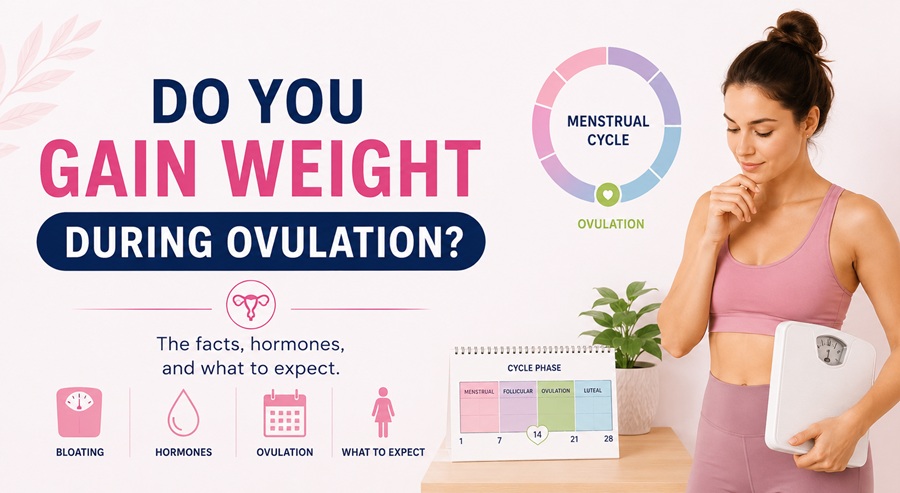
Yes, many women do gain a small amount of weight during ovulation — typically between 1 and 5 pounds — and it is almost entirely water weight, not fat. The gain is temporary, driven by hormonal shifts that cause the body to retain fluid, and it generally resolves within a few days once hormone levels begin to normalize after ovulation.
If you have stepped on the scale mid-cycle and wondered why the number is higher than usual, this is likely the explanation. Understanding what is actually happening in your body during ovulation makes the change feel far less alarming.
What Happens to Your Body During Ovulation
Ovulation occurs roughly in the middle of the menstrual cycle, around day 14 in a standard 28-day cycle, though the exact timing varies from person to person and cycle to cycle. The process is triggered by a surge in luteinizing hormone (LH) from the pituitary gland, which signals the ovary to release a mature egg into the fallopian tube.
In the days leading up to and during ovulation, the body undergoes a significant hormonal shift. Estrogen levels rise from the mid-follicular phase and peak just before the LH surge. Follicle-stimulating hormone (FSH) rises alongside LH to facilitate egg maturation. After ovulation, progesterone levels climb as the ruptured follicle transforms into the corpus luteum.
Each of these hormonal changes has physical effects on the body beyond reproductive function, and several of them directly influence fluid balance and body weight.
Why You Gain Weight: The Main Causes
Estrogen and Water Retention
Estrogen has a well-established effect on fluid balance. When estrogen levels peak around ovulation, the body tends to hold onto more water than usual. This happens at the cellular level — estrogen influences aldosterone, a hormone that regulates sodium and water retention in the kidneys. When sodium is retained, water follows it, and the result is a temporary accumulation of fluid in body tissues that shows up as weight on the scale and as puffiness or bloating in the abdomen, hands, and feet.
This water retention is not the same as gaining body fat. The scale number goes up, but the actual composition of the body has not changed in any meaningful way. The fluid redistributes and exits the body as hormone levels normalize.
LH and FSH Surges
The rapid surge in LH and FSH that triggers ovulation also contributes to fluid retention directly, independently of estrogen. These hormonal surges can cause tissues to hold more water temporarily, compounding the estrogen-driven retention. A study tracking fluid retention in 62 participants over a year found that bloating — a direct expression of this fluid accumulation — commonly began around five days before ovulation and persisted until menstruation.
Progesterone After Ovulation
In the days immediately following ovulation, progesterone levels rise. Progesterone contributes to fluid retention through a different mechanism than estrogen — it can slow gastrointestinal motility, meaning food moves through the digestive tract more slowly. This slowing causes gas buildup and digestive bloating on top of the hormonal water retention, which can make the feeling of heaviness and the scale weight more pronounced in the post-ovulatory phase than during ovulation itself.
Appetite Changes and Food Cravings
Hormonal fluctuations around ovulation do not just affect fluid balance — they affect appetite and food preferences. Some women experience a noticeable increase in hunger during the mid-cycle phase, as the body’s energy expenditure rises slightly around ovulation. The body is preparing for the possibility of fertilization and implantation, and caloric demand increases accordingly.
Cravings for sweet, salty, or high-carbohydrate foods are also common mid-cycle. High-carbohydrate foods in particular promote short-term water retention because carbohydrates are stored as glycogen in muscle and liver tissue, and each gram of glycogen is stored alongside approximately 3 grams of water. Eating more carbohydrates than usual around ovulation can therefore amplify the fluid retention that the hormones are already driving.
Breast Swelling
One contributor to ovulation-related weight that is easy to overlook is breast tissue swelling. Estrogen and progesterone both stimulate breast tissue, and many women notice their breasts feel fuller, heavier, or more tender around ovulation. This physical change contributes to total body weight even though it is localized tissue swelling rather than systemic fluid retention.
How Much Weight Is Normal to Gain?
Most women who notice ovulation-related weight gain report an increase of 1 to 5 pounds. This range is consistent across clinical observations, though individual experience varies considerably. Some women notice no change at all. Others who are particularly sensitive to hormonal fluctuations may sit toward the higher end of that range.
What is important to understand is that this weight is almost exclusively fluid. The body does not accumulate 1 to 5 pounds of fat in the span of a few days — creating that amount of fat would require consuming thousands of extra calories beyond your energy expenditure. When the number on the scale rises by 3 pounds mid-cycle and then drops again within a week without any dietary change, it is water moving in and out of tissue, not fat being gained and lost.
How Long Does the Weight Last?
The timing varies slightly depending on which phase of the cycle is driving the retention, but ovulation-related weight gain typically resolves within 3 to 5 days after ovulation as hormone levels begin to normalize. Once estrogen drops from its pre-ovulatory peak and progesterone settles into its post-ovulatory pattern, the fluid that was retained begins to be excreted through urine and the scale number returns to its pre-ovulatory baseline.
Some women find that the most significant bloating and fluid retention actually occurs in the premenstrual phase rather than at ovulation itself — this is the pattern of premenstrual syndrome (PMS), where progesterone dominance in the luteal phase drives a second wave of fluid retention before menstruation. In that case, what feels like ongoing ovulation-related weight gain is actually the luteal phase continuation.
Ovulation Weight Gain vs. Premenstrual Weight Gain
Understanding where in the cycle the weight gain is happening helps make sense of the whole picture.
During the follicular phase, in the first half of the cycle leading up to ovulation, estrogen is rising and many women feel at their lightest and least bloated. Around ovulation itself, the estrogen peak and LH surge produce the first wave of fluid retention described in this article.
In the luteal phase — the two weeks between ovulation and menstruation — progesterone rises and remains elevated. This extended progesterone exposure is associated with sustained or worsening fluid retention, digestive slowing, and breast tenderness. For many women, this is the more noticeable phase of weight fluctuation.
At the onset of menstruation, both estrogen and progesterone drop sharply, and the body sheds the retained fluid rapidly. This is why many women feel visibly less bloated in the first days of their period and notice the scale dropping despite menstrual bleeding.
Is This Weight Gain a Sign of a Problem?
For most women, the 1 to 5 pound fluctuation associated with ovulation and the luteal phase is entirely normal and requires no medical attention. It is a reflection of the body’s natural hormonal cycle functioning as intended.
It becomes worth discussing with a healthcare provider when the weight gain is significantly more than the typical range and does not resolve after menstruation, when bloating and fluid retention are severe enough to cause significant discomfort or interfere with daily life, when the pattern is accompanied by other irregular cycle symptoms, or when there is a history of conditions such as polycystic ovary syndrome (PCOS), endometriosis, or thyroid dysfunction that can alter hormonal patterns and fluid balance.
Unexplained persistent weight gain that does not follow the cyclical pattern of the menstrual cycle is a different situation entirely and warrants medical evaluation on its own terms.
Practical Ways to Manage Ovulation-Related Weight Gain
The techniques that most reliably reduce the uncomfortable aspects of ovulation-related fluid retention work with the body’s physiology rather than against it.
Reduce sodium intake in the mid-cycle window
Because estrogen drives water retention partly by promoting sodium retention in the kidneys, eating less sodium during the days around ovulation reduces the volume of fluid the body holds onto. This does not require a dramatic dietary overhaul — simply being mindful of high-sodium processed foods, salty snacks, and added salt during this window can make a noticeable difference.
Stay well hydrated
This is counterintuitive but physiologically sound. When the body is well hydrated, it has less reason to hold onto fluid defensively. Chronic low-grade dehydration signals the body to retain water as a protective response. Drinking adequate water throughout the cycle, and particularly around ovulation, supports the kidney’s ability to excrete excess fluid rather than retain it.
Light to moderate exercise
Physical activity promotes circulation and lymphatic drainage, both of which help move retained fluid out of peripheral tissues. Walking, swimming, yoga, and cycling are particularly effective because they are rhythmic and promote venous return without excessive physical stress during a time when the body may already feel heavy or uncomfortable.
Reduce refined carbohydrates around ovulation
Because glycogen storage directly drives water retention through the 3-grams-of-water-per-gram-of-glycogen mechanism, reducing intake of refined carbohydrates — white bread, pasta, pastries, sugary drinks — during the mid-cycle phase limits one of the behavioral contributors to ovulation weight gain. This does not mean eliminating carbohydrates entirely, which would be both unsustainable and unnecessary.
Magnesium
Magnesium plays a role in regulating fluid balance and has been shown in some studies to reduce premenstrual fluid retention and bloating when supplemented regularly. Foods rich in magnesium include leafy greens, nuts, seeds, and whole grains.
Track your cycle
One of the most practically useful things any woman can do to reduce anxiety about mid-cycle weight fluctuation is to track it. Using a period or cycle tracking app to record weight alongside cycle phase data reveals the pattern clearly over two or three cycles. Seeing that the scale reliably rises by 2 to 3 pounds mid-cycle and then falls after menstruation confirms the cyclical nature of the change and removes the psychological distress of unexplained weight variation.
When the Scale Is Not the Full Story
One of the most important principles for any woman monitoring her weight across a menstrual cycle is to understand that the scale is measuring total body mass — not just fat — and that total body mass fluctuates by several pounds throughout the cycle for perfectly normal physiological reasons.
Daily weight measurements across a full cycle can vary by as much as 5 to 6 pounds in some women, simply from fluid shifts driven by hormonal changes. Tracking weight only at one point in the cycle, or using a single weight measurement as a proxy for overall health trajectory, misses this normal variation entirely and can lead to unnecessary distress over numbers that would have resolved on their own.
Weekly weigh-ins at the same point in each cycle — for example, always in the early follicular phase a few days after menstruation begins, when fluid retention is lowest — give a more accurate picture of actual body composition trends over time.
For women who want to understand more about how hormonal changes across the menstrual cycle affect the body, the Office on Women’s Health at HHS provides accessible, evidence-based information on menstrual cycle physiology.
Frequently Asked Questions
Is it possible to not gain any weight during ovulation?
Yes, absolutely. Not every woman experiences noticeable weight gain around ovulation. Sensitivity to hormonal fluctuations varies considerably between individuals, and some women move through the ovulatory phase with minimal fluid retention and no scale change at all. Both experiencing the gain and not experiencing it fall within the normal range.
Does ovulation weight gain mean I am more fertile?
No. The fluid retention associated with ovulation is a side effect of the hormonal changes that drive ovulation, not an indicator of fertility quality. A woman can ovulate consistently with minimal fluid retention, and another can have significant bloating alongside irregular ovulation. The two are not clinically correlated.
Can birth control affect ovulation-related weight gain?
Yes, significantly. Combined oral contraceptives that contain estrogen and progestin suppress ovulation, which eliminates ovulation-driven hormonal fluctuations. Some women on combined contraceptives notice less cyclical weight variation. However, some hormonal contraceptives — particularly those with progestin-dominant formulations — can cause their own form of fluid retention independent of the ovulatory cycle. The specific contraceptive method and its hormonal profile determine the effect.
Why do I feel heavier right before my period than I did at ovulation?
This is a very common experience and reflects the progesterone-driven luteal phase that follows ovulation. Progesterone slows digestion, promotes further fluid retention, and sustains the bloating that may have begun at ovulation. Many women find that the week before menstruation produces more bloating and scale weight than ovulation itself, which is why premenstrual weight gain and bloating are among the most commonly reported PMS symptoms.
Should I avoid weighing myself during ovulation?
You do not need to avoid it, but contextualizing the number matters. If you weigh yourself daily, understanding that a mid-cycle increase of a few pounds is normal and temporary prevents the number from becoming a source of unnecessary anxiety. If daily weighing creates distress, weekly weighing at a consistent point in the cycle is a more psychologically sustainable approach.