
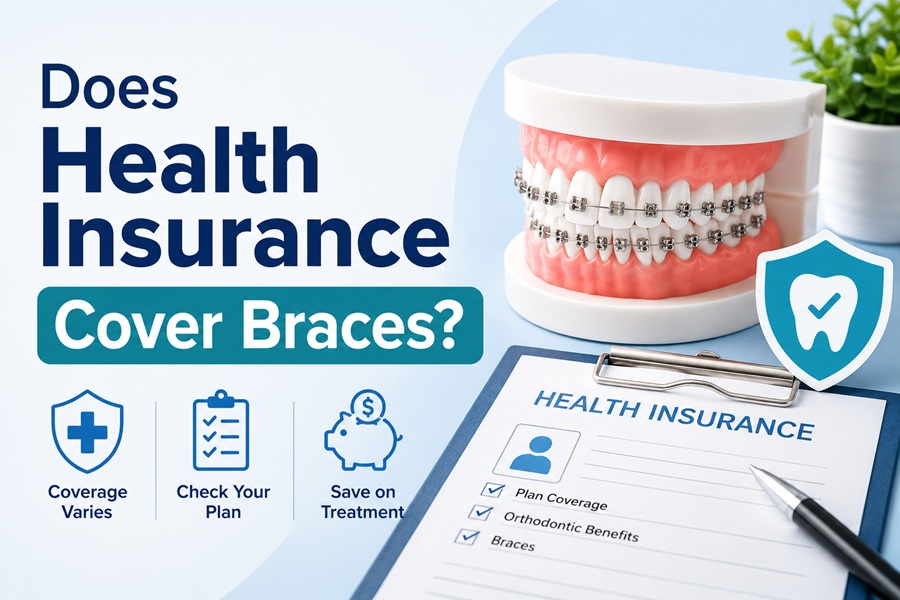
The short answer: standard health insurance typically does not cover braces. Orthodontic treatment — including braces and clear aligners — falls under dental coverage, not medical coverage, in most insurance plans. However, whether you actually pay for braces entirely out of pocket depends on several factors: whether you have dental insurance with orthodontic benefits, your age, your state, and whether your treatment qualifies as medically necessary.
Here is a complete breakdown of every insurance pathway that can help pay for braces, what each one covers, and exactly what to do to maximize your benefits.
Health Insurance vs. Dental Insurance: Why the Distinction Matters
Most Americans carry both health insurance and dental insurance as separate policies. The key point of confusion around braces coverage is that braces are almost always classified as a dental benefit — not a medical one.
Standard health insurance plans cover medically necessary procedures: hospitalizations, surgeries, medications, physician visits, and similar services. Routine dental work and orthodontics are typically excluded from medical health plans entirely, which is why most people need to purchase dental insurance as a separate policy.
The one significant exception is medical necessity — if braces are required to treat a documented medical condition rather than to straighten teeth for cosmetic or functional dental reasons, some health insurance plans will cover orthodontic treatment. This applies in limited situations, covered in detail below.
| Type of Insurance | Covers Braces? | Notes |
|---|---|---|
| Standard health insurance (employer) | Rarely | Only if medically necessary |
| Dental insurance with ortho benefits | Partially | Lifetime maximum applies |
| Dental insurance without ortho benefits | No | Must add or upgrade plan |
| Medicaid (children) | Often | Must meet medical necessity criteria |
| Medicaid (adults) | Rarely | Only a handful of states |
| CHIP | Often | Similar to Medicaid for children |
| ACA Marketplace plans (children) | Sometimes | Dental EHB must be purchased |
| HSA / FSA | Yes (reimbursement) | Pre-tax dollars reduce net cost |
Dental Insurance and Braces: How Coverage Actually Works
If you have dental insurance that includes orthodontic benefits, it will not pay for your entire treatment. Here is how the coverage math works in practice.
Most dental insurance plans cover 20% to 50% of orthodontic treatment costs. Plans also impose a lifetime orthodontic maximum — a separate cap from your annual dental maximum — that represents the most the insurer will ever pay toward orthodontic treatment for that person. Many plans include a lifetime orthodontic maximum, often $1,000 to $3,000 per person, and may cover a percentage of treatment, commonly 50%, up to that maximum.
Some specific plan examples: Delta Dental offers up to $1,500 lifetime coverage for braces, while MetLife’s High Option plan offers up to $3,500 for children and $3,000 for adults.
The practical implication is significant. For example, with $6,000 traditional braces and insurance offering 50% coverage up to a $2,000 maximum, you would still pay $4,000 out of pocket.
Key terms to know before you start treatment:
- Lifetime orthodontic maximum — The total dollar amount your plan will pay toward orthodontic treatment, ever. Once used, it is gone. The most important terms to understand are the orthodontic lifetime maximum (what your plan will pay, typically $1,000–$2,500), waiting period (how long before benefits activate), deductible (what you pay first), and co-payment (your share per service).
- Waiting period — Some plans have waiting periods before they pay for dental treatments such as braces. This can range from 6 to 18 months after enrolling in a new plan.
- Age restrictions — A plan may cover braces for children but not for adults. Always verify whether your plan’s orthodontic benefit applies to your age group.
- In-network vs. out-of-network — Out-of-network providers may result in higher out-of-pocket costs, even when they accept your insurance.
Does Dental Insurance Cover Invisalign?
Many dental insurance plans with orthodontic benefits do cover Invisalign, often at the same rate as traditional braces. The ADA notes that orthodontic coverage typically has a separate lifetime maximum, commonly between $1,000 and $2,500. Contact your insurance provider directly to confirm your specific benefits before starting treatment.
Coverage by brace type varies. Traditional metal braces receive the most comprehensive coverage, with most plans covering them at the standard 50% rate up to the lifetime maximum. Ceramic braces typically receive the same coverage as metal braces, though the higher cost means you will pay more out of pocket. Lingual braces are sometimes covered at the same rate as traditional braces, but some plans may consider them cosmetic and provide reduced or no coverage. Many modern insurance plans now cover clear aligners at the same rate as traditional braces.
When Health Insurance Does Cover Braces: Medical Necessity
Standard health insurance can cover orthodontic treatment in specific circumstances where braces are deemed medically necessary — meaning the treatment addresses a diagnosed health condition, not purely cosmetic or routine dental alignment.
Health insurance will sometimes cover orthodontics for adults when treatment is deemed medically necessary.
Medical necessity cases typically include:
- Severe malocclusion causing documented difficulty chewing or swallowing
- Cleft palate or other congenital craniofacial conditions affecting jaw structure
- Traumatic injury to the jaw or teeth requiring orthodontic correction — Medicaid typically covers braces for adults with broken jaws or dislodged teeth resulting from an accident.
- Severe skeletal discrepancies affecting bite function and documented by a physician
- Sleep apnea in some cases where orthodontic or orthopedic jaw treatment is part of the treatment plan
To pursue medical necessity coverage through your health insurer, you will typically need documentation from both a physician and an orthodontist, diagnostic records including X-rays and bite analysis, and a written medical necessity letter. Approval is not guaranteed and varies by insurer and plan.
Under the Affordable Care Act, federally funded and state-funded Medicaid insurance programs need to cover the costs of dental work if it is medically necessary.
Medicaid and Braces: Coverage for Children vs. Adults
Medicaid coverage for braces is one of the most misunderstood areas of orthodontic insurance. The rules differ sharply between children and adults, and vary further from state to state.
Children on Medicaid
In most states, Medicaid covers braces deemed medically necessary, including comprehensive evaluations, diagnostic imaging, and essential orthodontic treatment to correct severe dental issues impacting a child’s health.
The federal mandate that drives this is the EPSDT benefit — Early and Periodic Screening, Diagnostic, and Treatment. Medicaid mandates dental coverage for individuals under 21 through the EPSDT benefit, which includes orthodontic services when deemed medically necessary.
For those enrolled in Medicaid, dental coverage is required, at minimum, to provide relief of pain and infections, restoration of teeth, maintenance of dental health, and medically necessary orthodontic services.
In practice, a child must typically score above a threshold on the Handicapping Labio-lingual Deviation (HLD) index or a similar state-approved dental severity scale to qualify for Medicaid orthodontic coverage. Cases that qualify as medically necessary typically involve severe crowding, significant overbite or underbite, cleft palate conditions, or other documented dental health impairment.
Adults on Medicaid
The picture for adults is far less favorable. In most states, Medicaid dental coverage for adults is minimal or emergency-only, and orthodontic treatment for adults is rarely if ever included. Some states have expanded adult dental benefits, but comprehensive orthodontic coverage for adults on Medicaid is not standard across the country.
Only three states cover braces under Medicaid for adults. If you are an adult on Medicaid seeking orthodontic treatment, explore in-house payment plans through orthodontic offices as the most practical alternative.
CHIP: Coverage for Children Who Don’t Qualify for Medicaid
The Children’s Health Insurance Program (CHIP) covers children in families whose incomes are too high for Medicaid but too low for private insurance. CHIP provides comprehensive dental benefits similar to EPSDT, including orthodontic services when medically necessary. Coverage for braces under CHIP follows similar medical necessity rules.
CHIP provides low-cost health coverage to children, and some CHIP plans include dental and orthodontic benefits. As with Medicaid, orthodontic coverage under CHIP typically requires that a medical necessity criterion is met.
To find out if your child qualifies for Medicaid or CHIP, visit healthcare.gov or your state’s Medicaid office.
ACA Marketplace Plans and Braces
The Affordable Care Act classifies pediatric dental care as an Essential Health Benefit (EHB) — meaning insurers must make it available to children on Marketplace plans. However, this does not automatically mean braces are covered.
For kids and those under 18, insurance companies are required to provide a dental insurance option that meets the ACA requirements. In some states, if a child experiences pain or chewing difficulties, the dental provider may be required to cover all expenses.
Pediatric dental coverage under ACA plans must be offered, but it is not always bundled into the health plan premium — it may be a standalone add-on that must be separately purchased. And even when it is included, orthodontic coverage is not guaranteed without specifically verifying that the plan’s dental benefit includes orthodontics.
For adults, ACA plans are not required to include dental coverage at all.
How Much Do Braces Cost in 2026 Without Insurance?
Knowing the out-of-pocket baseline helps you assess how much your insurance is actually saving you.
Traditional metal braces are cheapest at $3,000–$7,000. Ceramic and clear aligners run a little higher. Lingual braces hidden behind the teeth reach $8,000–$13,000. Insurance covers orthodontics through a separate lifetime maximum, not your annual one.
Adults now make up roughly a third of orthodontic patients. Less insurance coverage — most orthodontic benefits are written for dependents under 18 — means adults more often pay the full fee.
| Brace Type | Average Cost (2026) | Insurance Typically Covers |
|---|---|---|
| Traditional metal braces | $3,000 – $7,000 | 25%–50% up to lifetime max |
| Ceramic braces | $4,000 – $8,500 | Same as metal in most plans |
| Clear aligners (Invisalign) | $3,000 – $8,000+ | Same as metal in many plans |
| Lingual braces | $8,000 – $13,000 | Varies; may be deemed cosmetic |
HSA and FSA: Using Pre-Tax Dollars to Pay for Braces
Even if your insurance does not cover braces, you can reduce your net cost significantly using a Health Savings Account (HSA) or Flexible Spending Account (FSA).
The IRS lists braces and other orthodontic care as a qualified medical expense in Publication 502, so both HSAs and FSAs apply. The 2026 contribution limits are $4,400 for individual HSA coverage, $8,750 for family HSA coverage, and $3,400 for FSA. HSA balances roll over year to year, which makes them useful for multi-year orthodontic treatment.
FSAs typically follow use-it-or-lose-it rules, with some plans allowing up to $680 in carryover. FSAs work especially well for the upfront costs of treatment — the down payment and initial records — since you can use a full year’s contribution at once. Either account lets you pay with pre-tax dollars, which translates to roughly 20 to 30 percent savings depending on your tax bracket.
HSA vs. FSA for braces at a glance:
| Account | 2026 Contribution Limit | Rollover | Best Used For |
|---|---|---|---|
| HSA (individual) | $4,400 | Yes — indefinitely | Multi-year treatment; long-term savings |
| HSA (family) | $8,750 | Yes — indefinitely | Families with children needing ortho |
| FSA | $3,400 | Up to $680 | Upfront costs; single-year treatments |
Note: HSA requires enrollment in a High-Deductible Health Plan (HDHP).
Other Ways to Reduce the Cost of Braces
If insurance and pre-tax accounts still leave a large gap, these options are worth exploring.
In-office payment plans. Most orthodontic offices offer their own financing — spreading the total cost over the treatment period (typically 18–24 months) with little or no interest. This is often the most flexible option and requires no credit check.
CareCredit and dental financing. Third-party healthcare financing through services like CareCredit allows patients to pay for orthodontic treatment over time with promotional interest-free periods. Be aware of deferred interest terms before signing.
Dental school clinics. Accredited dental and orthodontic school clinics offer orthodontic treatment at significantly reduced rates — typically 30–50% less than private practice. Treatment is performed by supervised graduate students and takes longer, but the clinical quality is generally high. Boston-area residents can explore programs at Tufts University School of Dental Medicine and Boston University Henry M. Goldman School of Dental Medicine.
Nonprofit programs. Programs like Smiles Change Lives and Smile for a Lifetime offer subsidized or reduced-cost orthodontic treatment for qualifying low-income families. Waiting lists can be long, but they are legitimate pathways to care.
Get multiple quotes. Getting quotes from at least two or three providers is strongly advised. Prices can vary by $1,000 or more for the same case in the same city.
Steps to Take Before Starting Orthodontic Treatment
Step 1 — Review your current dental plan. Check whether your plan includes an orthodontic benefit. Look specifically for “lifetime orthodontic maximum,” the percentage coverage, age restrictions, and any waiting period.
Step 2 — Call your insurer directly. Be sure to review how your dental insurance works to check if orthodontic coverage is included. Ask your insurance company for a written verification of benefits before treatment begins. Get the representative’s name and reference number.
Step 3 — Check Medicaid or CHIP eligibility. If your child is uninsured or on Medicaid, ask the orthodontist specifically whether they accept Medicaid and whether your child’s case meets medical necessity criteria in your state.
Step 4 — Maximize your HSA or FSA. If you have access to either account, plan your contributions around your treatment timeline. HSA funds can be saved over multiple years; FSA funds are best used for the year treatment begins.
Step 5 — Ask your orthodontist’s office to verify benefits. Most orthodontic offices will verify your insurance coverage on your behalf before your first appointment and provide an estimate of your out-of-pocket costs.
Frequently Asked Questions
Does regular health insurance ever pay for braces?
Rarely, and only in medically necessary cases — such as severe jaw trauma, cleft palate conditions, or documented functional impairment affecting eating or breathing. In these cases, a physician and orthodontist must both document the medical necessity, and approval still varies by plan.
At what age does insurance stop covering braces?
Most dental plans with orthodontic benefits impose an age limit, commonly 18 or 19, for dependent children. Adults now make up one-third of orthodontic patients in the U.S., but adult orthodontic coverage is less standard and often lower. Always verify your specific plan’s age cutoff.
Can I add orthodontic coverage to my existing dental plan?
Some insurers offer orthodontic coverage as an add-on rider for an additional monthly premium. This is worth considering if you are planning treatment within the next few years — but watch for waiting periods that may delay when benefits activate.
Does insurance cover a second round of braces?
The lifetime orthodontic maximum is exactly that — lifetime. If your plan paid out its maximum during a previous round of treatment, no additional orthodontic benefit remains under that plan, ever.
Is Invisalign covered the same as metal braces?
Many dental insurance plans with orthodontic benefits do cover Invisalign, often at the same rate as traditional braces. However, some older plans still limit orthodontic coverage to traditional braces only. Verify with your specific insurer.