
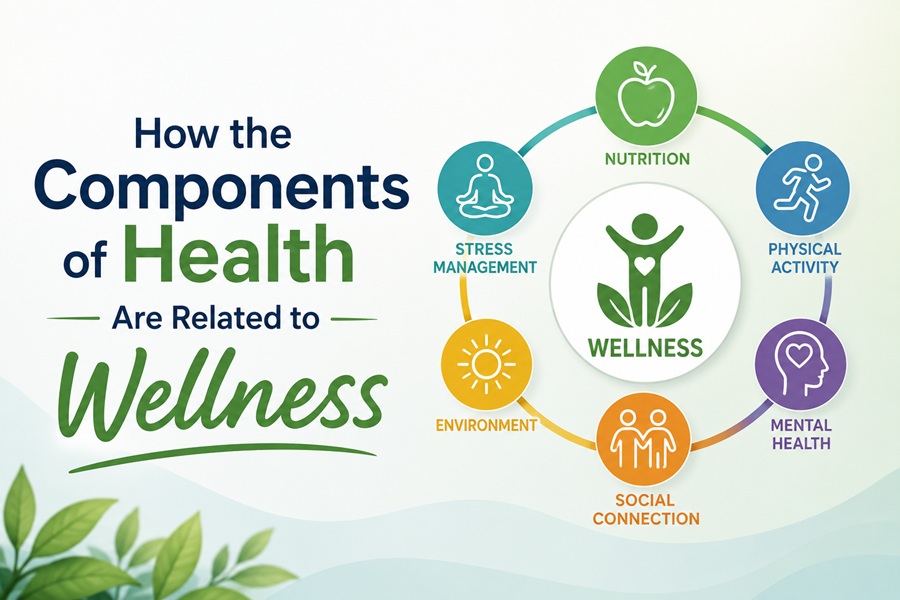
Most people think of health as something binary — you either have it or you don’t. But that framing misses almost everything important about how the human body and mind actually work. Health is multidimensional, and wellness is what happens when those dimensions work together. Understanding how the components of health connect to each other is not just an academic exercise — it changes how you make decisions about your own life every day.
Health and Wellness Are Not the Same Thing
Before getting into the components, it helps to draw a clear line between health and wellness, because the two terms get swapped constantly and imprecisely.
Health is a state — a condition of your body and mind at any given point. The World Health Organization defines it as complete physical, mental, and social well-being, not merely the absence of disease. That definition is important because it explicitly rejects the old model of health as simply “not being sick.”
Wellness is something different. It is a process — the active, ongoing effort to move toward better health across every dimension of your life. You can be technically healthy by clinical measures and still have poor wellness. A person who is physically fit but chronically isolated, mentally exhausted, and financially overwhelmed is not well in any meaningful sense of the word.
The relationship between health and wellness is directional: the components of health are the raw material, and wellness is what you build with them through conscious daily choices.
The Eight Components of Health
Modern health science recognizes eight core dimensions of health. Each one contributes to overall wellness — and critically, each one influences the others.
1. Physical Health
Physical health is the most visible dimension and the one most people focus on first. It covers how well your body functions — cardiovascular fitness, muscular strength, nutrition, sleep quality, immune response, and freedom from chronic disease.
What makes physical health so central to wellness is its reach into every other dimension. Poor sleep impairs emotional regulation and decision-making. Chronic pain increases depression risk. Inadequate nutrition affects concentration and mood. Physical health is the biological foundation that either supports or undermines everything else you are trying to build.
The reverse is equally true. Mental stress triggers cortisol release, which over time damages cardiovascular health, suppresses immune function, and disrupts sleep. Social isolation correlates with higher rates of heart disease. The body does not operate in a vacuum — it is continuously responding to psychological and social inputs.
2. Mental and Emotional Health
Mental health is not simply the absence of a diagnosable disorder. It is the ability to think clearly, regulate emotions, cope with stress, maintain perspective during hardship, and engage meaningfully with the world around you.
This component sits at the center of the wellness system because it has the widest connections. When mental health deteriorates, almost every other dimension is pulled with it. Motivation to exercise drops. Appetite shifts. Social withdrawal begins. Work performance suffers. Financial decisions become erratic. Meaning and purpose feel out of reach.
Conversely, strong emotional health amplifies every other component. People who manage stress well tend to sleep better, maintain healthier relationships, make more consistent long-term decisions, and experience better physical health outcomes across almost every measure.
3. Social Health
Social health is the quality of your relationships — with family, friends, colleagues, and community — and the degree to which you feel connected and supported.
This component is consistently underestimated, and the research that has emerged over the past decade has been striking. A 2023 meta-analysis pooling data from over 2.2 million people across 90 cohort studies found that loneliness was associated with a 14% increased risk of all-cause mortality. That figure puts chronic social isolation in the same risk category as smoking and obesity for long-term health outcomes. (Source: Nature Human Behaviour, 2023)
Social health affects physical health through multiple pathways — behavioral, psychological, and biological. Isolated people tend to have poorer diets, lower physical activity levels, worse sleep, and higher inflammatory markers. The relationship between social and mental health is bidirectional: loneliness increases the risk of depression, and depression increases the risk of further social withdrawal, creating a reinforcing cycle that is difficult to break without deliberately addressing both.
4. Intellectual Health
Intellectual health is the ongoing engagement of your mind — learning, creating, problem-solving, questioning, and growing. It is not about intelligence. It is about the habit of keeping your mind active and challenged.
This dimension connects to wellness in ways that compound over time. Regular intellectual engagement is one of the most protective factors against cognitive decline in older adulthood. It generates a sense of competence and accomplishment that feeds emotional wellbeing. It gives people tools to navigate health information, make better decisions, and advocate for themselves in medical and financial contexts.
When physical or mental health is compromised — through fatigue, depression, or chronic pain — intellectual engagement is often among the first things to go. Restoring it is therefore both a consequence and a driver of recovery.
5. Spiritual Health
Spiritual health is the sense of meaning, purpose, and connection to something larger than yourself. It does not require religious belief, though for many people religious practice is the primary vehicle for spiritual wellness.
The research on purpose and health is more robust than most people realize. People with a strong sense of life purpose have lower rates of depression and anxiety, better sleep, lower risk of cardiovascular events, and longer life expectancy. Purpose appears to act as a buffer against stress — people with clear meaning in their lives recover from adversity more quickly and maintain healthier behaviors during difficult periods.
Spiritual health also anchors the other components. It is harder to prioritize long-term physical health when you lack a compelling reason to do so. Purpose gives that reason. It connects daily choices — what you eat, how you treat others, how you spend your time — to something that feels genuinely important.
6. Environmental Health
Environmental health refers to the physical surroundings in which you live, work, and spend your time — and how those surroundings affect your body and mind.
This is one of the most underappreciated components of wellness because its effects are largely invisible and cumulative. Living near green space reduces cortisol levels and increases physical activity. Chronic exposure to noise pollution disrupts sleep and raises blood pressure. Poor air quality accelerates cardiovascular and respiratory disease. Unsafe or unstable housing creates persistent stress that cascades into mental and physical health impairment.
Environmental health also shapes behavior. Neighborhoods with accessible parks, walkable streets, and fresh food options make healthy choices easier. Neighborhoods without those features make them harder — not impossible, but harder in ways that compound daily over years and decades.
7. Occupational Health
Occupational health encompasses how your work life — its demands, its rewards, its culture, and its relationship to the rest of your life — affects your overall wellbeing.
Work matters for wellness beyond the paycheck it generates. Meaningful work provides structure, identity, purpose, and social connection. People who find their work engaging and purposeful consistently report better mental health outcomes than those who feel disengaged or trapped. On the other hand, environments characterized by chronic overwork, poor management, role conflict, or lack of autonomy are significant drivers of anxiety, depression, and burnout — all of which spill directly into physical and social health.
Work-life balance is not a soft concept. It is a measurable health variable with documented effects on sleep quality, relationship quality, and long-term physical health.
8. Financial Health
Financial health — the ability to meet your needs, manage unexpected expenses, and feel secure about your economic future — is a health variable in the most literal sense.
Chronic financial stress is physiologically damaging. It activates the same stress response systems as physical threats, keeping cortisol levels elevated over extended periods. The long-term consequences include increased risk of hypertension, impaired immune function, sleep disorders, and depression. Financial strain also constrains access to every other component of health — healthier food costs more, gym memberships cost money, therapy costs money, safe housing costs money.
Importantly, research consistently shows that beyond a threshold of basic security, additional wealth has diminishing returns on wellbeing. What matters most for long-term wellness is not wealth accumulation but financial stability — the absence of chronic economic stress.
How the Components Interact: A System, Not a List
The most important thing to understand about these eight components is that they do not function independently. They form a system, and that system is continuously self-reinforcing in either direction.
When one component is compromised, the others are rarely far behind. Consider what happens when someone loses their job. Financial stress rises immediately. Sleep deteriorates. Anxiety and depression emerge or worsen. Social withdrawal often follows — both from shame and from reduced social activity that was previously work-based. Physical health declines as routines collapse. Purpose and meaning become harder to access. Environmental health may deteriorate if housing becomes unstable.
A single disruption in one dimension cascades across the system.
The same interconnection works constructively. Regular exercise improves sleep and mood. Better mood restores motivation to socialize. Stronger social connections generate a sense of belonging and purpose. A clearer sense of purpose drives better occupational engagement. Improved financial stability reduces chronic stress. Lower stress improves cardiovascular health. And all of it feeds back into better sleep, completing the loop.
This is why the most effective approaches to wellness are holistic — they address multiple components simultaneously rather than treating each one as a separate problem with a separate solution.
Wellness Is Movement, Not a Destination
One of the most useful shifts in how health scientists now think about wellness is the move away from a binary model toward a continuum. Health is not something you either have or lack. It exists on a spectrum across every dimension, and people move along that spectrum constantly — in both directions — based on their circumstances and choices.
This framing is both more accurate and more empowering. It means that no one is permanently locked out of wellness by a chronic condition, a difficult past, or current hardship. It also means that no one can simply arrive at wellness and stop working. The goal is not to reach a perfect score across all eight dimensions. It is to move, consistently and deliberately, in the direction of better.
Small improvements compound. A 20-minute walk improves mood, sleep quality, and — if done with another person — social connection. One change touches three dimensions at once. This is how the system works in your favor when you understand it.
Key Takeaway
The components of health — physical, mental, social, intellectual, spiritual, environmental, occupational, and financial — are not separate categories to be managed one at a time. They are dimensions of a single interconnected system. Wellness is the state that emerges when those dimensions are actively and simultaneously cultivated. Neglect any one of them long enough, and the others will eventually reflect it. Invest in any one of them meaningfully, and the others tend to benefit as well.
That is the relationship between the components of health and wellness — not a list to memorize, but a system to understand and live inside of.
