
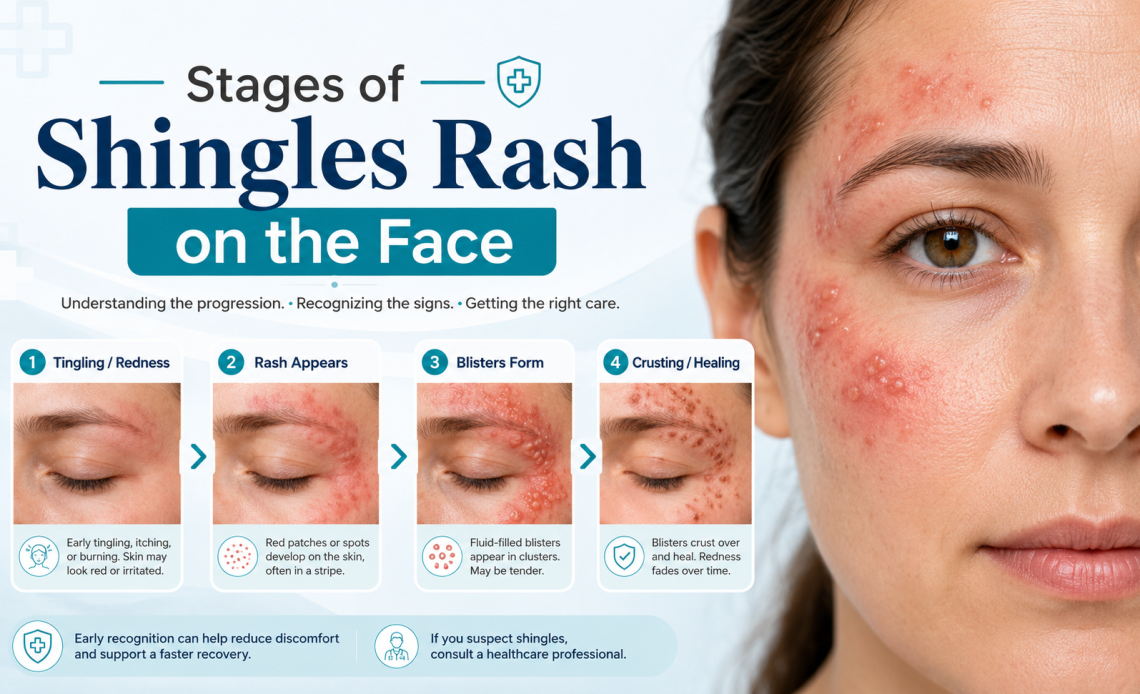
The Four Stages, Roughly in Order
| Stage | What You’ll Notice | Typical Duration |
| 1. Prodromal (pre-rash) | Tingling, burning, or aching on one side of the face, sometimes headache or general malaise, no visible rash yet | 1 to 4 days |
| 2. Early rash | Red, pink, or violet patches appear on one side, following the path of a single nerve | 1 to 3 days before blisters form |
| 3. Blistering (active) | Clusters of fluid-filled blisters develop over the red patches; this is the most painful and contagious stage | About 3 to 5 days of new blisters forming |
| 4. Crusting and healing | Blisters break open, dry out, and scab over as the skin begins to repair itself | 1 to 2 weeks, full clearing by 3 to 4 weeks |
The one-sided pattern is a genuine hallmark here. Shingles on the face almost always stays on the left or right, respecting the midline of the forehead and nose, rather than crossing to both sides.
Why a Facial Rash Gets Treated With More Urgency
The nerve most often involved in facial shingles is a branch that also serves the eye. When that branch is affected, the condition is called herpes zoster ophthalmicus, and it raises the risk of corneal damage, vision changes, and in some cases permanent vision loss if the eye itself becomes involved.
One early clue doctors watch for is a rash tip appearing on the side or tip of the nose, sometimes called Hutchinson’s sign, since the nerve branch supplying that area of skin also supplies the eye. This is why any facial rash following the pattern above deserves a same-week, ideally same-day, medical evaluation rather than a wait-and-see approach.
Facial Shingles vs Shingles on the Torso
| On the Face | On the Torso |
| Higher urgency due to eye involvement risk | Lower urgency, though still needs treatment |
| Can affect vision, hearing, or facial nerve function | Complications mostly limited to skin and long-term nerve pain |
| May cause drooping or weakness on one side of the face if a facial nerve is involved | Rarely affects nearby muscle function |
| Same antiviral treatment window, but with more urgency | Antivirals ideally started within 72 hours |
What Each Stage Feels Like, Not Just Looks Like
- Stage 1: often described as an electric, burning, or ‘sunburn-like’ sensation with no visible cause
- Stage 2: mild itching or increasing tenderness as the skin discoloration appears
- Stage 3: sharp, often severe pain, sometimes bad enough that clothing, wind, or hair touching the area feels unbearable
- Stage 4: pain typically starts easing as crusting begins, though itching during healing is common
Pain that continues well after the rash has fully healed is a separate, later complication called postherpetic neuralgia, which is more likely in people over 50.
Complications That Are More Likely With Facial Involvement
- Eye involvement (herpes zoster ophthalmicus), which can affect the cornea and vision
- Facial nerve palsy, causing temporary weakness or drooping on the affected side
- Hearing changes or balance issues if the rash involves the ear (Ramsay Hunt syndrome)
- Bacterial skin infection if blisters are scratched or not kept clean
- Postherpetic neuralgia, lingering nerve pain after the rash clears
Who’s More Likely to Get Shingles on the Face Specifically
- Adults over 50, since risk rises steadily with age
- Anyone with a weakened immune system, from illness or medication
- People under significant physical or emotional stress, which can trigger viral reactivation
- Anyone who has previously had chickenpox, which is nearly everyone born before routine childhood vaccination began
- People who haven’t received the shingles vaccine, which lowers overall risk
What to Actually Do, Stage by Stage
- At the first sign of one-sided tingling or pain on the face, call a doctor rather than waiting for a rash to confirm it, since antivirals work best started early.
- Once a rash appears, get evaluated within 72 hours if at all possible, sooner if it’s anywhere near the eye.
- During the blistering stage, keep the area clean and covered, avoid touching or scratching, and take prescribed antivirals exactly as directed.
- Use cool compresses and over-the-counter pain relief for comfort during the most painful stage.
- Avoid contact lenses and eye makeup on the affected side until a doctor has ruled out eye involvement.
- During crusting and healing, keep the area moisturized and protected, and avoid picking at scabs.
- Watch for new or worsening eye symptoms even after starting treatment, and report them immediately.
Signs This Needs Same-Day Medical Attention
- Any rash near the eye, eyelid, or tip of the nose
- Eye redness, pain, light sensitivity, or blurred vision
- New weakness or drooping on one side of the face
- Hearing changes, ear pain, or dizziness alongside the facial rash
- A rash that is spreading rapidly or becoming widespread rather than staying to one side
- Fever alongside a worsening rash
A Few Misconceptions Worth Correcting
A facial rash isn’t automatically shingles just because it’s painful. Other conditions can cause one-sided facial pain or rashes, which is exactly why a same-week evaluation matters, both to confirm shingles and to rule out equally serious the alternatives.
You can’t catch shingles from someone with shingles. What can happen is that someone who has never had chickenpox, or the chickenpox vaccine, can catch chickenpox from contact with an active shingles rash.
Waiting to ‘see if it gets worse’ is a common but risky instinct with facial shingles specifically, since the antiviral treatment window is time-sensitive and eye involvement can escalate quickly.
Where This Information Comes From
This staging pattern is consistent with the clinical description published by the CDC’s clinical overview of shingles, which outlines how the rash develops from clustered vesicles into scabbing over roughly 2 to 4 weeks.
For more on when facial or eye-area shingles specifically requires urgent care, Mayo Clinic’s overview of shingles symptoms and complications outlines the same-day warning signs in more detail.
When to Get Seen, and Where
Any suspected shingles on the face is worth a same-day or next-day appointment, not a wait-it-out approach. If it’s anywhere near your eye, treat it as urgent rather than routine.
If you don’t already have a primary care doctor or dermatologist to call, this guide to finding a doctor in Boston can help you find someone who can see you quickly.
Shingles is one of several viral rash conditions where the pattern and timing of the rash matter for diagnosis. If you’re trying to rule out something else first, our day-by-day guide to hand, foot, and mouth disease walks through a different but sometimes visually similar viral rash progression, particularly relevant if young children in the household have also been unwell.
The Short Version
Facial shingles moves through the same four stages as shingles anywhere else, tingling, rash, blistering, then crusting, but the location raises the stakes because of how close the affected nerves sit to the eye. A one-sided rash on the face, especially with any tingling beforehand or involvement near the nose or eye, is worth a same-day medical evaluation rather than a wait-and-see approach.
Questions People Ask About Facial Shingles
Can shingles on the face spread to both sides?
It’s very uncommon. Shingles almost always stays on one side of the face, respecting the midline, unless the immune system is significantly compromised.
How do I know if shingles is affecting my eye?
Watch for eye redness, pain, light sensitivity, blurred vision, or a rash near the tip or side of the nose, all of which warrant urgent evaluation.
Is facial shingles more painful than shingles elsewhere?
Pain intensity varies by person more than by location, but facial nerves are densely packed with sensation, so many people do find facial shingles especially uncomfortable.
Can shingles on the face cause permanent facial weakness?
It’s uncommon but possible if a facial nerve is involved. Prompt treatment lowers this risk, which is part of why early evaluation matters.
How long is someone with facial shingles contagious?
Until all blisters have crusted over. Before that, direct contact with blister fluid can transmit the virus to someone who hasn’t had chickenpox.
Will antiviral medication still help if I’ve had the rash for a few days?
It’s most effective within 72 hours, but doctors often still prescribe it beyond that window, especially with facial or eye involvement, since the risk of complications is higher.
Does the shingles vaccine prevent facial shingles specifically?
The vaccine lowers overall risk of shingles anywhere on the body, including the face, and also reduces the risk of complications if shingles does occur.
Should I go to urgent care or wait for my regular doctor?
If your regular doctor can’t see you same-day and there’s any rash near the eye, urgent care or an ophthalmologist is the safer choice rather than waiting.
