
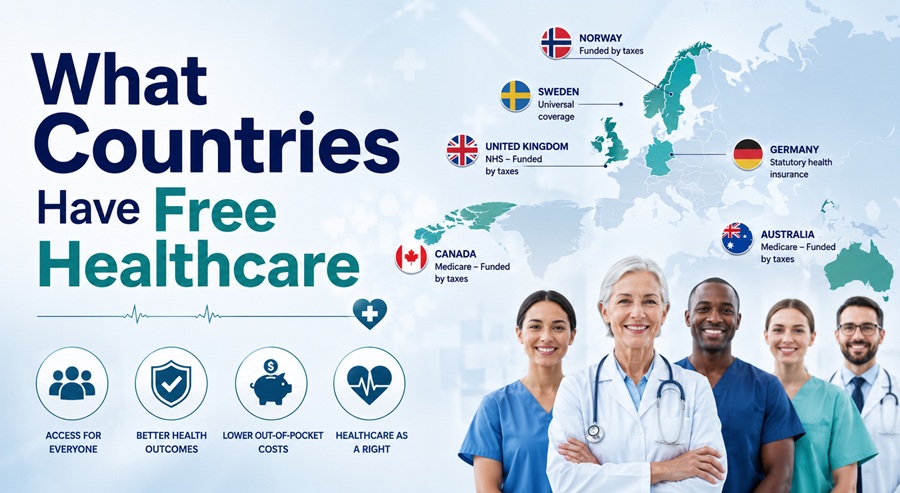
The phrase “free healthcare” is used constantly in political debate, and it misleads almost everyone who hears it. No healthcare system in the world is genuinely free — doctors, hospitals, medications, and equipment all cost money, and that money has to come from somewhere. What people mean when they ask which countries have free healthcare is: which countries provide healthcare at no direct cost at the point of use, funded instead through taxation or mandatory contributions?
The answer is a substantial portion of the developed world. Approximately 78 countries have some form of universal or publicly funded healthcare system. But the quality, comprehensiveness, and actual cost to individuals varies enormously — and understanding the differences between the major models reveals why simply having universal healthcare does not guarantee a good healthcare system, and why the absence of it does not automatically mean catastrophic outcomes.
The United States remains the only wealthy developed nation without a universal healthcare system, a fact that makes this topic particularly relevant for American readers thinking about what alternatives look like in practice.
What “Free” Actually Means
Before going country by country, the terminology is worth unpacking because it shapes the entire conversation.
Healthcare systems described as “free” are free at the point of service. When a resident of the United Kingdom sees a general practitioner, goes to the emergency department, has surgery, or receives cancer treatment through the National Health Service, they hand over nothing at the desk. No copay, no deductible, no bill that arrives weeks later. That is what free at the point of service means.
What they do pay is taxes. The NHS is funded through general taxation and National Insurance contributions taken from paychecks. In that sense, residents pay for healthcare — just collectively through taxation rather than individually at the time of care. The difference matters enormously in practice: taxation spreads risk across the entire population, whereas fee-for-service billing concentrates risk on individuals at their most vulnerable moments.
Systems described as universal but not fully “free” operate differently. France reimburses roughly 70 to 80 percent of healthcare costs, leaving patients to cover the remainder — typically through supplemental private insurance that most workers carry through their employers. Germany requires residents to enroll in statutory health insurance funded by mandatory payroll contributions. Switzerland mandates that every resident purchase private health insurance, with the government subsidizing premiums for low-income households. All three are universal. None are completely free.
The Four Basic Models
Healthcare systems worldwide roughly follow four structural models, and knowing which a country uses explains most of what you need to know about how it works.
The Beveridge Model — named after William Beveridge, who designed the British welfare state — funds healthcare entirely through taxation and delivers it through government-owned facilities with government-employed or government-contracted providers. Healthcare is free at the point of use, and there is no role for private insurance in covering basic care. The United Kingdom, Spain, and the Nordic countries broadly follow this model.
The Bismarck Model — named after German Chancellor Otto von Bismarck, who created the world’s first universal healthcare system in 1883 — funds coverage through mandatory payroll deductions from both employers and employees, which flow into non-profit “sickness funds.” Everyone is covered, but the insurance and delivery systems involve a mix of public and private actors. Germany, France, Japan, and Belgium use variations of this model.
The National Health Insurance Model combines elements of both. The government operates as the single insurer — collecting premiums, setting coverage rules, and paying providers — but delivery is primarily through private physicians and hospitals. Canada is the most prominent example.
The Out-of-Pocket Model is the default in countries that have not implemented universal coverage. People pay directly for care when they can afford it and go without when they cannot. Much of sub-Saharan Africa, Southeast Asia, and parts of Latin America still operate this way for large portions of their populations. It is also, effectively, how a significant minority of Americans without insurance experience the US system.
Countries With Free or Near-Free Healthcare at the Point of Use
United Kingdom
The National Health Service, established in 1948 under the post-war Labour government, is one of the world’s largest and most studied publicly funded healthcare systems. It covers every UK resident — regardless of income, employment status, citizenship, or immigration status — for essentially all medical care, including GP visits, specialist referrals, hospitalizations, surgery, mental health services, and emergency care. There are no charges at the point of use for most services.
Dentistry and optometry are partially exempt from the full NHS coverage model, with patients paying regulated, subsidized fees rather than market rates. Prescription medications carry a flat charge per item for working-age adults in England, though children, the elderly, pregnant women, and people on low incomes receive them free.
The NHS is funded primarily through general taxation and National Insurance contributions, which together represent about 8 to 9 percent of GDP. It employs roughly 1.5 million people, making it one of the largest employers in the world.
The system’s strengths are well documented: near-universal access, no financial barrier to care, and some of the lowest administrative costs of any developed-world healthcare system. Its widely discussed challenges are equally documented: long waiting times for elective procedures and specialist referrals, underfunding relative to comparable systems, staffing shortages, and significant variation in quality between regions.
Canada
Canada’s system, formally called Medicare, is a network of thirteen provincial and territorial health insurance plans rather than a single national system. The federal government sets minimum standards through the Canada Health Act and provides funding to provinces, which design and operate their own plans.
For residents, care is free at the point of service for all medically necessary hospital and physician services. There are no user fees for covered services. What is notably not covered by the public system in most provinces is prescription medications outside hospitals, dental care, vision care, and long-term care — a gap that has driven debate about expanding coverage for decades.
Canada sits in an interesting position internationally: its system is genuinely universal for core services and its outcomes are strong by many measures, but it faces persistent wait time challenges and per-capita outcomes that trail some European systems despite relatively high spending.
Australia
Australia’s universal system, called Medicare, was introduced in 1984 and operates as a national health insurance program funded through a combination of general taxation and a dedicated Medicare levy of 2 percent of taxable income.
Medicare covers visits to GPs and specialists — either fully, or with a government rebate that covers a substantial portion of the standard fee — as well as hospital treatment in public hospitals, including surgeries and procedures. Many GPs bulk-bill, meaning they charge only what Medicare reimburses and the patient pays nothing. Those who do not bulk-bill charge a gap fee above the Medicare rebate.
Australia maintains a parallel private health insurance sector that covers private hospital rooms, choice of surgeon, and services not covered by Medicare. The government encourages private insurance through tax incentives and a levy on higher earners who do not hold private coverage.
Nordic Countries: Denmark, Norway, Sweden, Finland
The Nordic countries consistently rank among the world’s best healthcare performers and operate some of the most comprehensive public systems. All are funded primarily through taxation and provide care free or nearly free at the point of service, with only modest caps on out-of-pocket spending.
Denmark provides free healthcare funded entirely through taxation with no copays for doctor visits, hospital stays, or emergency care. Dental care for children under 18 is also free. The system is organized around strong primary care with a registered GP acting as the entry point for all specialist care.
Norway operates through a combination of tax funding and the Government Pension Fund. GP visits carry a small fee of roughly 25 US dollars, but annual out-of-pocket costs are capped at approximately 250 dollars, after which all care is free for the rest of the year. Norway spends more per capita on healthcare than almost any country in the world outside the United States.
Sweden funds its healthcare through regional taxation managed by 21 regional councils. Patient fees are capped annually — around 100 US dollars for outpatient visits and 200 US dollars for prescription medications per year. Beyond those caps, all care is free.
Finland operates a mixed model of municipal public healthcare and occupational health services provided by employers, with the public system providing comprehensive coverage for all residents.
France
France’s system is consistently rated among the best in the world by international health organizations and represents a model that blends social insurance principles with strong universal access. Workers and employers both contribute mandatory payroll taxes into a national insurance fund (Assurance Maladie), which reimburses 70 to 80 percent of the cost of most medical services.
The remaining 20 to 30 percent is typically covered by supplemental private insurance, called mutuelle, which most French workers carry through employer benefit plans. For low-income residents, the government provides supplemental coverage free of charge, making care effectively free for the most vulnerable.
What makes the French system distinctive is its combination of near-universal access with genuine patient choice — residents can see any doctor, specialist, or hospital they choose without referral requirements, and reimbursement follows them. The system has low wait times, high physician density, and among the best health outcomes in the developed world.
Germany
Germany operates the world’s oldest universal healthcare system, introduced by Chancellor Bismarck in 1883 as a social insurance program for industrial workers. That fundamental structure — mandatory contributions from employers and employees flowing into regulated, non-profit insurance funds — remains at the core of the system today.
About 87 percent of the German population is covered by statutory health insurance through approximately 100 competing non-profit sickness funds. High earners above a threshold income can opt out of the statutory system into private insurance. The statutory system covers comprehensive care including doctor visits, hospital treatment, prescription medications, mental health services, dental care, and preventive services, with minimal copays.
Germany’s system produces strong outcomes with notably shorter wait times than the UK or Canada, reflecting higher healthcare spending and greater use of private providers operating within the regulated statutory framework.
Japan
Japan’s universal health system covers all residents through mandatory enrollment in one of two programs: an employment-based insurance scheme or a community-based national health insurance program for the self-employed and unemployed. Premiums are income-based and generally affordable.
The system uses a cost-sharing model in which patients typically pay 30 percent of costs, with the government or insurance covering the remaining 70 percent. For the elderly and children, cost-sharing rates are lower. Out-of-pocket costs are capped monthly by income level, preventing catastrophic expenses.
Japan achieves remarkable outcomes on this model: the world’s highest life expectancy, very low infant mortality, and high rates of preventive care utilization, while spending significantly less per capita than the United States.
Brazil
Brazil stands out among middle-income countries for the ambition and scope of its public healthcare system. The Sistema Único de Saúde, known as SUS, provides free healthcare to everyone present in Brazil — citizens, permanent residents, tourists, refugees, and undocumented immigrants — with no prior enrollment, application, or paperwork required.
The SUS covers primary care through family health teams embedded in communities, hospital treatment, surgery, medications on the national formulary, and emergency services. It is funded through federal, state, and municipal taxation. Brazil’s inclusive approach — covering anyone within its borders regardless of status — is arguably the most universally accessible system in the world by formal policy, even if resource constraints create significant quality variation in practice.
Cuba
Cuba is frequently cited as a remarkable outlier: a low-income country that achieves health outcomes comparable to wealthy nations through an entirely government-operated healthcare system with no charges at any point of service.
Cuba has more doctors per capita than virtually any country in the world and has achieved infant mortality rates lower than the United States. Life expectancy is comparable to many wealthy European countries. The system operates through neighborhood family doctor-nurse pairs providing primary care, polyclinics offering outpatient specialist services, and hospitals for inpatient care — all entirely free, entirely public, and extensively preventive in orientation.
Cuba’s health outcomes coexist with severe limitations in medications, medical equipment, and hospital infrastructure caused by chronic resource constraints and trade sanctions. The system’s outcomes reflect the prioritization of human resources — training enormous numbers of doctors and deploying them in the community — rather than technological sophistication.
How These Systems Compare to Each Other and to the United States
The Commonwealth Fund, a nonprofit research organization, conducts comprehensive annual comparisons of healthcare systems in wealthy nations. Its 2024 report ranked Australia first overall, followed by the Netherlands and the United Kingdom. The United States ranked last among the eleven countries studied — despite spending more per capita on healthcare than any other country in the world by a large margin.
The United States spends approximately 12,000 US dollars per person per year on healthcare. The United Kingdom, which provides comprehensive free care to all residents, spends approximately 5,300 dollars per person. Germany spends about 8,000 dollars. Canada spends around 6,300 dollars.
The American system’s higher spending does not produce better outcomes on population-level measures — life expectancy, infant mortality, chronic disease burden, or preventable mortality. It does produce extremely high performance on some process measures, like speed of specialist access for insured patients, availability of advanced technology, and cancer survival rates for patients who receive treatment. The gap between insured and uninsured Americans accounts for much of the divergence between those process strengths and population-level weaknesses.
Approximately 4.6 billion people globally — roughly half the world’s population — still lack access to essential health services, according to the World Health Organization. The gap is sharpest in sub-Saharan Africa and parts of South and Southeast Asia, where out-of-pocket payment models mean that illness remains a leading driver of poverty.
The Trade-Offs: What Free Healthcare Costs and What It Does Not Deliver
No healthcare system perfectly solves the fundamental problem of how to provide unlimited human health needs with finite resources. The countries with the most comprehensive free systems have trade-offs that their residents live with daily.
Wait times are the most commonly cited challenge. The UK’s NHS and Canada’s Medicare both face significant waiting periods for elective procedures, non-urgent specialist appointments, and in some cases diagnostic imaging. A Canadian waiting months for a hip replacement or an NHS patient waiting weeks to see a dermatologist is experiencing a real limitation of systems that provide access to everyone but must ration the timing of care.
Quality variation exists within all systems, frequently along geographic lines. Rural and low-income areas within universal-coverage countries often receive lower-quality care than urban centers, regardless of whether the system is nominally free to all.
Pharmaceutical coverage is uneven. Many universal systems provide strong coverage for hospital care and physician services but weaker coverage for outpatient prescription medications — Canada being the most prominent example among wealthy nations.
Administrative complexity and taxation represent the genuine financial cost that residents of universal systems pay, even if they pay nothing when they visit a doctor.
None of these trade-offs argue against universal coverage as a goal — the evidence consistently shows that universal systems produce better population health outcomes at lower aggregate cost than fragmented, market-based systems. They do argue against imagining that any system has solved the resource allocation problem entirely. For context on how the United States compares to these international systems, the Commonwealth Fund’s international health policy comparisons provide the most rigorous annually updated data available.
Frequently Asked Questions
Is healthcare in Canada actually free?
For covered services — hospital care and physician visits — it is free at the point of use with no bills, copays, or deductibles. Residents pay for the system through provincial and federal taxes. What is not covered in most provinces is dental care, vision care, and most outpatient prescription medications, which leaves meaningful gaps that many Canadians cover through employer benefit plans or private insurance.
Does free healthcare mean lower quality?
Not by the evidence. Countries with universal free systems — particularly the UK, France, Germany, and the Nordic countries — consistently produce health outcomes that match or exceed the United States on most population-level measures, at significantly lower per-capita cost. The trade-off tends to be access speed for elective services, not clinical quality.
Why doesn’t the United States have universal healthcare?
The United States has programs that cover specific populations — Medicare for people over 65 and certain disabled individuals, Medicaid for low-income households, and the Veterans Administration for eligible veterans — but no comprehensive universal coverage for the general working-age population. The reasons are political, historical, and structural, involving the powerful interests of private insurance and pharmaceutical industries, federalist governance structures, and decades of contested policy debate. The Affordable Care Act reduced the uninsured rate significantly but did not achieve universal coverage.
Can tourists access free healthcare in countries with universal systems?
Emergency care is typically available to visitors in most universal-coverage countries regardless of insurance status — no one is turned away from an emergency department. Routine care is generally limited to residents. Some bilateral agreements between countries allow citizens of each to access the other’s public system. Brazil is the notable exception, formally providing free care to anyone present in the country under any status.
What is the difference between universal healthcare and socialized medicine?
Universal healthcare means everyone has access to coverage — it says nothing about who delivers care or owns the facilities. Socialized medicine specifically means the government owns the hospitals and employs the providers, as in the UK’s NHS. Most universal systems are not socialized medicine — Germany, France, and Japan, for example, use private physicians and private hospitals operating within a regulated insurance framework.