
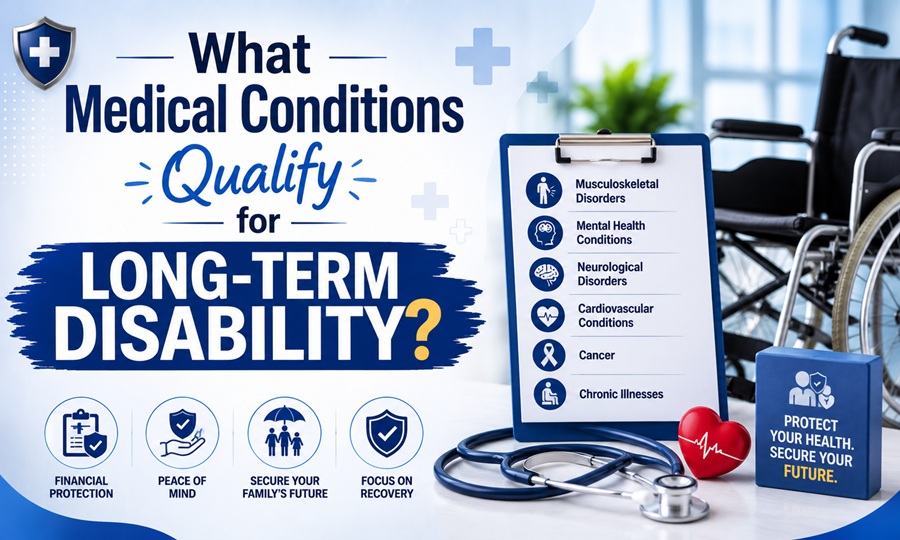
When a serious illness or injury makes it impossible to keep working, long-term disability benefits can replace a significant portion of your income while you focus on your health. But the process of qualifying is more nuanced than most people expect, and the list of conditions that can qualify is far broader than the obvious ones.
Here is what you need to know — how long-term disability actually works, which conditions most commonly qualify, how private insurance differs from government benefits, and what determines whether a claim gets approved or denied.
The Most Important Thing Most People Get Wrong
Before listing any conditions, there is a concept that most articles on this topic get wrong, and understanding it changes everything about how you approach a claim.
Long-term disability coverage does not simply approve or deny based on a diagnosis. What it evaluates is whether your condition prevents you from working — specifically, whether it prevents you from performing the duties of your occupation or, in some policies, any occupation at all.
Two people can have the same diagnosis and receive completely different outcomes. A surgeon with severe arthritis in their hands may qualify immediately because their condition directly prevents them from performing the precise manual work their career requires. An accountant with the same arthritis severity may face a harder case because their primary job function — sitting at a computer analyzing financial data — may not be as directly impaired.
The medical condition is the starting point. The impact on your ability to perform work is the finish line. Keeping that distinction in mind matters whether you are dealing with a private long-term disability insurance policy or applying for Social Security Disability Insurance.
Private Long-Term Disability Insurance vs. SSDI: Two Different Systems
Most working Americans encounter long-term disability through two separate pathways, and they operate very differently.
Private long-term disability insurance is typically offered through an employer’s benefits package, though individuals can also purchase their own policies. These policies generally replace 40% to 60% of your pre-disability income after a waiting period — called an elimination period — that typically runs from 60 to 180 days after you become disabled. Benefits can last for a fixed number of years (two, five, or ten years are common) or in some policies all the way to age 65. The definition of disability in the policy document is everything — “own occupation” policies are more generous than “any occupation” policies.
Social Security Disability Insurance (SSDI) is a federal government program funded through payroll taxes. It covers workers who become unable to engage in any substantial gainful activity due to a medically determinable impairment expected to last at least 12 months or result in death. SSDI pays monthly benefits that ranged from $943 to $3,822 per month in 2025, based on your earnings history. The program approved only about 36% of initial claims in fiscal year 2025, with roughly 64% denied at the first application stage — making it one of the more difficult benefits programs to access quickly.
Both systems will be referenced throughout this article because many people dealing with a serious condition need to navigate both simultaneously.
Musculoskeletal and Connective Tissue Conditions
Musculoskeletal conditions are the leading cause of long-term disability claims in the United States, accounting for a larger share of approved claims than any other category. This makes sense given how central physical function is to most forms of work.
Degenerative disc disease and chronic back conditions are among the most frequently filed claims. Persistent, severe back pain that limits sitting, standing, lifting, or moving creates demonstrable occupational limitations that both private insurers and the Social Security Administration recognize. The challenge with back conditions is that objective documentation — MRI findings, failed treatments, documented functional limitations — matters enormously. Vague reports of pain without supporting imaging and specialist notes routinely lead to denials.
Rheumatoid arthritis and osteoarthritis cause joint damage, chronic pain, stiffness, and functional limitations that can make sustained work impossible in moderate to severe cases. Rheumatoid arthritis in particular, as an autoimmune condition, can affect multiple organ systems beyond the joints, strengthening a disability claim when systemic involvement is documented.
Fibromyalgia qualifies for long-term disability, but it is one of the more contested conditions in claims processing because it lacks a definitive objective diagnostic test. Insurers and SSA examiners rely on documented treatment history, specialist evaluations, and consistent evidence of functional limitations. Claims for fibromyalgia benefit significantly from thorough rheumatologist documentation.
Lupus and other connective tissue diseases are systemic conditions with wide-ranging effects including joint pain, fatigue, neurological symptoms, and organ involvement. Lupus is on the Social Security Administration’s Compassionate Allowances list in its most severe forms, meaning the most advanced cases can receive expedited review.
Cardiovascular Conditions
Heart disease remains the leading cause of death and serious disability in the United States, and cardiovascular conditions represent a substantial category of long-term disability claims.
Heart failure significantly limits physical exertion, stamina, and in advanced cases, cognitive function. When heart failure is documented with reduced ejection fraction, persistent symptoms despite treatment, and demonstrated limitations in physical capacity, it qualifies for both private LTD and SSDI.
Coronary artery disease and history of heart attack can qualify when residual functional limitations prevent the person from returning to work at their previous level of activity. The post-cardiac rehabilitation picture — what you can actually do after treatment — is what insurers and SSA evaluate, not just the diagnosis itself.
Severe cardiac arrhythmias, particularly those causing syncope, reduced cardiac output, or requiring significant medication management, can qualify when they prevent reliable occupational function.
Stroke frequently results in permanent functional deficits — motor weakness, speech impairment, cognitive changes, fatigue — that make return to work impossible or significantly limited. Post-stroke disability is evaluated based on the residual deficits six months or more after the event.
Cancer
Cancer and its treatment create disability from multiple directions simultaneously: the disease itself, the side effects of chemotherapy and radiation, surgical recovery, and in many cases the permanent physical changes that follow treatment.
Private LTD policies typically cover cancer during active treatment when the person cannot work, and in cases of recurrence or lasting treatment effects. The Social Security Administration has a Compassionate Allowances program that includes over 200 serious cancers, allowing for expedited approval in as few as 10 days once sufficient medical evidence is received. Terminal cancers and cancers that have metastasized to distant sites receive near-automatic approval at this expedited level.
Types of cancer that commonly qualify include breast cancer, lung cancer, colon cancer, ovarian cancer, pancreatic cancer, prostate cancer with advanced spread, leukemia, lymphoma, brain cancer, and kidney cancer, among many others. The key variables are stage, treatment response, and functional impact rather than the specific type.
Neurological Conditions
Neurological diseases often cause progressive functional decline that eventually makes sustained employment impossible, and the Social Security Administration’s Compassionate Allowances list includes many of the most severe.
Multiple sclerosis causes fatigue, mobility problems, cognitive changes, vision disturbances, and pain. Relapsing-remitting MS may allow for periods of function interspersed with disabling relapses. Progressive forms of MS qualify more readily because of their trajectory of increasing disability.
Parkinson’s disease in moderate to advanced stages causes tremor, rigidity, impaired balance, and cognitive changes that directly prevent most forms of sustained work.
ALS (amyotrophic lateral sclerosis) is on the Compassionate Allowances list and receives immediate expedited processing. The progression is rapid and the outcome well understood, making this one of the more straightforward qualifying diagnoses.
Epilepsy with uncontrolled seizures qualifies when seizures are frequent, unpredictable, and unresponsive to treatment, creating safety hazards and preventing reliable work attendance and performance.
Traumatic brain injury resulting in persistent cognitive deficits — memory impairment, attention difficulties, executive function problems, behavioral changes — qualifies when those deficits are well documented and prevent occupational function.
Dementia including Alzheimer’s disease qualifies for SSDI, though most people with Alzheimer’s are over 65 and already eligible for Medicare and Social Security retirement benefits. Early-onset Alzheimer’s — occurring before age 65 — is specifically included on the Compassionate Allowances list.
Mental Health Conditions
Mental health conditions are fully recognized as qualifying conditions for both private LTD and SSDI, though they face higher rates of scrutiny and denial than many physical conditions. This does not reflect their seriousness — it reflects the documentation challenges involved.
Major depressive disorder in its severe, treatment-resistant forms can be completely disabling. When depression prevents a person from maintaining basic daily function, sustaining concentration, attending work reliably, or interacting with others, it meets disability criteria. Consistent psychiatric treatment records and documented functional limitations are essential to a successful claim.
Bipolar disorder in its most severe presentations — with frequent hospitalizations, treatment-resistant episodes, and significant functional impairment between episodes — qualifies for both private LTD and SSDI.
Schizophrenia and other psychotic disorders are among the more commonly approved mental health conditions because the cognitive disorganization, hallucinations, and behavioral disturbances they cause are often severe and well-documented in psychiatric records.
PTSD is recognized as a qualifying condition when it causes severe functional impairment. Veterans with service-connected PTSD often navigate both VA disability claims and SSDI simultaneously, and the two systems can work in parallel.
Severe anxiety disorders, including panic disorder with frequent attacks, severe social anxiety, and OCD with significant functional impairment, qualify when documented consistently over time with specialist treatment notes.
A critical practical point: private LTD policies commonly limit mental health benefits to 24 months of coverage, even when physical conditions receive benefits through age 65. This limitation is standard in many group plans and is one of the most important policy details to review before filing a claim.
Immune System and Autoimmune Conditions
HIV/AIDS qualifies for SSDI when the condition has progressed to cause significant functional limitations. Advanced AIDS with documented opportunistic infections and functional decline qualifies more directly. Many HIV-related conditions are included on the Compassionate Allowances list.
Lupus in its systemic, severe form — affecting kidneys, the nervous system, or multiple organ systems — qualifies under both private insurance and SSDI, with the most severe presentations on the Compassionate Allowances list.
Chronic fatigue syndrome and ME (myalgic encephalomyelitis) are recognized by both the Social Security Administration and most private insurers as potentially disabling, though like fibromyalgia they face significant documentation challenges. Thorough specialist documentation and functional capacity evaluations strengthen these claims considerably.
Respiratory Conditions
Chronic obstructive pulmonary disease (COPD) in advanced stages severely limits physical exertion and in moderate to advanced cases even sedentary activity. Pulmonary function tests provide the objective evidence that SSA and private insurers rely on to evaluate severity.
Severe asthma that requires frequent hospitalizations, does not respond to standard treatment, and causes persistent, documented functional limitation can qualify.
Pulmonary fibrosis and other interstitial lung diseases cause progressive scarring and irreversible reduction in lung function. Pulmonary fibrosis in its more advanced forms is included on the Compassionate Allowances list.
Endocrine and Metabolic Conditions
Type 1 and Type 2 diabetes with serious complications — neuropathy causing significant sensory loss, retinopathy causing severe vision impairment, nephropathy resulting in kidney failure, or cardiovascular complications — qualify when those complications cause functional limitations beyond the diabetes management itself.
Kidney failure requiring dialysis qualifies almost automatically under the Medicare disability provisions, and dialysis patients are among the few groups who can receive Medicare before age 65 without the standard 24-month SSDI waiting period.
Severe thyroid conditions and other endocrine disorders qualify when they cause significant functional impairment that is documented and treatment-resistant.
How Claims Are Evaluated: What Determines Approval or Denial
Understanding the conditions that qualify is only part of the picture. How claims are evaluated — and why so many legitimate claims are denied — is equally important.
Every successful long-term disability claim rests on three pillars: medical evidence, functional documentation, and consistency.
Medical evidence means objective records from treating physicians, specialists, imaging studies, lab results, and documented treatment history. Vague descriptions of pain without supporting diagnostic records carry very little weight. The SSA denied 64% of initial applications in fiscal year 2025, and a significant portion of those denials came down to insufficient medical documentation rather than ineligible conditions.
Functional documentation means specific, documented evidence of what you cannot do — how long you can sit, stand, walk, lift, concentrate, or maintain pace — and how those limitations prevent you from performing your job. “I am in pain” is not sufficient. “I cannot sit for more than 20 minutes without severe lumbar pain at a 7/10 level, documented in six months of physical therapy notes and supported by MRI findings of L4-L5 disc herniation with nerve impingement” is the kind of record that supports approval.
Consistency means your medical records, your statements, and your observable behavior all tell the same story. Inconsistencies between what you report to your doctor, what you report on your disability application, and what your daily activity looks like are among the most common reasons claims are denied or benefits are terminated after approval.
The Social Security Administration’s Compassionate Allowances program fast-tracks 300 specific conditions where the diagnosis itself is strong evidence of qualifying disability. Terminal illnesses and the most severe cancers approved through this pathway carry a 95% approval rate and process in approximately 10 days. For all other conditions, the standard five-step evaluation process — which examines work activity, severity, listed impairments, past work, and other work — is applied.
The Elimination Period: The Gap Nobody Talks About Enough
One of the most practically important aspects of long-term disability claims is the elimination period — the waiting period between when you become disabled and when benefits begin.
Most private LTD policies have elimination periods of 60, 90, or 180 days. During this window, you receive nothing from your LTD policy. You may receive short-term disability benefits if your employer offers them, but those typically cover only 60 to 90 days. The gap between short-term disability ending and long-term disability beginning is a period many families are not financially prepared for.
SSDI has its own waiting period: benefits do not begin until the sixth full month of disability, and Medicare coverage does not begin until 24 months after SSDI eligibility begins. A person approved for SSDI in January 2025 with a disability onset date in that month would not receive Medicare coverage until January 2027.
Planning for these gaps — through emergency savings, continuation of employer coverage through COBRA, or ACA Marketplace coverage — is one of the most important financial planning steps for anyone with a serious ongoing medical condition.
Practical Steps If You Are Filing a Claim
Document everything from day one. Every doctor’s visit, every specialist consultation, every medication change, every functional limitation discussed with your care team should be in writing in your medical records. Do not rely on verbal conversations.
Be specific with your doctors. When your physician asks how you are doing, describe your functional limitations explicitly — how far you can walk, how long you can sit, whether you can concentrate for sustained periods — not just your pain level. The records your doctors generate based on those conversations become the evidence your claim depends on.
Understand your policy’s definition of disability. “Own occupation” means you qualify if you cannot do your specific job. “Any occupation” means you must be unable to do any job for which you are reasonably qualified by education, training, or experience. These two definitions produce dramatically different outcomes.
Do not miss appeal deadlines. For private LTD claims, ERISA (the Employee Retirement Income Security Act) governs most employer-sponsored policies and sets specific deadlines for internal appeals. Missing an appeal deadline can permanently foreclose your right to challenge a denial in court.
Consider professional guidance for complex cases. The Social Security Administration’s own data shows approval rates climb significantly at the hearing stage — from 36% at initial application to substantially higher rates when cases reach an administrative law judge, particularly with legal representation. For conditions that face high denial rates or for claims that have already been denied, working with a disability attorney or advocate is worth serious consideration. The SSA’s official guidance on the disability application process is available at ssa.gov/disability.
Frequently Asked Questions
Does a condition have to be permanent to qualify for long-term disability?
For SSDI, the condition must be expected to last at least 12 months or result in death. For private LTD insurance, the policy terms define the duration requirement — many policies cover conditions that prevent work for the benefit period even if eventual recovery is possible.
Can mental health conditions qualify the same as physical ones?
Yes, legally they are treated the same. However, as noted above, many private LTD policies cap mental health benefits at 24 months. SSDI does not impose this cap. The documentation standard for mental health claims is also higher in practice, requiring consistent psychiatric treatment records and detailed functional assessments.
What if my condition is not on any official list?
The SSA’s listed impairments are not the only path to approval. Many conditions qualify through what is called a medical-vocational allowance — a determination that even though the condition does not meet a listed impairment, the combination of the person’s limitations, age, education, and work history means no jobs exist that they can perform. This pathway approves a significant number of claims.
Can I work at all while receiving long-term disability?
For SSDI, the 2025 substantial gainful activity limit was $1,550 per month for non-blind individuals. Earning above that threshold generally disqualifies an application or terminates existing benefits. Private LTD policies have their own rules on partial disability and return-to-work provisions that vary by policy.
What is the difference between SSDI and SSI?
SSDI (Social Security Disability Insurance) is based on your work history and the payroll taxes you have paid. SSI (Supplemental Security Income) is a need-based program for people with limited income and resources who are disabled, blind, or over 65, regardless of work history. Both require medical evidence of disability, but SSI has additional financial eligibility requirements.