
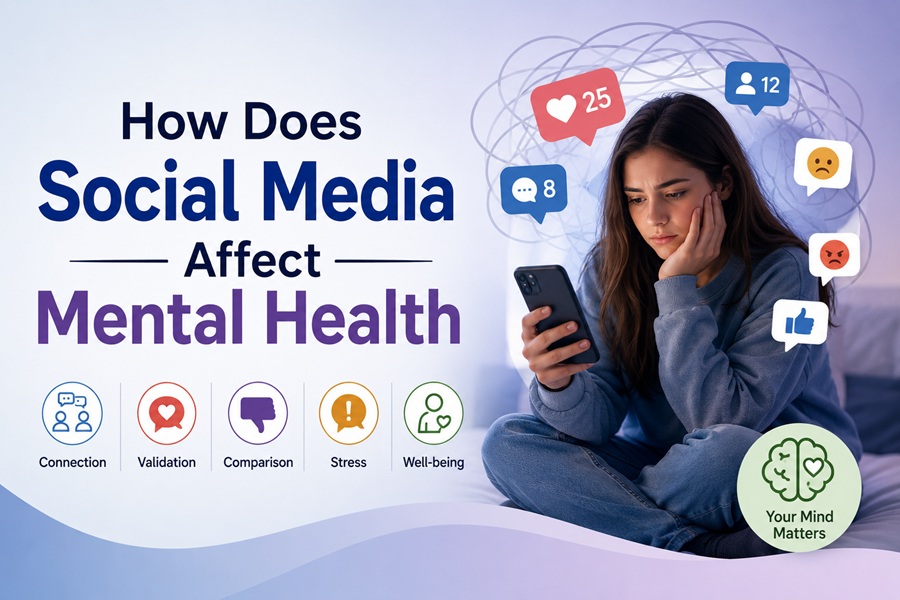
Over 4.6 billion people use social media worldwide, and most of them do it every single day. The average American spends 2 hours and 16 minutes on these platforms daily. That is more time than most people spend exercising, cooking, or having meaningful conversations in a week. Given that scale, the question of what social media does to mental health is not academic — it is one of the most practically important health questions of our time.
The honest answer is complicated. Social media can genuinely harm mental health when used heavily, passively, and without awareness. It can also provide real connection, community, and support when used intentionally. What separates one outcome from the other is largely about pattern, frequency, and the kind of attention you bring to it.
The Numbers That Define the Problem
Before getting into mechanisms, the scale of the mental health concern deserves to be stated plainly.
Adolescents who spend more than three hours daily on social media are twice as likely to experience poor mental health outcomes compared to those who use it less. Teens using platforms for five or more hours per day face a 2.8 times higher risk of developing depression. Among heavy teen users specifically, 41% rate their mental health as poor or very poor, compared to 23% among light users. Nearly half of all U.S. teens — 45% — say they spend too much time on social media, up from 36% just two years earlier in 2022. And 48% of teens now believe social media has a mostly negative impact on people their age, compared to just 32% in 2022. The shift in self-awareness among teenagers is striking.
Adults are not immune. Nearly 40% of adults report that social media makes them feel lonely or isolated. Heavy social media use is linked to a 66% higher risk of depression in adults, and individuals who use seven or more social media platforms are three times more likely to experience anxiety than those who use two or fewer.
Why the Brain Gets Hooked
Social media’s effect on mental health starts in the brain’s reward system. Every notification, like, or comment triggers a small dopamine release — the same neurotransmitter involved in eating, sex, and substance use. What makes platforms particularly effective at capturing attention is the unpredictability of those rewards. You never know exactly when the next positive response will arrive, and that variability is neurologically more compelling than a predictable reward. It is the same mechanism that makes slot machines more addictive than vending machines.
Platforms are engineered around this. More engagement means more advertising revenue, so every design decision — infinite scroll, notification badges, algorithmic feeds — is built to exploit the brain’s reward circuitry. The result for heavy users is a pattern of compulsive checking that feels more like a reflex than a choice, because over time, it becomes one. Roughly 1 in 4 social media users report feeling genuinely addicted to their platforms.
The Specific Ways It Harms Mental Health
Comparison Culture and Self-Esteem
What people post on social media is almost never representative of their actual lives. They post the vacation, not the credit card bill afterward. They post the relationship milestone, not the argument that happened the week before. They post the body at its best, often filtered and posed. The consumer of all this content is comparing their unedited internal experience to an endless stream of other people’s curated performances, and the comparison is always unfavorable.
60% of social media users report that it negatively affects their self-esteem. 50% of people aged 14 to 24 say Instagram specifically makes them more anxious. This is not coincidence — Instagram is an image-first platform built almost entirely around visual comparison of appearance and lifestyle.
Anxiety and Depression
Social media use is associated with a 70% increase in self-reported depression symptoms among teenagers. 41% of Gen Z users say social media makes them feel anxious, sad, or depressed. In a longitudinal study tracking children from ages 9 to 10, increasing daily social media use from about 7 minutes to 74 minutes was associated with a 35% jump in depressive symptoms after three years — a finding that matters because it tracks the same children over time, not just a snapshot comparison.
Sleep Destruction
78% of social media users scroll through their phones before bed. Screens emit blue light that suppresses melatonin production by up to 55%, delaying sleep onset and reducing sleep quality. Social media use is associated with a 40% higher risk of sleep disturbances, and more than 4 in 10 teenagers specifically say social media hurts the amount of sleep they get. Since poor sleep independently worsens anxiety, depression, concentration, and emotional regulation, this is not a side effect — it is a primary pathway through which social media damages mental health.
Cyberbullying
59% of U.S. teens report experiencing cyberbullying. Victims of online harassment are twice as likely to suffer from anxiety and depression as those who have not experienced it. What makes cyberbullying particularly damaging compared to its offline equivalent is that it follows people everywhere — there is no physical space of refuge. The harassment can be public, permanent, and witnessed by hundreds or thousands of peers simultaneously.
65% of those involved in cyberbullying score higher on anxiety and depression measures than uninvolved peers. Among LGBTQ+ youth specifically, 43% report experiencing cyberbullying on social media, reflecting how platforms can amplify existing vulnerabilities.
FOMO and Chronic Dissatisfaction
Fear of missing out is a documented psychological phenomenon that social media industrializes. When people constantly see others attending events, forming relationships, and living experiences they are not part of, it generates feelings of exclusion and inadequacy that are difficult to reason away. Approximately 71% of people report using social media to escape real-life problems — which means many users are already emotionally vulnerable when they open the app, and the content they encounter there makes them feel worse, not better.
The Part That Gets Undercovered: Real Benefits
The conversation about social media and mental health has tilted so far negative in public discourse that the genuine benefits rarely get serious attention. That imbalance is its own kind of distortion.
52% of people across age groups say social media positively affects their mental health by helping them stay connected with friends and family. For people who are geographically isolated, physically limited, or part of minority communities that lack local support, social platforms provide access to community that would otherwise not exist. During the COVID-19 pandemic, when in-person social contact was severely restricted, online communities provided meaningful emotional support that measurably reduced isolation for millions of people.
Social media has also driven a significant cultural shift in how mental health is discussed publicly. Conditions that once carried deep stigma are now openly discussed by creators with large audiences, normalizing help-seeking and reducing the shame that has historically prevented people from getting treatment. Platforms also serve as genuine access points to mental health resources — crisis lines, therapist directories, and self-help tools — for people who might not know where else to look.
For creative people and young people developing their identities, platforms offer a canvas for self-expression and a community of people with shared interests. 32% of users say social media helps them connect with people who share their interests in ways that feel genuinely meaningful to them.
The key variable in most of the positive research is intentionality. People who use social media to actively connect with others tend to report better outcomes than people who use it to passively consume content from strangers.
Passive vs. Active Use: The Distinction That Changes Everything
One of the most important findings in recent research is that not all social media use works the same way on mental health. The type of use matters as much as the amount.
Passive use means scrolling without engaging — watching content, observing others’ posts, consuming without contributing. It is associated consistently with worse mental health outcomes, negative self-comparison, and increased loneliness. Active use means commenting, messaging, sharing, creating — actually interacting with other people. It more closely resembles the social benefits of real-world interaction and produces better mental health outcomes across most studies.
The problem is that passive use is the default for most people. The infinite scroll format, autoplay features, and algorithmic feeds are all designed to keep users in consumption mode rather than interaction mode, because passive consumption is more time-intensive and therefore more profitable.
Practical Steps That Actually Work
Limiting social media to 30 minutes per day has been shown to reduce anxiety, depression, and loneliness by approximately 35%. That does not mean deletion is the only option — it means intentional limits have real, measurable effects.
Auditing your feed is equally important. Every account that consistently produces envy, inadequacy, or distress is extracting something from your mental health every time you see it. Unfollowing is not antisocial — it is a health decision.
Keeping phones out of the bedroom eliminates both nighttime scrolling and morning reflexive checking in one move, which directly addresses the sleep disruption pathway. Disabling non-essential notifications has been shown to decrease social media-induced stress by roughly 25% on its own.
If you notice that your use has become compulsive, that your mood reliably drops during or after scrolling, or that you have tried to cut back and found yourself unable to, those are signals worth taking seriously with a mental health professional. The platforms are designed by teams of engineers to be difficult to stop using. That is not a personal failure — it is a design feature working as intended.
Who Is Most at Risk
The evidence is clear that teenagers, and particularly teenage girls, carry the highest risk. The adolescent brain is still developing the prefrontal cortex, which governs impulse control, long-term thinking, and emotional regulation. This makes young people neurologically more susceptible to the reward loops social media exploits. Nearly 10% of teen girls report that social media has directly hurt their mental health, compared to 6% of boys — a gap that researchers attribute largely to the heavier weight of appearance-based comparison on female-dominated platforms like Instagram.
Young adults aged 18 to 25 are also high-risk, given that this age group combines high social media engagement with elevated rates of anxiety and depression. People with pre-existing mental health conditions, people who are already socially isolated, and people in the midst of major life transitions are all more vulnerable to the negative effects.