
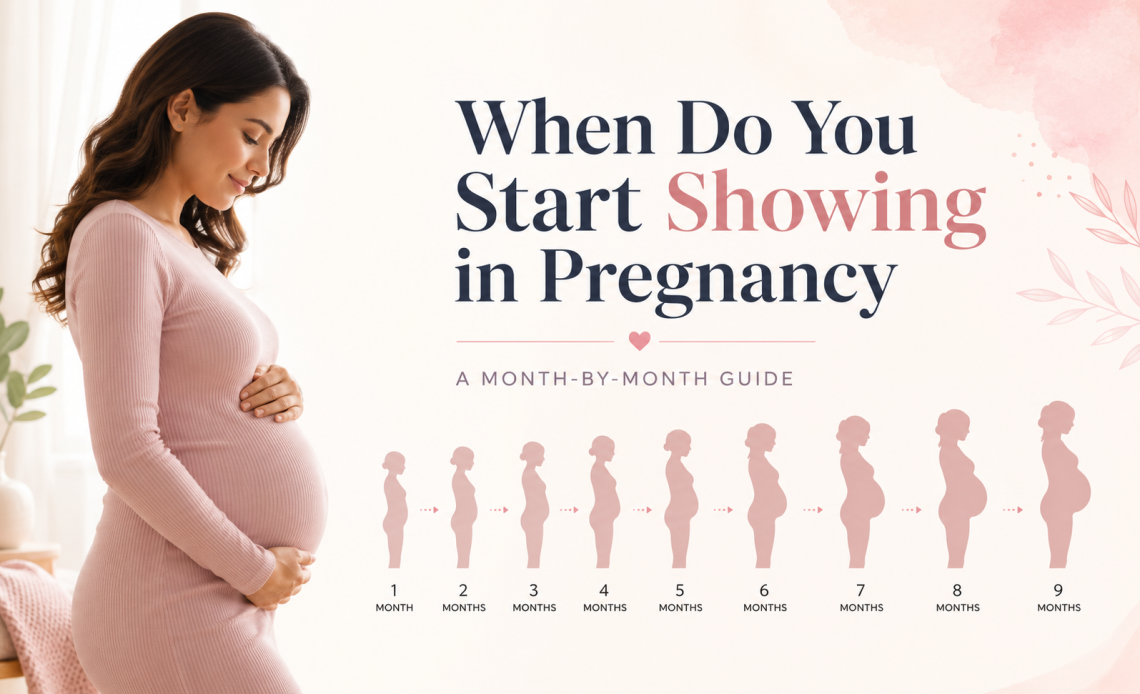
Most people start showing a small pregnancy bump somewhere between 12 and 16 weeks, though it is genuinely common to show earlier or later than that. If you are asking when do you start showing in pregnancy, there is not one universal timeline, and the range of normal is wider than a lot of pregnancy content lets on.
What actually determines when you show has less to do with a due date calculation and more to do with your body type, muscle tone, how many pregnancies you have had before, and even how the baby happens to be positioned. Here is how that timeline typically breaks down, and what can shift it earlier or later.
A Rough Week-by-Week Timeline
| Weeks | What’s Typically Happening | Visible From Outside? |
| 6 to 10 weeks | Uterus is still tucked behind the pelvic bone | Rarely, maybe slight bloating |
| 11 to 13 weeks | Uterus starts rising out of the pelvis | Occasionally, mostly in later pregnancies |
| 14 to 16 weeks | Uterus is now noticeably above the pelvic bone | Common starting point for a first pregnancy |
| 17 to 20 weeks | Bump is more defined, uterus reaches near the belly button | Very common by this point |
| 21+ weeks | Growth becomes steady and more predictable week to week | Expected for almost everyone by now |
Think of this less as a fixed schedule and more as a general curve. Plenty of healthy pregnancies fall well outside these windows in either direction.
Why Your First Pregnancy Might Show Differently Than Later Ones
This is one of the most consistent patterns in pregnancy: first-time mothers tend to show later than people who’ve been pregnant before. The reason comes down to muscle. Abdominal and uterine muscles that have never stretched to accommodate a pregnancy hold everything in more tightly, so the bump stays tucked in longer. After a first pregnancy, those muscles are naturally a bit looser, so second and third pregnancies tend to show noticeably earlier, sometimes by several weeks.
What Else Changes the Timing?
Body Type and Height
People with a taller torso often have more room for the uterus to grow upward before it becomes visible outward, which can delay showing. Shorter torsos tend to show a bit sooner simply because there’s less internal space.
Number of Previous Pregnancies
As mentioned above, this is one of the biggest factors. Each pregnancy tends to show a little earlier than the last.
Multiples
Carrying twins or more almost always means showing earlier, often by four to six weeks compared to a single pregnancy, since there’s simply more inside the uterus sooner.
Uterine Position
A tilted uterus, whether tipped forward or backward, can change exactly when and how a bump becomes visible, though it usually evens out as pregnancy progresses.
Bloating Versus an Actual Bump
Early pregnancy bloating, caused by hormonal changes slowing digestion, is often mistaken for ‘showing’ well before the uterus has actually grown enough to be the real cause.
Weight and Body Composition
This affects when a bump becomes visible to others, but it does not reflect how well the pregnancy itself is progressing internally.
Should You Be Concerned If You’re Showing Early or Late?
In most cases, no. Showing at 10 weeks or not showing until 22 weeks can both be completely normal, depending on your body and pregnancy history. That said, a few patterns are worth mentioning to your doctor rather than just wondering about:
- A bump that seems to grow very rapidly over just a few days
- A significant size difference from what your doctor expects based on your due date, noted at a regular appointment
- Sudden, unusual abdominal swelling paired with pain
- Little to no growth at all by the third trimester
Your prenatal appointments already track uterine growth with a measurement called fundal height, so your doctor is monitoring this more precisely than a mirror ever could.
The Part Nobody Really Warns You About
Showing ‘late’ compared to friends or people on social media can bring up real anxiety, even when everything is medically fine. And showing early sometimes invites unsolicited comments about whether you’re ‘having twins’ or further along than you are. Neither reaction is really about you, they’re about how differently every pregnant body carries. Fundal height measurements at your appointments are a far more reliable signal of how things are actually progressing than how you compare to anyone else’s bump.
What Tends to Speed Up vs Slow Down Showing
| Tends to Show Sooner | Tends to Show Later |
| Second or later pregnancy | First pregnancy |
| Carrying multiples | Carrying one baby |
| Shorter torso | Longer torso |
| Weaker core muscle tone | Stronger, tighter core muscles |
| Higher amniotic fluid volume | Lower amniotic fluid volume |
Practical Notes for Each Stage
- First trimester: don’t read too much into bloating, it’s not the same as showing and usually settles down by week 12 or so.
- Early second trimester: this is when many people start needing looser waistbands before an actual visible bump appears.
- Mid second trimester: maternity clothes usually become genuinely more comfortable than regular clothes around this point.
- Third trimester: growth tends to be more linear and predictable, and your doctor will track this closely at every visit.
- Any stage: comparing your timeline to someone else’s pregnancy photos rarely tells you anything useful about your own.
A Few Things Worth Setting Straight
Showing early does not mean you’re further along than your due date suggests. Due dates are set by ultrasound measurements and last period dates, not by bump size.
Showing late does not mean something is wrong with the pregnancy. Plenty of perfectly healthy pregnancies simply take longer to become visible from the outside.
A bigger bump does not mean a bigger baby. Bump size is influenced by muscle tone, fluid levels, and uterine position far more than by the baby’s actual size.
You can’t reliably guess a baby’s sex or size from bump shape. This is a persistent piece of folklore with no real basis in how pregnancy actually works.
What Prenatal Providers Actually Track Instead
Rather than relying on visible appearance, doctors and midwives measure fundal height, the distance from the pubic bone to the top of the uterus, starting around 20 weeks. This measurement, generally expected to roughly match the week of pregnancy in centimeters after that point, gives a far more objective sense of growth than how a bump looks in the mirror or in clothes.
If you’re ever unsure whether your own timeline is typical, that fundal height measurement at your next appointment is a much better conversation starter than comparing yourself to other people’s pregnancies.
When Is It Actually Worth Bringing Up With Your Doctor?
Mention it at your next appointment if your bump seems to have grown unusually fast in just a few days, if you notice little to no visible growth by the third trimester, or if abdominal swelling comes with pain, reduced fetal movement, or other symptoms that feel off. Otherwise, differences in showing timeline are one of the least useful things to worry about during pregnancy.
The Short Version
Most people show somewhere between 12 and 16 weeks, but ‘most people’ still leaves a wide, completely normal range on either side. First pregnancies tend to show later, later pregnancies tend to show sooner, and body type and multiples shift things further. Your prenatal appointments are already tracking your baby’s growth with far more precision than the mirror can, so there’s rarely a reason to worry about your personal timeline unless your doctor flags something specific.
Common Questions About Showing During Pregnancy
Is it normal to show at 8 weeks?
A visible bump at 8 weeks is less common and is more often bloating than an actual growing uterus, though it can happen, especially in later pregnancies or with multiples.
Why haven’t I started showing yet at 20 weeks?
This can still be within a normal range, especially for a first pregnancy or a longer torso, though it’s worth mentioning at your next prenatal visit if you’re concerned.
Does showing early mean I’m having twins?
Not necessarily. While multiples often do show earlier, plenty of single pregnancies also show earlier than average for other reasons, like previous pregnancies or body type.
Can stress or diet affect when I start showing?
Not in any medically established way. Timing is driven mostly by muscle tone, pregnancy history, and body structure, not stress levels or diet.
Does bump size relate to baby size?
Not reliably. Bump size is influenced by many factors besides the baby’s actual size, so doctors use direct measurements and ultrasounds rather than bump appearance to track growth.
Should I worry if my bump looks different than it did in a previous pregnancy?
This is common and expected. Each pregnancy can look and show differently, even for the same person, due to changes in muscle tone and other factors.
When do doctors start measuring bump growth officially?
Fundal height measurements typically begin around 20 weeks and continue at each prenatal visit for the rest of the pregnancy.
What’s the best way to know if my timeline is actually normal?
Your prenatal appointments, which track fundal height and use ultrasound when needed, are a far more reliable gauge than comparing your bump to anyone else’s.