
Quick Answer
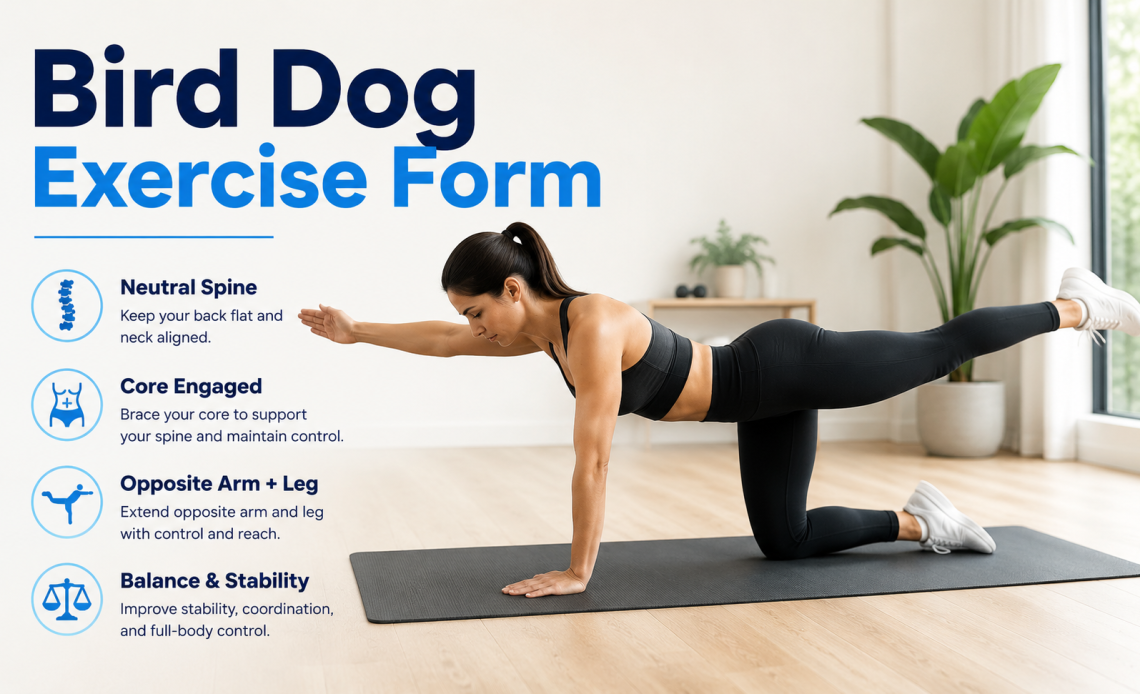
The bird dog is a quadruped core stabilization exercise done on all fours, and learning proper Bird Dog Exercise Form is what makes it effective. You extend one arm forward and the opposite leg back simultaneously, hold for 3 to 10 seconds while keeping the spine neutral and hips level, then return slowly and switch sides. It trains the core, glutes, lower back, and shoulder stabilizers all at once, with almost zero spinal compression. Spine researcher Dr. Stuart McGill at the University of Waterloo classified it as one of his Big Three exercises for spinal health alongside the curl-up and side plank.
At a Glance
| Detail | Information |
| Also Called | Quadruped opposite arm and leg extension |
| Equipment Needed | None, just a mat or padded surface |
| Primary Muscles | Erector spinae, multifidus, glutes, transverse abdominis, rectus abdominis |
| Secondary Muscles | Hamstrings, deltoids, trapezius, latissimus dorsi, iliopsoas |
| Beginner Sets and Reps | 2 to 3 sets of 6 to 8 reps per side, 5-second holds |
| Intermediate | 3 sets of 10 to 12 reps, 8 to 10 second holds, add elbow-to-knee crunch |
| Best For | Lower back pain, core stability, posture, injury prevention, rehab |
Why One of the Simplest Exercises Is Also One of the Best
Most core exercises either load the spine aggressively or train only one muscle group at a time. The bird dog does neither. It builds full-trunk stability, engages both the anterior and posterior chains, and does all of this with near-zero compressive force on the lumbar discs.
That combination is why it appears in physical therapy clinics, elite athlete programs, and beginner fitness routines at the same time. The challenge scales with you, and the risk stays low regardless of level.
What Exactly Is the Bird Dog Exercise?
The bird dog is a bodyweight stability exercise performed from a hands-and-knees position. You brace your core, then extend one arm straight forward and the opposite leg straight back simultaneously, holding both parallel to the floor without letting your hips rotate or your spine arch.
The name comes from the position itself: extending limbs in opposite directions resembles a hunting dog on point, body still and limbs outstretched, locked into position while bracing against movement.
Technically it is classified as an anti-rotation exercise, meaning its primary job is to resist the rotational force created when you extend a limb, not to produce rotation. That resistance is where the deep core muscles do their work.
How Do You Do the Bird Dog Exercise With Correct Form?
- Set up your starting position: get onto all fours with hands directly under your shoulders and knees directly under your hips. Your back should be flat, not arched or rounded. Your neck should be in a neutral position, eyes looking at the floor a few inches in front of you.
- Engage your core before moving: take a breath in, then brace your abs as if you are about to take a punch. This pre-bracing is the part most beginners skip and the reason many bird dogs fail to activate the right muscles.
- Extend one arm and the opposite leg simultaneously: reach your right arm forward while extending your left leg straight back. Both should move at the same speed, reaching parallel to the floor at the same time. Do not lead with one limb and catch up with the other.
- Check your alignment before holding: hips must stay level, not tilted toward the extended leg. Shoulders must stay square to the floor, not rotating. Spine stays neutral throughout, neither arching at the lower back nor rounding at the upper back.
- Hold for 3 to 10 seconds: beginners start with 3 to 5 seconds. As control improves, extend the hold. Breathe steadily throughout. Do not hold your breath.
- Return slowly and with control: bring both the arm and leg back to the start position without letting them drop or swing. Controlled lowering matters as much as controlled extension.
- Switch sides and repeat: complete all reps on one side before switching, or alternate sides each rep. Both approaches are valid. Alternating sides requires slightly more balance demand.
What Muscles Does the Bird Dog Actually Work?
The bird dog is a full-trunk exercise, not just a back or core exercise. A 2026 study published in the Journal of Strength and Conditioning Research confirmed it produces high activation in the multifidus and erector spinae while keeping lumbar compressive forces within safe ranges.
| Muscle | Role in the Bird Dog |
| Erector spinae | Extends and stabilizes the spine throughout the movement |
| Multifidus | The deep spinal stabilizer that controls segment-by-segment spinal control |
| Transverse abdominis | The deepest abdominal muscle, acts as a corset to stabilize the pelvis during limb extension |
| Rectus abdominis | Controls spinal flexion and prevents excessive arching during extension |
| Gluteus maximus | Drives hip extension in the extended leg, activated at rates similar to a bodyweight squat |
| Hamstrings | Assist the glutes in hip extension and knee stabilization |
| Latissimus dorsi | Stabilizes the shoulder during arm extension |
| Posterior deltoid | Supports the arm in extension and maintains shoulder alignment |
| Trapezius | Stabilizes the shoulder blades and supports scapular positioning |
| Iliopsoas | Controls hip flexion during the return phase |
What Are the Most Common Bird Dog Form Mistakes?
- Hiking the hip on the extending leg side: the most common error. The hip lifts upward as the leg extends, which means the glutes and core are not doing their job and the lower back is compensating. The hip should stay level throughout the extension.
- Rotating the torso when extending the arm: the shoulder of the extending arm tends to dip or rotate forward. This is the core failing to resist the rotational pull of the limb movement. Focus on keeping both shoulders square to the floor.
- Arching the lower back: extending the leg too high above parallel causes the lumbar spine to arch. The leg should stop at hip height, parallel to the floor, not higher.
- Skipping the core brace before extending: extending limbs without pre-bracing the core turns the bird dog into a balance test rather than a stability exercise. The sequence matters: brace first, then extend.
- Rushing through the reps: moving quickly reduces the time under tension and removes the stability demand. The bird dog is an exercise specifically about slow, controlled movement. Speed undermines everything the exercise is designed to do.
- Letting the head drop or crane upward: the neck should stay neutral, eyes looking at the floor. Dropping the head forward or craning up to look ahead breaks the neutral spine alignment.
- Holding the breath: breath-holding briefly raises intra-abdominal pressure, which can feel like it adds stability, but sustained breath-holding during a hold trains a coping mechanism rather than actual core endurance. Breathe steadily throughout.
Why Is the Bird Dog So Effective for Lower Back Pain?
Most exercises that strengthen the core and lower back do so by loading the spine under compression, think deadlifts, squats, or sit-ups. The bird dog is specifically different because it trains spinal stability while keeping compressive load very low.
Dr. Stuart McGill at the University of Waterloo, whose research on spine biomechanics is widely cited in both clinical and athletic settings, identified the bird dog as one of his Big Three exercises precisely because it activates the deep stabilizing muscles of the spine, particularly the multifidus, without subjecting the lumbar discs to the bending and compressive forces that other exercises impose.
Research supports its use in rehabilitation programs, showing that it contributes to reduced recurrence of lower back pain when included as part of a comprehensive core strengthening routine. It is not a treatment for acute lower back injury on its own, but it is one of the most consistently recommended long-term prevention and rehabilitation exercises available.
How Is the Bird Dog Different From the Dead Bug, and Which Should You Do?
| Feature | Bird Dog | Dead Bug |
| Starting position | Hands and knees (quadruped) | Lying on your back (supine) |
| Stability demand | Higher, no floor support for spine | Lower, back is supported by the floor |
| Floor feedback | None, harder to feel neutral spine | Floor provides tactile feedback, easier to maintain neutral |
| Core challenge type | Anti-rotation and anti-extension | Anti-extension and anti-flexion |
| Difficulty level | Slightly higher for beginners | Better starting point for beginners with back pain |
| Best use | Core stability, spinal endurance, rehabilitation, athletics | Core activation, beginners, early post-injury rehab |
The practical recommendation from many physical therapy programs is to use both. Start your core work with the dead bug to activate deep stabilizers with floor feedback, then progress to the bird dog for a greater stability challenge. Both exercises together cover more of the core than either does alone.
How Many Sets and Reps of Bird Dogs Should You Do?
| Level | Sets and Reps | Hold Duration | Notes |
| Beginner | 2 to 3 sets, 6 to 8 reps per side | 3 to 5 seconds | Focus on holding hips level before adding reps |
| Intermediate | 3 sets, 10 to 12 reps per side | 8 to 10 seconds | Add elbow-to-knee crunch between holds for progression |
| Advanced | 3 to 4 sets, 12 to 15 reps per side | 10 seconds or more | Add resistance band or ankle weight for load progression |
| Rehab or senior | 2 sets, 5 to 6 reps per side | 3 to 5 seconds | Begin with arm-only or leg-only single-limb progression first |
Rest 24 to 48 hours between bird dog sessions before training the same muscle groups again. Because the exercise works deep spinal stabilizers and the glutes, it fits well into most workout schedules two to three times per week.
What Are the Best Bird Dog Progressions Once You Master the Basic Form?
- Stage 1, single-limb bird dog: extend arm only, or leg only, before combining both. This builds the stability required for the full movement with less coordination demand.
- Stage 2, standard bird dog with hold: the classic form described above, with 5 to 8 second holds and full control through the return.
- Stage 3, bird dog with elbow-to-knee crunch: after extending, bring the arm and leg together underneath the torso to touch elbow to knee, then re-extend. This adds an anti-flexion challenge and increases time under tension significantly.
- Stage 4, banded bird dog: loop a light resistance band around the wrist and opposite foot to add external load to the extension, increasing the demand on the glutes and shoulder stabilizers.
- Stage 5, stability ball bird dog: place hands on a stability ball instead of the floor. The unstable surface dramatically increases the core stability demand.
- Stage 6, standing bird dog: performed standing on one leg with the opposite arm and leg extending. Transitions the stability challenge into a functional single-leg strength and balance exercise.
Who Is the Bird Dog Best For, and Are There Any Reasons to Skip It?
The bird dog suits an unusually wide range of people:
- Beginners starting a core strengthening routine for the first time
- Anyone with chronic lower back pain as part of a rehabilitation program
- Older adults building balance and core stability
- Athletes and performance-focused individuals training anti-rotation strength
- People who sit for long periods and need spinal stabilizer activation
It is not appropriate for:
- Anyone with acute lower back flare who cannot get into the quadruped position without pain. In these cases, the supine dead bug is a safer starting point.
- Anyone with significant wrist pain who cannot bear weight on their hands. A fist or forearm variation may be possible, but this should be confirmed with a physiotherapist.
What Most People Miss About the Bird Dog
Most people think about the bird dog as an arm and leg exercise. The arms and legs are just the handles. The real work happens in the trunk: the deep spinal stabilizers resisting the rotational pull of the extending limbs, the core preventing the lower back from arching, and the glutes driving the hip extension.
When the exercise is done correctly, you should feel the work in your glutes, lower back, and abs, not primarily in your shoulder or hip flexor. If you are feeling fatigue mainly in your arm or leg, the core is probably not engaging properly and the movement has become a balance exercise rather than a stability exercise.
The fix in almost every case is slowing down, pre-bracing the core, and checking hip level before the first rep.
The Four Point Form Check You Should Do Before Every Set
Run through these four checks at the start of each set, before any limb moves, to confirm you are set up correctly:
- Check 1, hands under shoulders, knees under hips: your starting position should form a box, four equal corners. Anything wider or narrower changes the stability demand in ways that usually reduce core activation.
- Check 2, spine neutral: neither arched at the lower back nor rounded at the upper. A useful cue: imagine balancing a glass of water on your lower back. If it would slide off, your spine is not neutral.
- Check 3, core braced before any limb moves: breathe in, then brace as if bracing for a punch. Extension starts only after the brace is set.
- Check 4, hips level throughout: the moment one hip rises to accommodate leg extension, the core has failed its anti-rotation job. Lower the leg until the hip is level, then hold that position.
What Should You Do Next?
If you have never done the bird dog before, start with 2 sets of 6 reps per side with 3 to 5 second holds. Focus entirely on keeping the hips level and the spine neutral rather than worrying about reps or hold time.
If you have been doing them but feel more fatigue in your arm or hip than in your glutes and abs, slow down, add the four-point form check before each set, and reduce the hold time until form is solid.
Avoid progressing to bands, weights, or standing variations until you can complete 10 reps per side at an 8-second hold without any hip rotation or lower back arching. Getting the base form right first makes every progression more effective.
Suggested Internal Links
Add these once matching pages exist on your site, using descriptive anchor text:
- Link to a dead bug exercise guide using anchor text like “how the dead bug exercise complements the bird dog”
- Link to a lower back pain exercise guide using anchor text like “Dr. McGill Big Three exercises for lower back health”
- Link to a core exercises for beginners guide using anchor text like “the best beginner core exercises that protect the lower back”
