If you have ever been told by a doctor or nurse to stop eating and drinking before a procedure, you have been placed on NPO status — even if nobody used those exact words. NPO is one of the most frequently used instructions in all of clinical medicine, and yet most patients have no idea what it stands for, why it is necessary, or what happens if they ignore it.
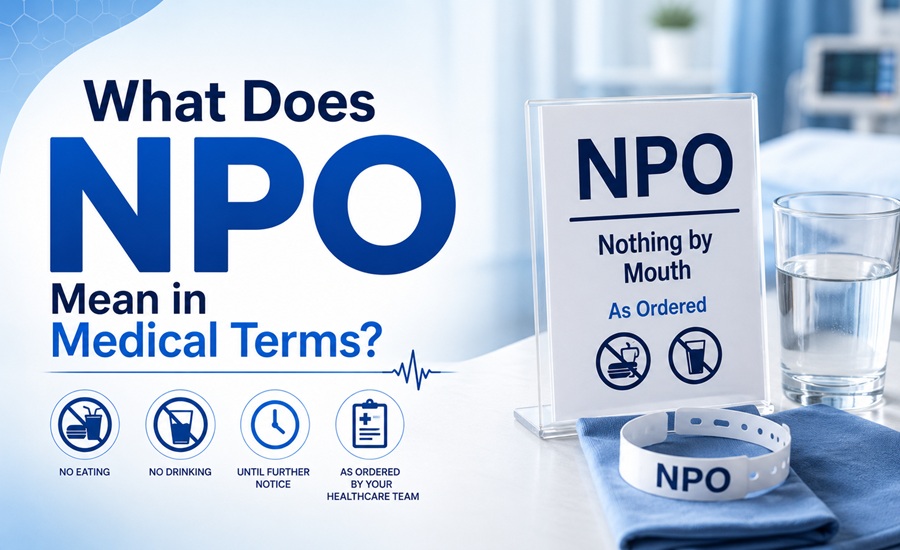
NPO stands for nil per os, a Latin phrase meaning “nothing by mouth.” When a doctor orders NPO for a patient, it means exactly what the Latin says — no food, no drinks, and in many cases no medications taken orally — for a defined period of time before a procedure, surgery, or during treatment of a medical condition.
It is a simple instruction with serious clinical consequences. Understanding what it means and why it exists can make a real difference in how safely your care goes.
The Latin Roots and Why the Term Still Matters
Like PRN, QD, and dozens of other abbreviations in clinical medicine, NPO is a Latin holdover from an era when Latin served as the universal language of science and medicine. The full phrase nil per os breaks down as nil (nothing), per (through/by), and os (mouth). In the United Kingdom, the equivalent instruction is NBM — nil by mouth — which means the same thing in plainer English.
The American Medical Association’s style guide actually discourages the use of NPO in formal medical writing in favor of spelling out “nothing by mouth,” but the abbreviation is so deeply embedded in clinical practice that it remains universally used in hospitals, nursing notes, surgical schedules, and pre-procedure instructions across the country and worldwide.
When you see NPO on a hospital wristband, chart, or pre-operative instruction sheet, treat it as a firm clinical directive, not a suggestion.
Why Doctors Order NPO: The Core Reason
The primary reason for NPO orders is to prevent a dangerous and potentially fatal complication called pulmonary aspiration.
When you are awake and something goes down the wrong way — food, liquid, or stomach contents — your body responds immediately. You cough, you gag, you sit up. Those protective reflexes are automatic and powerful, and they clear the material from your airway before it can reach your lungs.
Under general anesthesia, those reflexes are suppressed. Your gag reflex stops working. Your cough reflex is blunted. Your muscles are relaxed. If your stomach contains food or liquid at that point and you vomit — which anesthesia can trigger — the contents travel directly into your lungs without any protective response to stop them.
The result is aspiration pneumonia, a serious lung infection caused by inhaled stomach contents. In severe cases, it can progress to acute respiratory failure. Perioperative aspiration pneumonia carries a mortality rate estimated at around 27%, making it one of the most consequential preventable complications in surgical medicine.
An empty stomach eliminates the material available to aspirate. NPO is the method used to achieve that.
NPO Guidelines: How Long Is Long Enough?
The old rule in medicine was simple — nothing by mouth after midnight before a morning surgery. That rule was applied rigidly for decades, even when it meant a patient having an afternoon procedure had not eaten or drunk anything for 16 or more hours.
Current guidelines from the American Society of Anesthesiologists, updated and refined over the past two decades, are considerably more nuanced. They recognize that different substances leave the stomach at different rates and that excessive fasting has its own risks, including dehydration, low blood sugar, patient discomfort, and in vulnerable populations, malnutrition.
| What Was Consumed | Minimum Fasting Time Before Surgery |
|---|---|
| Clear liquids (water, clear juice, black coffee, plain tea) | 2 hours |
| Breast milk | 4 hours |
| Infant formula | 6 hours |
| Light meal (toast, clear liquids) | 6 hours |
| Full meal (fried foods, fatty foods, meat) | 8 hours or more |
The distinction between clear liquids and solid food is clinically significant. Clear liquids pass through the stomach relatively quickly — research has consistently shown that drinking water up to two hours before surgery results in lower gastric volume than fasting for four or more hours. This is why patients are now typically encouraged to keep drinking clear fluids until two hours before their procedure, rather than fasting from the previous night.
Your surgical team will give you specific instructions based on your procedure, your health status, your age, and any medications you take. Those instructions take precedence over general guidelines. If you are unsure what you can and cannot have, call your surgeon’s office rather than guessing.
Beyond Surgery: Other Medical Situations That Require NPO
Most people associate NPO exclusively with pre-surgical preparation, but the order is used across a wide range of clinical situations where oral intake would either cause harm or interfere with diagnostic accuracy.
Acute pancreatitis is one of the most common non-surgical NPO situations. The pancreas produces digestive enzymes that are activated by eating. When the pancreas is inflamed, giving it complete rest by stopping all oral intake allows the inflammation to subside without the additional stimulation that food would trigger. Patients with moderate to severe pancreatitis may be NPO for several days while being supported nutritionally through intravenous fluids or tube feeding.
Bowel obstruction requires NPO to prevent anything from adding to the blockage. When the intestine is partially or fully obstructed, eating or drinking makes the situation worse and increases the risk of perforation. NPO gives the bowel rest while the obstruction is assessed and treated.
Gastrointestinal bleeding calls for NPO while the source and severity of the bleed is identified. Eating stimulates blood flow to the digestive system and can worsen active bleeding. It also means the stomach and intestines cannot be properly examined endoscopically if they contain food.
Stroke with swallowing difficulties is one of the more complex and sometimes prolonged NPO situations. Stroke can damage the parts of the brain that control swallowing, resulting in a condition called dysphagia. Patients with severe post-stroke dysphagia cannot swallow safely and are placed NPO to prevent aspiration of food or liquid into the lungs. Nutrition in these cases is delivered through nasogastric tubes or intravenous lines while swallowing rehabilitation proceeds.
Diagnostic procedures — including colonoscopy, endoscopy, abdominal ultrasound, and CT scans with contrast — frequently require NPO or modified fasting. An empty bowel or stomach is necessary for the imaging or scope to produce accurate, unobstructed results. A stomach full of food makes an upper endoscopy both dangerous and diagnostically useless.
Severe nausea and vomiting sometimes prompt temporary NPO status to rest the gastrointestinal system, reduce the likelihood of aspiration in a vomiting patient, and allow antiemetic medications to work.
Before certain laboratory tests, including fasting blood glucose, lipid panels, and some hormonal tests, patients are instructed not to eat for 8–12 hours to ensure that test results reflect baseline values rather than post-meal fluctuations.
What NPO Actually Allows — and What It Does Not
The literal meaning of nil per os — nothing by mouth — is absolute. But in clinical practice, NPO orders are often tailored, and what is included or excluded matters.
What is generally not allowed under standard NPO:
- All solid foods
- Milk and dairy products
- Juice with pulp or smoothies
- Alcohol
- Chewing gum in most surgical settings
- Hard candy
What may be allowed depending on the specific order:
- Clear water (often permitted until 2 hours before surgery under current guidelines)
- Black coffee or plain tea without milk (often permitted until 2 hours before)
- Essential oral medications with a small sip of water — depending on the situation and medication type
The medication question deserves particular attention. Many patients on NPO before surgery take daily medications for blood pressure, heart disease, seizures, or psychiatric conditions. Stopping these abruptly is not safe. In most cases, the anesthesiology team will specify which medications should be taken the morning of surgery with a small sip of water and which should be held. Never assume — always ask your care team explicitly about your regular medications when you are given NPO instructions.
The Risks of Extended NPO — What Does Not Get Said Enough
NPO exists to protect patients from a real and serious complication. But extended NPO status carries its own clinical risks that are not always communicated as clearly as the instruction itself.
Dehydration develops rapidly in patients who are NPO for more than a few hours, particularly the elderly, children, and those who are already unwell. Intravenous fluid replacement is standard for NPO patients in hospitals, but outpatient or pre-procedural patients fasting at home may not have that safety net.
Hypoglycemia is a concern for diabetic patients on NPO, particularly those on insulin or sulfonylureas. Blood sugar management during NPO periods requires specific planning — diabetic patients should always receive explicit glucose management instructions as part of their NPO guidance.
Muscle breakdown occurs with extended fasting. When the body has no oral fuel supply, it begins metabolizing muscle tissue for energy. Research has shown that NPO lasting three or more consecutive days is independently associated with prolonged hospital stays, hospital-acquired malnutrition, and higher rates of complications. This is why hospitals try to transition NPO patients to tube feeding or IV nutrition as quickly as possible when oral intake must be restricted beyond the short term.
Medication management becomes complicated when patients are NPO for extended periods, since many drugs are only available in oral form and cannot easily be substituted.
What Happens If You Eat Before a Procedure While on NPO
This is not an academic question. It happens, and the consequences are real.
If you eat or drink something when you are supposed to be NPO and your care team discovers it before the procedure begins, your surgery or procedure will almost certainly be postponed. Rescheduling protects you from the aspiration risk that NPO was designed to prevent.
If you eat while NPO and do not tell anyone, you expose yourself to serious danger. If you develop complications under anesthesia related to aspiration, the care team will not have been alerted to the elevated risk and cannot take appropriate precautions.
The right thing to do if you accidentally eat or drink during an NPO period is to tell your surgeon, anesthesiologist, or nurse immediately. A delay or rescheduling is genuinely much better than the alternative.
NPO in Pediatric Patients
Children, particularly infants, require special consideration when NPO orders are placed. Young children do not understand why they cannot eat or drink, and prolonged fasting in small children carries more rapid risk of dehydration and hypoglycemia than in adults.
Current pediatric fasting guidelines are more permissive about clear fluids than the old midnight cutoff rule suggested. For most routine procedures, infants and young children can have clear liquids up to two hours before anesthesia, breast milk up to four hours before, and formula or light solid food up to six hours before.
For parents, the most important thing to understand is that the fasting instructions you receive from the surgical team are designed to balance two competing risks: the danger of aspiration on one side, and the discomfort and physiological stress of excessive fasting on the other. The guidelines aim to minimize both. The American Academy of Pediatrics provides updated guidance on pediatric fasting at healthychildren.org, which is a useful resource for parents navigating a child’s surgical preparation.
NPO vs. Clear Liquid Diet vs. Full Liquid Diet
NPO is the most restrictive oral intake status, but it is one point on a spectrum of dietary restrictions used in clinical medicine. Understanding where it sits relative to other restrictions helps patients understand what their care team is actually asking.
| Restriction Level | What Is Allowed |
|---|---|
| NPO | Nothing by mouth (sometimes essential medications with a sip of water) |
| Clear liquid diet | Water, clear broth, plain gelatin, clear juice without pulp, popsicles, black coffee or plain tea |
| Full liquid diet | Everything on clear liquids plus milk, cream soups, smoothies, pudding, ice cream |
| Soft diet | Soft solid foods that require minimal chewing — mashed potatoes, soft cooked vegetables, tender meats |
| Regular diet | No restrictions |
Patients transitioning out of an NPO status after surgery or illness often move through these stages sequentially, with the care team advancing the diet as the patient’s tolerance improves.
Frequently Asked Questions
Can I brush my teeth while on NPO?
Yes, in most cases. Brushing your teeth with a small amount of toothpaste and rinsing without swallowing is generally permitted under NPO status. Ask your care team if you are unsure.
Can I take my blood pressure medication while NPO?
This depends entirely on the specific instructions from your surgical or medical team. Many blood pressure medications should be taken the morning of surgery with a small sip of water. Others should be held. Never make this decision independently — ask your anesthesiologist or surgeon specifically which medications to take and which to skip.
Why does my NPO start at midnight when my surgery is at 2 PM?
This is an outdated practice that many hospitals still use for scheduling simplicity, even though current evidence supports more flexible timing. If you have a late surgery time and a midnight NPO start seems like an excessively long fast, ask your surgeon whether updated clear liquid guidelines apply to your situation. You may be able to have water or clear liquids until much closer to your procedure time.
Does NPO mean I cannot have ice chips?
In many NPO orders, small amounts of ice chips are permitted for comfort, particularly for hospitalized patients. However, this varies by facility and clinical situation. Always check with your nurse before assuming ice chips are allowed.
What if I am on NPO but feel extremely thirsty or hungry?
Tell your nurse. They can ensure you are receiving adequate intravenous fluids if you are admitted, assess whether your NPO instructions allow any exceptions, and make sure your discomfort is addressed within the boundaries of what is clinically safe.