
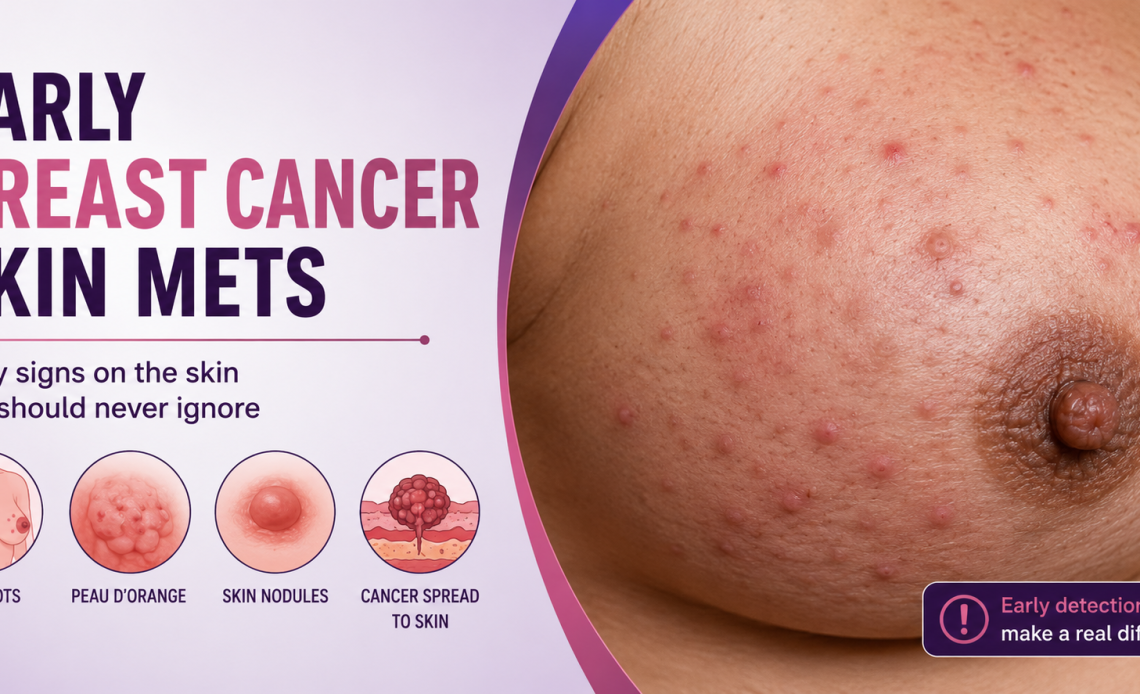
Key Takeaways
- Skin metastases happen when breast cancer cells spread to or just below the skin, most often on the chest wall, abdomen, scalp, or the original breast.
- Up to 10% of breast cancer cases involve skin metastases, and they can occasionally appear before the underlying breast cancer is even diagnosed.
- Common signs include new firm nodules, skin color or texture changes, a rash or dimpled “orange peel” appearance, and sores that don’t heal.
- A key clue: these changes tend to worsen over time instead of improving with topical treatment, unlike a typical skin infection or rash.
- A biopsy is required to confirm the diagnosis, and treatment ranges from surgery and radiation for limited areas to systemic therapies for more widespread involvement.
Most of the time, a new skin change gets chalked up to a rash, an ingrown hair, or an infection that will clear up on its own. But early breast cancer skin mets describes something else: cancer cells that have reached the skin itself, either as a sign that existing breast cancer has spread, or, less commonly, as the very first clue that breast cancer is present at all, sometimes before a lump is ever felt.
This isn’t a common presentation, but it’s an important one to recognize, since skin-based signs are often easier to notice early than a deep internal change would be. Here’s what actually shows up, why it happens, and what the path to diagnosis and treatment looks like.
Why Skin Can Sometimes Be the First Place This Shows Up
Skin metastases, also called cutaneous metastases, occur when cancer cells travel from the original tumor to the skin, either through direct extension (the tumor growing outward into the skin), through the lymphatic vessels, or through the bloodstream. Breast cancer is, by a wide margin, the most common internal cancer to produce cutaneous metastases in women, accounting for roughly 70% of cutaneous metastasis cases in women according to research on the condition. In rare, well-documented cases, these skin changes have appeared before any breast lump was found or before breast cancer was otherwise suspected, which is exactly why dermatologists and pathologists are trained to consider it as a possibility when a skin lesion doesn’t fit a typical, benign pattern.
What Skin Metastases Actually Look and Feel Like
- A new change in skin color, ranging from pink or red to darker or bruised-looking patches
- Firm, painless nodules on or just beneath the skin, often round or oval and rubbery to the touch
- A dimpled, pitted texture resembling an orange peel (called peau d’orange)
- Localized itching or discomfort in the area
- Open sores or wounds that don’t heal on a normal timeline
- A rash or reddened patch that doesn’t resolve, and sometimes spreads outward over days to weeks
These changes most often appear on the chest wall, the same breast as the original cancer, the abdomen, or the scalp, though they can occasionally appear at more distant sites too.
The Detail That Often Separates This From an Ordinary Skin Problem
Skin metastases can genuinely look like an infection at first, with swelling, redness, and tenderness that mimics cellulitis or another inflammatory skin condition. The detail that tends to raise suspicion is the response to treatment: an ordinary infection or rash typically improves with antibiotics, topical steroids, or basic skin care within a week or two. Skin changes tied to an underlying cancer tend to persist or worsen despite that treatment, sometimes growing larger, becoming firmer, or developing new areas, rather than following the expected healing pattern.
The Main Reasons This Happens
| Mechanism | What’s Happening | How It Tends to Look |
| Direct extension | The primary tumor grows outward into the overlying skin | Skin appears red, hardened, or thickened; can ulcerate |
| Inflammatory breast cancer (primary or secondary) | Cancer cells block lymphatic vessels in the dermis | Widespread swelling, warmth, and skin discoloration, often mistaken for infection |
| Local recurrence | Cancer reappears after treatment, often near a scar or radiation site | Change specifically at or near a mastectomy scar or treated area |
| Distant metastatic spread | Cancer cells travel through blood or lymph to reach the skin | Firm nodules, sometimes on the scalp, abdomen, or areas away from the breast |
How This Actually Gets Diagnosed
A doctor can often suspect a skin metastasis just by examining the area, but a biopsy is required to confirm it. Depending on how much skin is involved, this might be a surgical biopsy, a needle core biopsy, or a punch biopsy, which uses a small circular tool to remove a sample containing several skin layers. Once cancer is confirmed in the skin, additional imaging is typically ordered to check whether the disease has spread elsewhere in the body, since a skin metastasis is generally treated as a sign of more advanced disease requiring a fuller picture of what’s going on internally.
How Skin Metastases Are Treated
Treatment goals center on slowing cancer growth, controlling the skin changes themselves, and maintaining quality of life. The specific approach depends heavily on how much skin is involved:
- Surgery: often the first option when the affected area is small and well-defined, sometimes paired with radiation afterward.
- Radiation therapy: used to target cancer cells directly and can help control localized skin involvement.
- Chemotherapy: a systemic treatment considered when more skin is affected or when cancer has spread beyond the skin.
- Hormonal therapy: used for hormone receptor-positive cancers, working by blocking the hormones that fuel tumor growth.
- Targeted therapy: drugs aimed at specific cancer cell features, such as HER2-targeting medications for HER2-positive cancers.
- Immunotherapy: harnesses the immune system against cancer cells and may be used in specific, appropriate cases.
- Electrochemotherapy: combines chemotherapy drugs with electrical pulses to help the drugs enter cancer cells more effectively, an option sometimes used for cutaneous metastases specifically.
What Determines the Outlook
Prognosis depends heavily on how much skin is involved and the specific biology of the cancer. Hormone receptor-positive tumors generally carry a somewhat better prognosis, and HER2-positive cancers have seen meaningfully improved outcomes thanks to targeted therapies developed over the past two decades. Localized skin involvement that’s caught and treated aggressively can sometimes be well controlled, while skin metastases appearing at sites distant from the original tumor tend to indicate more advanced disease and a more guarded outlook. In every case, care from a coordinated team, oncology, surgery, dermatology, and radiation, tends to produce the best combination of disease control and quality of life.
When a Skin Change Deserves a Prompt Exam
A new firm nodule that doesn’t hurt but doesn’t go away: painless, persistent lumps are a pattern worth having examined rather than watched indefinitely.
A rash or red patch that isn’t improving with standard treatment after one to two weeks: lack of response to appropriate treatment is one of the more telling clues.
Any skin change near a previous breast cancer treatment site or mastectomy scar: this location specifically warrants prompt evaluation given the possibility of local recurrence.
A sore that won’t heal, or skin that develops a dimpled, orange-peel texture: both are recognized signs that merit a same-week appointment rather than a wait-and-see approach.
Bottom Line
Skin metastases from breast cancer are uncommon, but they’re a recognized and important presentation, capable of showing up as a sign that existing cancer has spread or, less often, as the very first clue that breast cancer is present at all. The pattern to watch for is a skin change, whether a nodule, rash, discoloration, or non-healing sore, that doesn’t behave like an ordinary skin problem and doesn’t improve with standard treatment. A biopsy is the only way to confirm what’s actually happening, and getting that answer promptly gives the most options for treatment and the best chance at a good outcome.
Frequently Asked Questions
Can skin changes really be the first sign of breast cancer?
Yes, though it’s uncommon. Documented cases exist where cutaneous metastasis appeared before any breast lump was found or before breast cancer was otherwise suspected.
How common are skin metastases in breast cancer overall?
Estimates suggest up to about 10% of breast cancer cases involve skin metastases at some point, most often in people already diagnosed with the disease.
How can I tell a skin metastasis from a normal rash or infection?
The biggest clue is response to treatment: ordinary rashes and infections typically improve within one to two weeks of appropriate care, while metastasis-related changes tend to persist or worsen.
Is a biopsy always necessary to confirm this diagnosis?
Yes, while a doctor may strongly suspect a skin metastasis on physical exam, a biopsy is required to confirm the diagnosis and guide treatment decisions.
Does finding a skin metastasis mean the cancer has spread everywhere?
Not necessarily, but it does prompt additional imaging to check for cancer elsewhere in the body, since it’s generally treated as a sign of more advanced disease.
What’s the difference between local recurrence and true skin metastasis?
Local recurrence describes cancer reappearing at or near the original treatment site, such as a mastectomy scar, while metastatic spread describes cancer cells traveling through the blood or lymphatic system to reach the skin at a different location.
Are skin metastases treatable?
Yes, treatment options range from surgery and radiation for limited, localized areas to systemic therapies like chemotherapy, hormone therapy, targeted therapy, or immunotherapy for more widespread involvement.
Should I see a dermatologist or an oncologist about a suspicious skin change?
Either is a reasonable starting point, dermatologists are often the first to recognize the pattern, while oncologists coordinate the fuller workup and treatment plan once a metastasis is confirmed.