
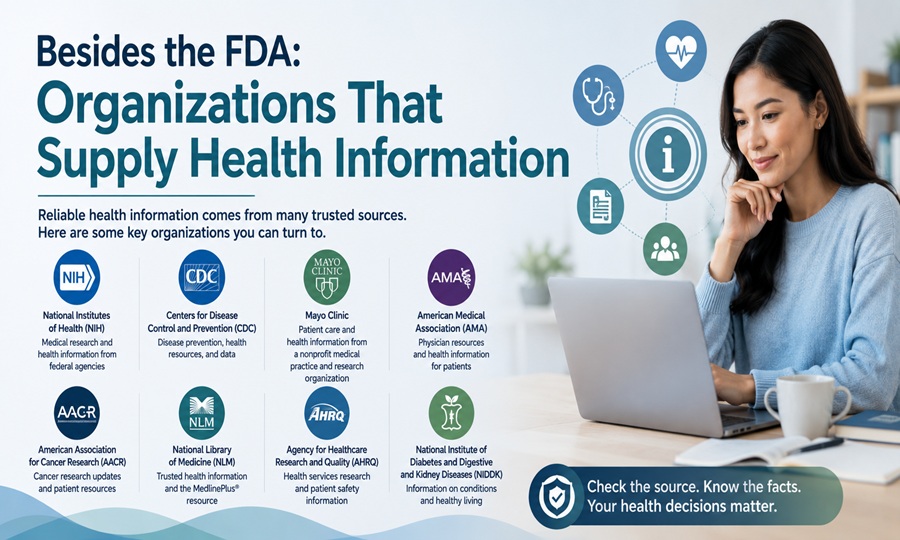
The Food and Drug Administration is one piece of a much larger ecosystem of organizations that produce and distribute health information. Beyond the FDA, the most important sources include the Centers for Disease Control and Prevention (CDC), the National Institutes of Health (NIH), the World Health Organization (WHO), the U.S. Department of Health and Human Services (HHS), the Substance Abuse and Mental Health Services Administration (SAMHSA), the American Heart Association (AHA), the American Cancer Society (ACS), and several others — each with a different focus and a different kind of authority.
Knowing who these organizations are, what they cover, and what distinguishes one from another helps you find the right source for any health question rather than settling for the first result in a search engine.
| Acronym | Full Name | Type | Primary Focus | Website |
| CDC | Centers for Disease Control and Prevention | Federal | Disease prevention, outbreak response, public health data | cdc.gov |
| NIH / NLM | National Institutes of Health / National Library of Medicine | Federal | Medical research, clinical studies, MedlinePlus consumer portal | nih.gov / medlineplus.gov |
| WHO | World Health Organization | International (UN) | Global disease surveillance, international health standards and guidance | who.int |
| HHS | U.S. Dept. of Health and Human Services | Federal | Oversees all federal health agencies; sets national health policy | hhs.gov |
| SAMHSA | Substance Abuse and Mental Health Services Administration | Federal | Mental health, addiction treatment, behavioral health resources | samhsa.gov |
| AHA | American Heart Association | Non-profit | Heart disease, stroke prevention, cardiovascular research and education | heart.org |
| ACS | American Cancer Society | Non-profit | Cancer prevention, detection, research, and patient support | cancer.org |
| AHRQ | Agency for Healthcare Research and Quality | Federal | Healthcare quality, patient safety, evidence-based practice guidelines | ahrq.gov |
| OSHA | Occupational Safety and Health Administration | Federal | Workplace health and safety standards and education | osha.gov |
The CDC: America’s Primary Public Health Agency
The Centers for Disease Control and Prevention (CDC) is a federal agency under the Department of Health and Human Services and the country’s lead institution for disease surveillance, prevention, and outbreak response. It tracks infectious diseases, monitors chronic conditions such as diabetes and heart disease, publishes vaccination schedules, and issues guidance during public health emergencies.
The CDC publishes data on causes of death, cancer rates, birth statistics, and dozens of other health metrics through its National Center for Health Statistics. For any question about disease trends, vaccine schedules, or how a particular illness is spreading in the United States, the CDC is the primary reference.
The NIH and the National Library of Medicine
The National Institutes of Health is the world’s largest funder of biomedical research. It is made up of 27 institutes and centers, each focused on a different area of medicine, from cancer to aging to mental health. The NIH funds tens of thousands of research studies each year and publishes results through its peer-reviewed journals and public databases.
For everyday consumers, the most useful NIH resource is MedlinePlus, a free service run by the National Library of Medicine. MedlinePlus covers more than 1,000 diseases, conditions, and wellness topics in plain English and Spanish, with no advertising. It pulls from NIH, CDC, and other trusted sources, making it one of the cleanest starting points for health research that most people have never heard of.
The World Health Organization
The WHO is a specialized agency of the United Nations responsible for international public health. It sets global health standards, coordinates responses to pandemics and outbreaks, publishes disease statistics from countries worldwide, and issues guidance on everything from nutrition labeling to antibiotic resistance.
While the FDA regulates what happens inside the United States, the WHO operates at the global level. Its guidelines carry significant weight among national health agencies around the world, and they are often the benchmark used when comparing health standards across countries.
HHS: The Federal Umbrella
The U.S. Department of Health and Human Services is the cabinet department that oversees most of the major federal health agencies, including the FDA, CDC, NIH, SAMHSA, and the Centers for Medicare and Medicaid Services (CMS). HHS sets overall national health policy and coordinates how these agencies work together.
HHS.gov serves as a consumer-facing portal where the public can find links to health resources across all of these agencies, making it a useful starting point when you are not sure which specific agency covers a particular topic.
SAMHSA: Behavioral Health and Addiction
The Substance Abuse and Mental Health Services Administration is the federal agency dedicated specifically to mental health and substance use disorders. It produces evidence-based guidelines for treatment programs, funds community mental health centers, runs the National Helpline (1-800-662-4357, free and confidential 24/7), and publishes national survey data on substance use and mental illness.
SAMHSA is the authoritative source for anyone looking for information on addiction, recovery, or mental health treatment options in the United States. It fills a gap the FDA does not cover: the safety and efficacy of drugs is regulated by the FDA, but how those conditions are treated and what support systems exist is SAMHSA’s territory.
The American Heart Association and the American Cancer Society
Not every organization supplying health information to the public is a government agency. Non-profit voluntary organizations play an equally important role, particularly for specific disease areas.
The American Heart Association, founded in 1924, publishes science-based treatment guidelines, funds cardiovascular research, and runs public education campaigns on topics like blood pressure, cholesterol, diet, and stroke warning signs. Its guidelines are used by clinicians worldwide and are updated as new evidence emerges.
The American Cancer Society funds research, operates a 24/7 information helpline, publishes cancer statistics, and helps patients navigate treatment options. Both organizations are independent of the government, which means they can sometimes move faster than federal agencies in updating recommendations as new evidence appears.
AHRQ and OSHA: Quality and Workplace Health
The Agency for Healthcare Research and Quality (AHRQ) focuses on the quality, safety, and cost-effectiveness of health care. It produces evidence-based practice guidelines that clinicians use to make treatment decisions, and publishes data on medical errors, hospital safety, and health outcomes.
The Occupational Safety and Health Administration (OSHA) focuses specifically on health and safety in the workplace. It sets and enforces standards for exposure to chemicals, noise, and physical hazards, and provides public information on occupational health risks. For anyone dealing with a work-related health question, OSHA is the relevant federal authority.
FDA vs. Other Organizations: How They Differ
Understanding how the FDA fits into this landscape helps clarify when to go where for health information.
| Organization | Structure | What It Covers | Role in Plain Terms |
| FDA | Federal agency under HHS | Drug and food safety, approvals, labeling, medical device oversight | Regulatory body — approves what can legally be sold |
| CDC | Federal agency under HHS | Disease tracking, vaccination guidance, outbreak response, health statistics | Operational health protection and public health surveillance |
| NIH | Federal agency under HHS | Funding and conducting biomedical research, publishing study results | Research engine that generates the evidence behind guidelines |
| WHO | United Nations specialized agency | Global disease surveillance, international standards, outbreak coordination | Sets international health benchmarks, not binding US law |
| AHA / ACS | Non-profit voluntary organizations | Public education, advocacy, research funding for specific conditions | Independent voices that can challenge or supplement government guidance |
How to Evaluate Any Health Information Source
The number of organizations producing health information can itself feel overwhelming. A few principles help separate reliable sources from unreliable ones.
- Check who runs the site. Government agencies (.gov), established non-profits with disclosed funding, and academic medical centers are the most reliable categories.
- Look at the date. Medical guidance changes. A recommendation from 2010 may have been revised. Look for a published or last-reviewed date on any health guidance you read.
- Check whether claims are backed by cited studies. Reputable organizations link to or reference the research behind their guidance.
- Be cautious with commercial sites. Some health websites generate revenue from advertising or product sales, which can influence what they publish.
- Cross-reference across agencies. If the CDC, NIH, and WHO all say the same thing, it has a stronger foundation than a single organization’s claim.
Where to Start for Different Health Questions
| Source Type | Examples | Trust Level | Why |
| Government (.gov) sites | CDC, NIH, FDA, HHS, SAMHSA, AHRQ | High | Bound by public accountability; peer-reviewed basis |
| Established non-profits | AHA, ACS, American Diabetes Association | High | Mission-driven; disclose funding; publish evidence-based guidelines |
| International bodies | WHO, PAHO | High | Multi-country expert consensus; independent of single government |
| Academic medical centers | Harvard Health, Mayo Clinic, Johns Hopkins | High | Research-based; physician-authored; updated regularly |
| Commercial health sites | WebMD, Healthline | Moderate | Check funding sources and editorial policies carefully |
| Social media / influencers | Various | Variable / Low | No accountability; often misrepresent or misquote studies |
Why This Matters
The FDA regulates what enters the market. The CDC tracks what is making people sick. The NIH funds the research that explains why. The WHO coordinates the global picture. SAMHSA fills the behavioral health gap. Non-profits like the AHA and ACS translate all of that into accessible public guidance for specific conditions.
No single organization covers everything. Understanding which one to consult for a given question is a basic health literacy skill that leads to better decisions and less time spent sorting through unreliable information.