
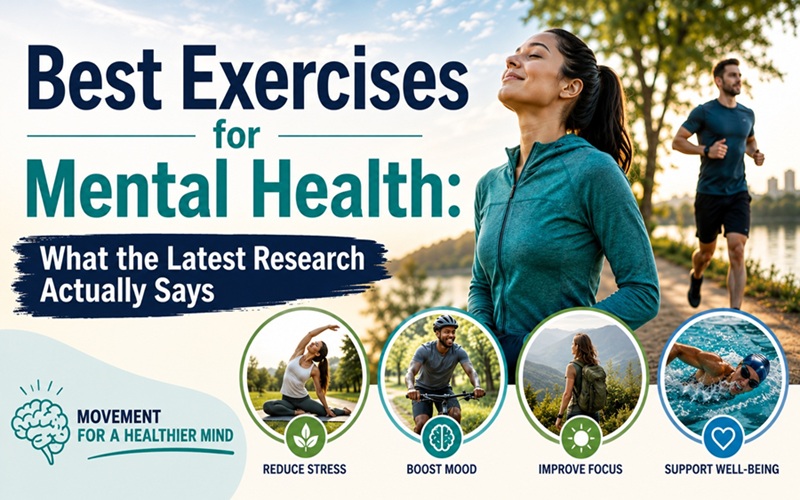
The relationship between physical exercise and mental health is one of the most robustly supported findings in all of modern medicine. Decades of research, hundreds of clinical trials, and several major umbrella reviews published between 2024 and 2025 confirm what many people already sense intuitively: moving your body regularly makes your mind healthier.
But not all exercise is equal when it comes to mental health outcomes. The type of exercise, how intensely you do it, how often, and for how long — all of these variables affect the results. This article covers what the latest research actually says about which exercises are most effective, why they work at a biological level, and how to use that information practically.
Important note: This article is for general informational purposes. Exercise can support mental health and complement professional treatment, but it is not a substitute for therapy, medication, or any other form of clinical care. If you are experiencing symptoms of depression, anxiety, or any other mental health condition, please consult a licensed healthcare provider. Free mental health resources are listed at the bottom of this article.
How Exercise Affects the Brain: The Science
Before looking at specific exercises, it is worth understanding why exercise helps the mind at all. The mechanisms are multiple and now well understood.
Neurotransmitter regulation
Physical activity directly stimulates the brain’s key mood-regulating chemicals. A 2024 review published in Behavioural Brain Research found that aerobic exercise increases serotonin receptor sensitivity and elevates serotonin levels throughout the brain by improving the availability of tryptophan, the amino acid from which serotonin is produced. This is the same neurochemical pathway targeted by SSRI antidepressants — but exercise achieves it without pharmaceutical side effects.
Exercise also boosts dopamine and its associated receptors, triggering the production of brain-derived neurotrophic factor (BDNF), a protein that supports the growth and survival of neurons. Additionally, physical activity immediately raises norepinephrine levels, which affects focus, attention, and the brain’s ability to regulate stress response — the same system targeted by certain ADHD medications. [Source: Behavioural Brain Research, 2024; American Psychological Association]
Endorphin release and neurogenesis
During exercise, the body releases endorphins — the brain’s natural analgesics. These chemicals block pain signals, produce a sense of wellbeing, and are responsible for the well-known “runner’s high.” Research published in Frontiers in Psychology (2025) found that endorphin release during exercise may strengthen neurogenesis, the biological process by which new neurons are generated, particularly in the hippocampus — the brain region central to learning, memory, and emotional regulation. [Source: Frontiers in Psychology, 2025]
Cortisol and stress hormone reduction
Exercise also acts as a regulator of the body’s stress response. Regular physical activity lowers baseline cortisol levels and improves the body’s ability to recover from cortisol spikes triggered by stressful events. Over time, this builds physiological resilience to stress. Yoga, tai chi, and moderate-intensity aerobic exercise have been shown to enhance vagal tone and reduce cortisol levels, improving emotional regulation. [Source: Frontiers in Psychology, 2025]
Structural brain changes
Beyond chemistry, exercise induces lasting structural changes in the brain. Research confirms that regular physical activity improves neuroplasticity in the hippocampus and enhances the functionality of the prefrontal cortex, the region responsible for decision-making, emotional regulation, and impulse control. These changes accumulate over time and represent one of the most compelling arguments for exercise as a long-term mental health strategy rather than a short-term mood fix.
The Landmark 2024 BMJ Study: Which Exercises Work Best
The most comprehensive and widely cited recent study on this topic was published in The BMJ in February 2024. Researchers conducted a systematic review and network meta-analysis of 218 randomized controlled trials involving more than 14,000 participants. The study compared different forms of exercise for their effectiveness in treating depression.
The findings were clear. For people using exercise as their primary treatment for depression, the most effective exercise types were walking or jogging, yoga, strength training, and dancing. The more vigorous the activity, the greater the mental health benefits were likely to be. Even low-intensity activities such as walking and yoga produced meaningful improvements.
For people combining exercise with talk therapy, yoga, tai chi, and aerobic exercise stood out as particularly effective, especially for men and older adults. People who combined antidepressants with any form of exercise fared better than those taking medication alone.
The authors concluded that these forms of exercise “could be considered alongside psychotherapy and drugs as core treatments for depression.” They noted that given the cost-effectiveness, accessibility, and physical health benefits of exercise, these results strongly support its role as a first-line intervention, particularly in settings where traditional mental health treatments may be less accessible. [Source: The BMJ, February 2024]
A separate umbrella review published by the British Journal of Sports Medicine in 2025 — covering 57 pooled data analyses, 800 component studies, and 57,930 participants aged 10 to 90 — reached similar conclusions, finding aerobic exercise to be particularly effective for relieving symptoms of both depression and anxiety. [Source: British Journal of Sports Medicine, 2025]
The Best Exercises for Mental Health
1. Walking
Walking is the most accessible form of exercise on this list and among the most evidence-supported for mental health. A 2024 systematic review and meta-analysis published in the Journal of Medical Internet Research analyzed multiple randomized controlled trials and found that various forms of walking can effectively reduce symptoms of depression and anxiety, performing comparably to other active interventions. [Source: Journal of Medical Internet Research, 2024]
Walking works for several reasons. It is rhythmic and repetitive, which has a naturally meditative quality that can quiet anxious thinking. It exposes people to daylight and often to outdoor environments, both of which have independent mood benefits. It is low-barrier enough that even people experiencing severe depression or anxiety can typically begin with it.
Research indicates that even 10 minutes of walking can produce an immediate improvement in mood. Getting 150 minutes of moderate-intensity walking per week has been associated with a reduction in depression risk of up to 45 percent and anxiety risk by approximately 16 percent. [Source: CareersInPsychology.org, citing 2024 review data]
For people beginning to use exercise for mental health, walking is the recommended starting point precisely because it does not require equipment, a gym membership, athletic ability, or any significant time commitment.
How to start: Begin with 15 to 20 minutes per day at a comfortable pace. Build toward 30 minutes most days of the week. Walking outdoors in green spaces or near water amplifies the mental health effect, but indoor walking is also effective.
2. Running and Jogging
Running builds on the mental health benefits of walking with added intensity. The more vigorous the exercise, the greater the mental health benefits — and running sits clearly in the vigorous category.
The 2024 BMJ study specifically identified jogging and running as among the most effective exercises for depression, a finding consistent with decades of earlier research. Running produces a pronounced endorphin response and significantly elevates serotonin and dopamine levels. The runner’s high is not a myth: it is a well-documented neurological phenomenon.
Running also offers a strong sense of measurable progress. Distances increase, times improve, and the sense of achievement that comes with those milestones contributes positively to self-efficacy and self-esteem, both of which are commonly diminished in people with depression or anxiety.
For those new to running, the transition from walking is recommended to be gradual. A walk-run interval approach — alternating periods of walking with short running intervals, progressively extending the running intervals — is an effective way to build fitness while managing the physical demands.
How to start: Begin with a walk-run interval program, such as running for 1 minute and walking for 2 minutes, repeated over 20 to 30 minutes. Progress the running intervals weekly. Three sessions per week is a sufficient starting frequency.
3. Yoga
Yoga occupies a unique position in the research literature because it combines physical movement with breath control and mindfulness, delivering benefits through multiple pathways simultaneously. No other single exercise modality addresses the body, the nervous system, and the mind in the same integrated way.
The 2024 BMJ study rated yoga among the most effective exercises for depression, both as a standalone treatment and in combination with psychotherapy. A 2024 systematic review published in Frontiers in Psychiatry on older adults found that mind-body exercises — including yoga — significantly reduced symptoms of anxiety and depression by enhancing vagal tone, lowering cortisol levels, and improving emotional regulation. [Source: Frontiers in Psychiatry, 2024]
Yoga’s effectiveness for anxiety in particular is well established. Breath-based yoga practices directly engage the parasympathetic nervous system, shifting the body out of the fight-or-flight stress response and into a state of physiological calm. For people whose anxiety has a strong physical component — elevated heart rate, muscle tension, shallow breathing — yoga addresses those symptoms directly.
Yoga also appears to be particularly valuable as an adjunct to other mental health treatments. When combined with cognitive behavioral therapy or other forms of psychotherapy, it has shown stronger outcomes than either approach used alone.
How to start: Beginners can access free yoga classes on YouTube or through apps. A twice-weekly practice of 30 to 45 minutes is a reasonable starting point. Hatha yoga and yin yoga are gentler styles suited to beginners; vinyasa yoga provides more cardiovascular challenge. Consult your physician before beginning yoga if you have any musculoskeletal conditions.
4. Strength Training (Resistance Exercise)
Strength training — also called resistance exercise, encompassing weight machines, free weights, and resistance bands — has historically received less research attention for mental health than aerobic exercise. That gap is now being filled rapidly, and the results are compelling.
A $3.6 million grant from the National Institute of Mental Health awarded to Iowa State University is currently funding a 16-week randomized controlled trial with 200 adults with depression, examining the effects of low-dose versus high-dose resistance exercise training. The study, running through 2026, reflects how seriously the scientific community now takes strength training as a mental health intervention. [Source: Iowa State University Research, 2024]
A 2025 systematic review and meta-analysis published in the International Journal of Mental Health Nursing confirmed that both aerobic and resistance exercise reduce symptoms of depression and anxiety in diagnosed adults, and found that the evidence for resistance training is now strong enough to warrant clinical recommendation. [Source: International Journal of Mental Health Nursing, 2025]
Strength training’s mental health benefits operate through several mechanisms: it increases dopamine and serotonin, builds physical confidence and body image, creates a sense of mastery and accomplishment, and reduces the inflammatory markers that are commonly elevated in people with depression.
For middle-aged adults — a population that often faces depression connected to chronic stress, occupational burnout, and metabolic change — moderate-intensity resistance training has been shown to be particularly effective at improving emotional regulation without producing excessive physical fatigue. [Source: Frontiers in Psychology, 2025]
How to start: Two to three sessions per week of 30 to 45 minutes is sufficient for mental health benefits. A full-body routine covering the major muscle groups is appropriate for beginners. Consider working with a certified trainer for initial sessions to establish correct technique. Many gyms offer low-cost introductory sessions.
5. High-Intensity Interval Training (HIIT)
High-intensity interval training, which alternates short bursts of maximum-effort exercise with brief recovery periods, has gained increasing attention as a mental health intervention — particularly for adolescents and younger adults.
A study cited in a 2025 Frontiers in Psychology review found that HIIT has shown particular promise in improving depression in adolescents, potentially due to its strong stimulation of dopamine release and improvement in stress regulation. [Source: Frontiers in Psychology, 2025]
HIIT also offers a time efficiency advantage. Sessions typically run 20 to 30 minutes, making them practical for people whose schedule does not accommodate longer workouts. Research published in the Journal of Medical Internet Research (2024) found that short, intense bursts of exercise can produce significant improvements in aerobic fitness, which is itself a predictor of better mental health outcomes.
The caution with HIIT is that it demands a baseline level of fitness and places significant stress on the cardiovascular system and joints. It is not the recommended starting point for sedentary individuals or people with cardiovascular conditions. A period of regular moderate exercise — walking, light jogging, or cycling — before transitioning to HIIT is advisable.
How to start: A standard HIIT structure for beginners involves 20 seconds of intense effort followed by 40 seconds of rest, repeated 8 to 10 times. This can be applied to exercises like cycling, bodyweight squats, or jumping jacks. Always consult a doctor before starting HIIT if you have any cardiac, respiratory, or joint conditions.
6. Swimming
Swimming is one of the few exercises that combines aerobic conditioning with a meditative sensory environment. The rhythmic movement, the sensation of water, and the breathing discipline required by swimming all contribute to a calming effect that extends beyond the cardiovascular benefit.
The 2024 Behavioural Brain Research review specifically identified swimming as an exercise that increases serotonin receptor sensitivity and elevates serotonin levels in the brain. [Source: Behavioural Brain Research, 2024]
Swimming is also particularly well suited to people who experience joint pain, injury, or physical limitations that make land-based exercise uncomfortable. The buoyancy of water reduces the load on joints while still providing a full-body workout. For people with anxiety, particularly those for whom the physical sensation of exertion — elevated heart rate, breathlessness — can trigger panic responses, the water environment often provides a more manageable context for vigorous exercise.
How to start: Most public pools and YMCAs offer lane swimming sessions. Beginning with 20 to 30 minutes of steady swimming two to three times per week is appropriate for most adults. If technique is a barrier, beginner adult swimming lessons are widely available.
7. Tai Chi and Qigong
Tai chi and qigong are slow, deliberate movement practices originating in Chinese medicine and martial arts tradition. They involve coordinated movement, breathing control, and meditative focus — sharing some characteristics with yoga but distinct in their form and cultural context.
For anxiety and depression, the 2024 BMJ study found that mind-body exercises including tai chi perform particularly well when combined with talk therapy. A 2024 network meta-analysis published in Frontiers in Psychiatry examining mind-body exercises in older adults found that tai chi and qigong reduced anxiety and depression while enhancing vagal tone and lowering cortisol. [Source: Frontiers in Psychiatry, 2024]
For older adults specifically — who may have mobility limitations that rule out higher-impact activities — tai chi represents one of the most evidence-supported options available. It can be practiced indoors or outdoors, requires no equipment, and can be adapted to different levels of mobility.
Tai chi’s mental health benefits are slower to accrue than those of vigorous aerobic exercise but appear to be particularly durable. Practitioners often report sustained improvements in stress management and emotional regulation that persist well beyond individual sessions.
How to start: Community centers, senior centers, and YMCAs often offer tai chi classes at low or no cost. YouTube has a large number of free beginner tai chi sequences. Two to three sessions per week of 20 to 40 minutes is a standard starting recommendation.
8. Dancing
Dancing appeared as one of the most effective exercises for mental health in the 2024 BMJ study — a finding that surprised some but makes sense when the mechanisms are examined. Dance combines aerobic movement, rhythmic music, social interaction (in group settings), creative expression, and cognitive engagement in a single activity.
Each of those components has independent mental health value. Music alone has documented effects on mood. Social interaction during exercise amplifies the endorphin response compared to solo exercise. Creative expression is associated with positive affect and reduced depressive symptoms. The combination appears to be powerful.
Dance is also unusual in that it tends to produce high levels of enjoyment and intrinsic motivation, which matters enormously for long-term adherence. The biggest predictor of exercise’s mental health benefit is consistency over time — and people are more likely to keep doing something they genuinely enjoy.
How to start: Dance can be as informal as dancing alone at home or as structured as an adult dance class. Zumba, ballroom dancing, salsa classes, and dance fitness apps all provide accessible entry points. Even 20 to 30 minutes of dancing to music you enjoy counts as moderate-intensity exercise.
How Much Exercise Is Needed for Mental Health Benefits?
The 2025 systematic review published in Frontiers in Psychology found that exercise of moderate intensity had the most significant effect on mood, and that exercise lasting 10 to 30 minutes was more effective in improving positive mood than longer sessions. This is a useful finding for people who believe they need to exercise for an hour or more to gain mental health benefits. [Source: Frontiers in Psychology, 2025]
The 2025 meta-analysis in Frontiers in Psychology covering university students found that engaging in physical activity three times or fewer per week produced better mental health outcomes than exercising four to seven times per week. This suggests that rest and recovery are not just physically important but psychologically beneficial as well. [Source: Frontiers in Psychology, 2025]
In practical terms: three sessions per week of 20 to 45 minutes at moderate to vigorous intensity is a reasonable and evidence-supported target for mental health benefits. This is achievable for most adults without requiring dramatic lifestyle changes.
Exercise as a Complement to Professional Treatment
A point the research consistently emphasizes: exercise is not a replacement for professional mental health care. For mild to moderate depression and anxiety, evidence suggests exercise can be as effective as medication or therapy in some populations — but this does not mean people should substitute exercise for professional treatment they have been prescribed or are receiving.
The most consistent finding across recent research is that exercise performs best as a complement to established treatments. People who combined exercise with talk therapy showed stronger outcomes than those using either alone. People who exercised while taking antidepressants fared better than those taking medication without exercise. [Source: Harvard Health, 2024]
If you are managing a mental health condition, discussing exercise with your treating clinician — whether that is a therapist, psychiatrist, or primary care physician — is the most appropriate starting point. Many clinicians now actively recommend exercise as part of a comprehensive treatment plan.
Getting Started When Motivation Is Low
Depression and anxiety make beginning an exercise routine genuinely harder. Low energy, poor concentration, social withdrawal, and physical lethargy are all symptoms of depression — and they are also the exact barriers that make starting exercise difficult. Acknowledging this is important.
Research suggests that starting small is more effective than starting ambitiously. A 10-minute walk is not a trivial intervention: it has documented immediate effects on mood. Doing something small consistently builds the physiological and psychological momentum that makes doing more feel possible over time.
Choosing an activity you do not hate matters more than choosing the theoretically optimal exercise. Enjoyment is a stronger predictor of long-term adherence than efficiency. Finding a social context for exercise — a walking group, a class, a running partner — adds accountability and the additional mental health benefit of social connection.
Exercising outdoors when possible adds the benefit of natural light exposure, which has direct effects on circadian rhythm, melatonin, and mood. Even grey-sky outdoor walking produces more light exposure than indoor environments.
Disclaimer and Mental Health Resources
This article is intended for general health education only. It does not constitute medical advice and should not be used to diagnose, treat, or replace professional mental health care. Exercise can be a powerful tool in supporting mental health, but it works best alongside professional support — not instead of it.
If you or someone you know is struggling with mental health, the following free resources are available:
Boston Public Health Commission — Center for Behavioral Health and Wellness Free mental health referrals and resources for Boston residents. Website: https://www.boston.gov/government/cabinets/boston-public-health-commission/mental-and-emotional-health
Massachusetts Department of Mental Health — 24/7 Behavioral Health Helpline Free, no insurance required. Available in English and other languages. Provides clinical assessment, triage, and referral to treatment. Mobile crisis teams available 24/7. Call: 833-773-2445 Website: https://www.mass.gov/dmh
SAMHSA National Helpline Free, confidential, 24/7 treatment referral and information service for individuals and families facing mental health or substance use challenges. Call: 1-800-662-4357 Website: https://www.samhsa.gov
988 Suicide and Crisis Lifeline If you or someone you know is in crisis, call or text 988 at any time. Available 24 hours a day, 7 days a week.
Sources referenced in this article include: The BMJ (February 2024), British Journal of Sports Medicine (2025), Frontiers in Psychology (2025), Frontiers in Psychiatry (2024), Journal of Medical Internet Research (2024), International Journal of Mental Health Nursing (2025), Behavioural Brain Research (2024), Harvard Health Publishing (2024), American Psychological Association, Iowa State University Research (2024), and the Boston Public Health Commission.